
Showing 1–30 of 62 results

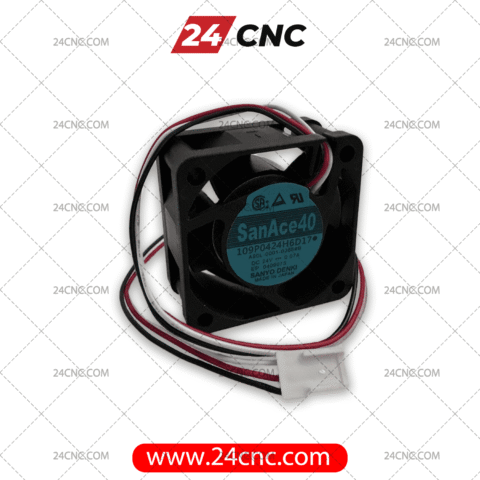


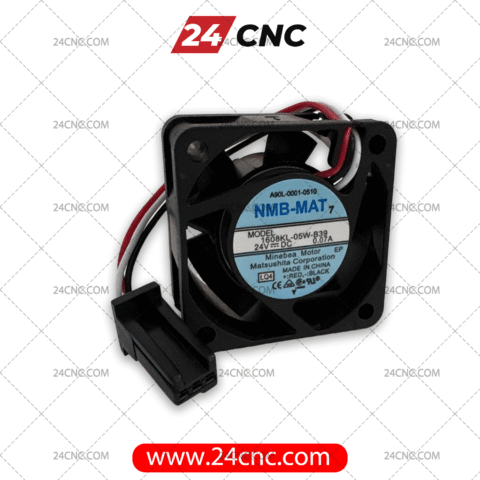


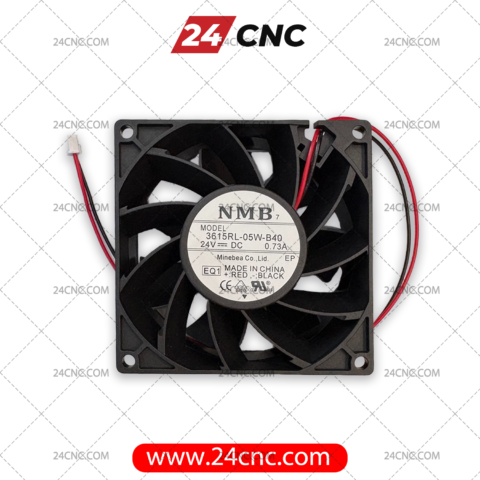


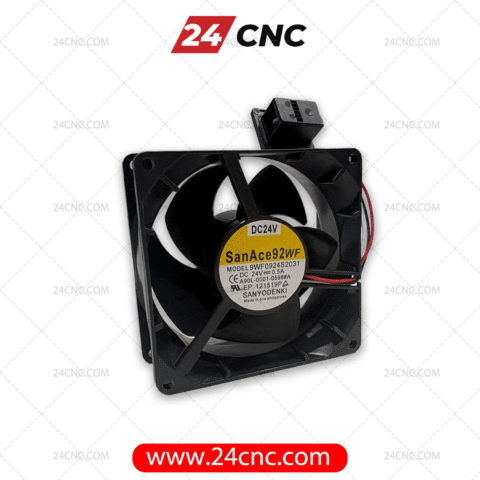

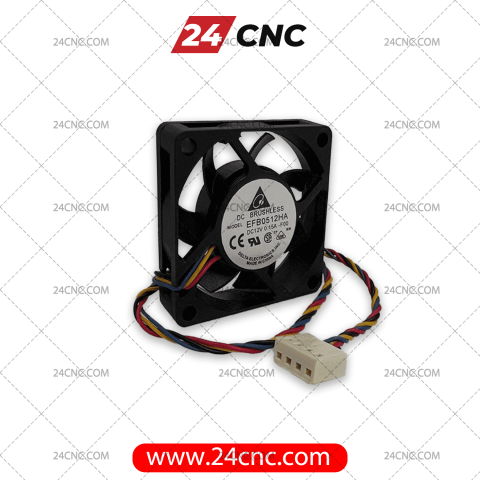
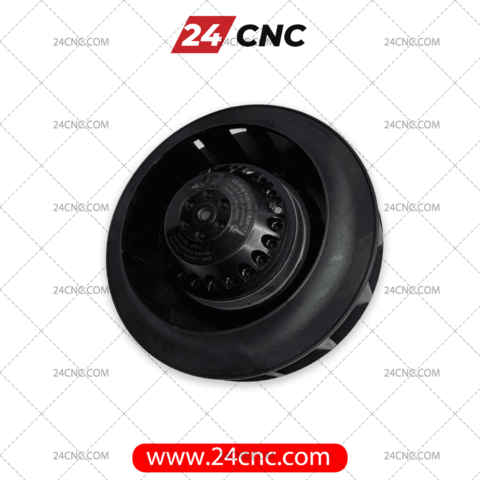
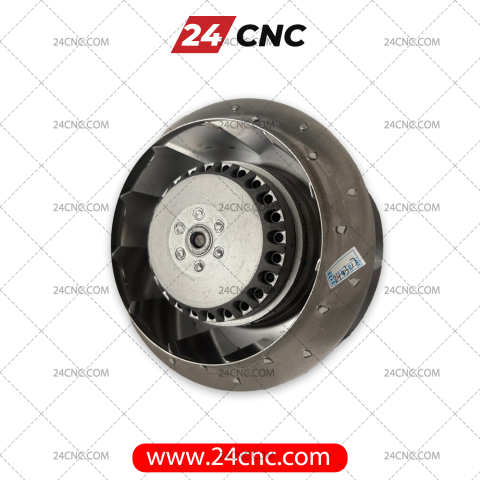

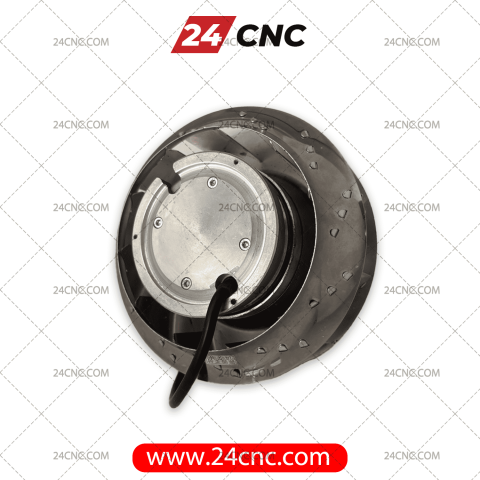
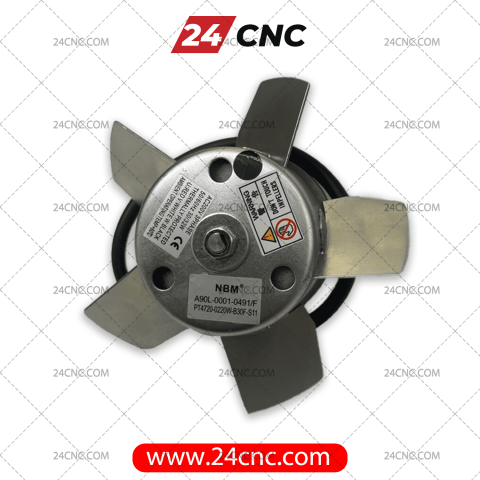
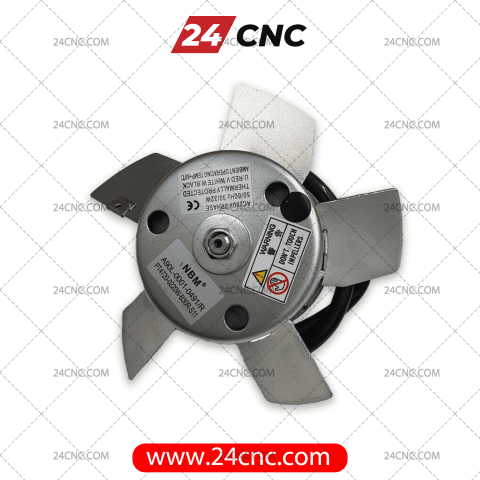
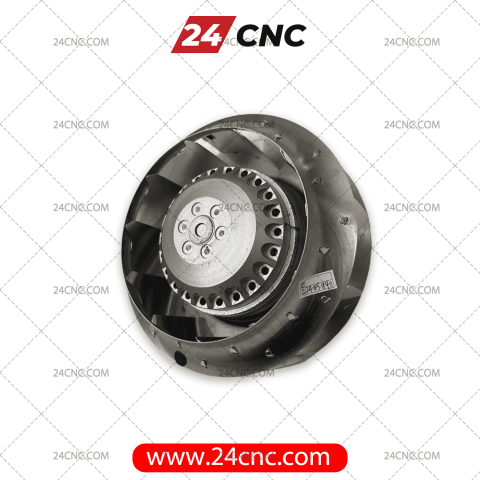
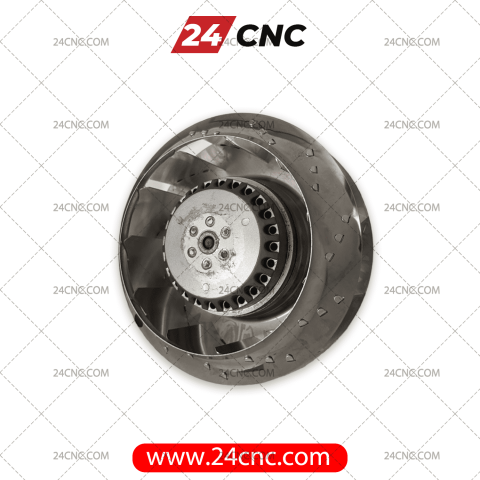
In the relentless environment of high-speed manufacturing, thermal management is the silent guardian of your machine’s electronic ecosystem. CNC machining centers generate massive amounts of thermal energy. High-frequency switching within amplifiers and inverters, the continuous torque of servo motors, and the intense power density of modern controllers all contribute to a rapidly rising internal temperature.
When an OEM cooling fan degrades, becomes clogged with coolant mist, or fails entirely, the resulting heat accumulation is swift and destructive. This degradation does not merely shorten component lifespans; it triggers hard thermal alarms that immediately halt production, leading to catastrophic downtime and missed delivery schedules. At 24CNC, our mission is to provide the exact, genuine replacement CNC fans engineered to match the precise volumetric airflow and static pressure requirements of your equipment.
The True Cost of Heat in CNC Electronics
To understand why genuine OEM fans are critical, one must look at the Arrhenius equation as it applies to solid-state electronics. A widely accepted rule of thumb in electrical engineering states that for every $10^\circ \text{C}$ rise in operating temperature above the rated ambient limit, the life expectancy of an electronic component—such as the capacitors inside a Fanuc™ spindle drive—is reduced by $50\%$.
If your electrical cabinet normally operates at $35^\circ \text{C}$, a failed circulation fan can easily allow localized hotspots to reach $55^\circ \text{C}$ to $65^\circ \text{C}$. The mathematical reality is harsh:
Where $L$ is lifespan and $\Delta T$ is the change in temperature. If $\Delta T = 20^\circ \text{C}$, your $\$5,000$ drive will last exactly one-quarter of its designed lifespan. Investing in a $\$50$ to $\$150$ genuine replacement fan is not an expense; it is highly leveraged insurance
Drive & Controller Fans
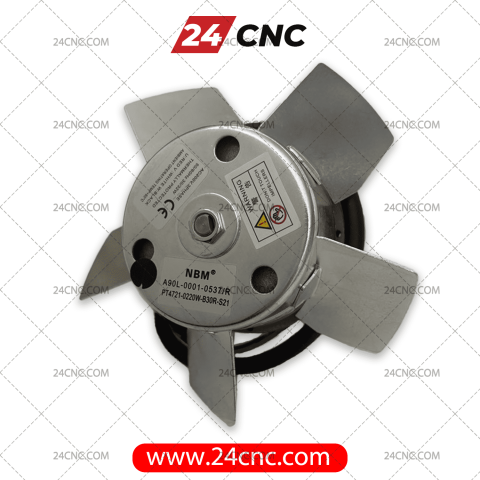
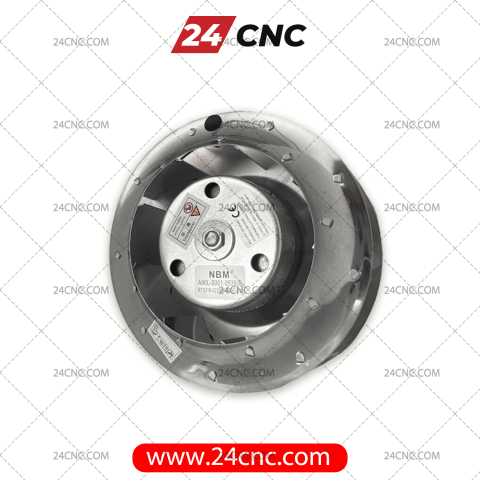
Compact, sensor-equipped 24VDC & 200VAC fans for VFDs, Servo Drives, and Power Supply Modules. Designed for pinpoint cooling.
Motor Cover Fans
High-flow external cooling cowls for heavy-duty Spindle and Axis Motors. Built to withstand flying chips and oil mist.
Decoding CNC Thermal Alarms
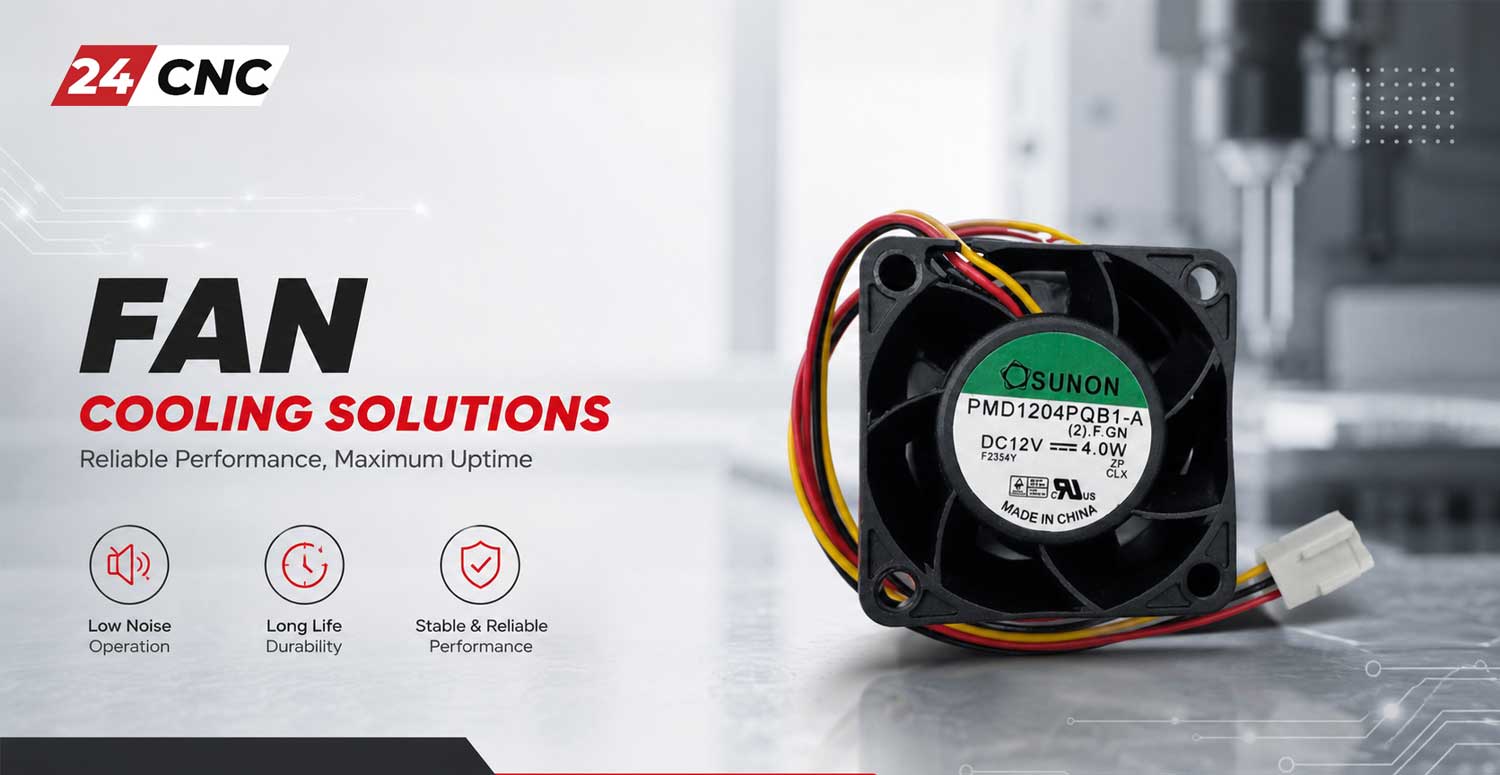
Unlike standard consumer electronics, industrial CNC controllers actively monitor their cooling systems. They do not wait for the drive to overheat; they monitor the fan’s RPM directly via a dedicated tachometer or locked-rotor sensor wire (usually the yellow, white, or blue wire in a 3-pin configuration). When a fan seizes, the controller throws a specific alarm code:
- Fanuc Alarm 2 / Fanuc OH (Overheat) Alarm: Often indicates a failure of the cooling fan inside the Alpha or Alpha i series Spindle/Servo Amplifier module. The machine will drop out of ‘Ready’ state immediately.
- Siemens F30004 / F30011: Indicates a drive heatsink overtemperature or a direct fan fault on the Sinamics power module.
- Mitsubishi AL. 46 / AL. 45: Cooling fan error on the MDS series drives, pointing directly to a drop in fan RPM.

Bearing Technology: Why Cheap PC Fans Fail in Machine Shops
A frequent and costly mistake made by inexperienced maintenance personnel is attempting to replace a $\$60$ Fanuc™ amplifier fan with a $\$10$ standard computer fan of the same physical dimensions (e.g., $60\times60\times25\text{mm}$). Beyond the lack of an alarm sensor, standard PC fans utilize sleeve bearings.
Sleeve bearings rely on a thin layer of porous oil. In a CNC environment, continuous micro-vibrations from cutting operations, combined with airborne coolant vapor, quickly wash away or contaminate this lubricant. The fan seizes within weeks. Genuine industrial fans from brands like Sanyo Denki and NMB-MAT utilize Dual Ball Bearings (DBB). Ball bearings are sealed, handle axial and radial loads perfectly (allowing mounting in any orientation), and offer an MTBF (Mean Time Between Failures) of over $50,000$ to $70,000$ hours in harsh industrial conditions.
The Engineer’s Selection Guide: Identifying the Exact Part
Do not guess. Verify these five critical metrics found on your failed fan’s nameplate before ordering:
- Physical Dimensions & Form Factor: Measured as Length $\times$ Width $\times$ Depth. A $40 \times 40 \times 20\text{mm}$ fan cannot replace a $40 \times 40 \times 10\text{mm}$ fan; the amplifier casing simply will not close. Pay attention to the frame shape (ribbed vs. flangeless).
- Operating Voltage & Current: Is the fan drawing control logic voltage ($24\text{VDC}$) or AC line voltage ($100\text{VAC}$ / $200\text{VAC}$ / $220\text{VAC}$)? Connecting a $24\text{VDC}$ fan to a $200\text{VAC}$ terminal results in immediate, explosive failure. Ensure the amperage ($A$) rating closely matches the OEM spec to avoid overdrawing the controller’s internal power supply.
- Airflow (CFM) & Static Pressure: Volumetric flow rate ($Q$) is measured in Cubic Feet per Minute (CFM) or Cubic Meters per Minute ($\text{m}^3/\text{min}$). Static pressure is crucial for pushing air through tightly packed drive heatsinks.
- Connector & Pinout: Does the fan have 2 wires, 3 wires, or a proprietary 4-pin OEM housing? At 24CNC, we supply fans with the exact OEM connectors so you can perform a true “plug-and-play” repair without risky wire splicing.
- Sensor Type: Differentiate between Tachometer output (pulse frequency based on speed) and Locked-Rotor output (a simple open/closed circuit when the fan stops). Using the wrong sensor type will result in an immediate drive alarm.
Technical Matrix: Common CNC Fan Profiles
| Application Zone | Standard Voltages | Approved OEM Brands | Sensor Requirement | Airflow Direction |
|---|---|---|---|---|
| Internal Servo/Spindle Drive | $24\text{VDC}$ | Sanyo Denki, Nidec | Locked-Rotor (3-Wire) | Exhaust (Pulling heat out) |
| Drive Heatsink (External Base) | $200\text{VAC}$, $24\text{VDC}$ | NMB-MAT, Panaflo | Tachometer or None | Intake (Blowing over fins) |
| Spindle Motor Cover | $200\text{VAC}$ / 3-Phase | Royal, Ebmpapst | None (Monitored by motor temp) | Intake (Forced cooling) |
| Main Cabinet Heat Exchanger | $110\text{VAC}$ / $220\text{VAC}$ | Ebmpapst, Orix | None | Closed Loop Circulation |
Preventative Maintenance: Extending Fan Life
To maximize the lifespan of your replacement fans and prevent sudden machine halts, implement these simple maintenance routines:
- Quarterly Cabinet Inspections: Open the electrical cabinet (adhering to Lockout/Tagout procedures) and visually inspect all amplifier and controller fans. Dust buildup on the leading edges of the fan blades heavily degrades aerodynamic efficiency and CFM output.
- Gentle Cleaning: Never use a high-pressure air nozzle (like shop air at $100\text{ PSI}$) to blow out a fan. The extreme air velocity can over-spin the fan far beyond its rated RPM, generating back-EMF that destroys the drive’s control board, or shattering the ball bearings. Use a soft brush and a low-pressure electrical contact cleaner.
- Filter Replacement: If your machine cabinet utilizes intake filters on the doors, replace them monthly. A clogged cabinet filter starves the internal drive fans of fresh ambient air, creating a vacuum effect that pulls dirty shop air through unsealed gaps.
Comprehensive FAQ
Why is my Fanuc drive still throwing an alarm after I replaced the fan?
If you installed a genuine 3-wire replacement fan and the alarm persists, two things may be happening. First, verify the pinout; sometimes aftermarket fan connectors have the sensor wire and ground wire swapped. Second, the fan control circuit on the drive’s internal PCB may have burned out when the original fan failed. In this case, the entire amplifier requires repair.
How do I interpret a part number like “9WF0424F6D04”?
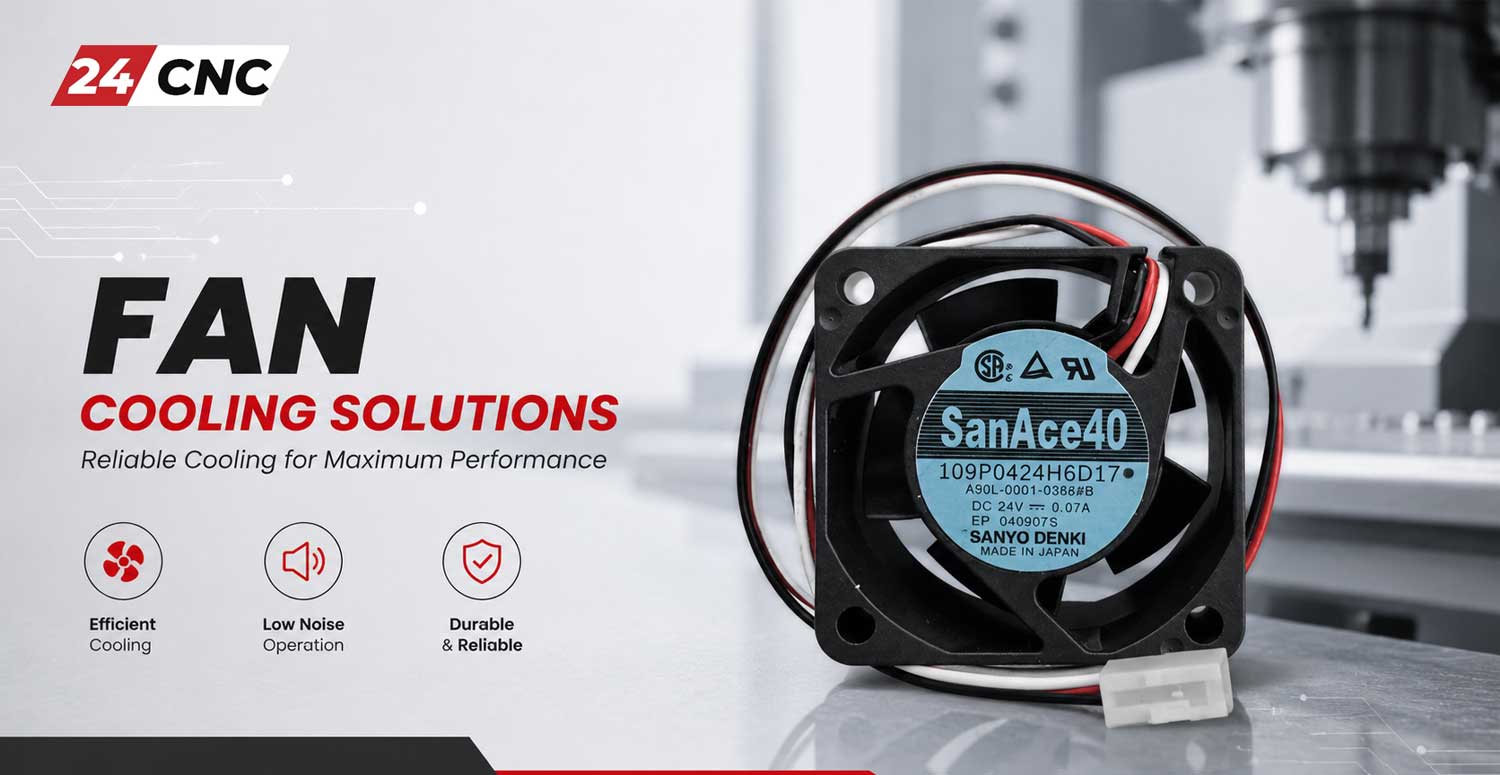
OEM part numbers contain all the fan’s specs. For example, in a Sanyo Denki San Ace number, “04” represents a $40\text{mm}$ frame, “24” denotes $24\text{VDC}$, and the “D” suffix usually indicates a locked-rotor sensor. Our product pages cross-reference these complex manufacturer codes directly with the CNC machine builder’s part numbers (e.g., Fanuc A90L-0001-0XXX).
Are refurbished fans reliable?
When professionally refurbished, yes. A proper refurbishment involves stripping the fan, replacing the ball bearings with high-speed Japanese SKF or NSK bearings, balancing the impeller, and strictly testing the sensor output on an oscilloscope. We clearly label our stock condition on every product page to suit your budget and risk tolerance.
Can you cross-reference obsolete fans?
Absolutely. Many older Matsushita or Nidec fans used in 1990s CNC equipment are no longer manufactured. Our engineering team can cross-reference the original CFM, voltage, and sensor logic to provide a modern, drop-in replacement that fully satisfies the legacy controller.
Restore Your Machine’s Reliability Today
A thermal alarm is your machine begging for intervention. Do not bypass safety sensors or risk destroying a five-figure servo drive. Browse our extensive, live-inventory of genuine OEM cooling fans, or let our CNC specialists match the perfect part to your exact machine specifications.