
Showing all 6 results


In the highly demanding field of precision CNC machining, the structural integrity and mechanical fluidity of the linear motion system represent the foundational backbone of dimensional accuracy. When traditional cast-iron-on-cast-iron machine tool guideways begin to wear, the resulting metal-to-metal contact generates severe positioning errors, exponentially increased thermal expansion, and dangerous mechanical loads on your servo motors and servo amplifiers. The ultimate manifestation of this wear is the dreaded “stick-slip” (chatter) effect during low-speed, high-precision feed rates.
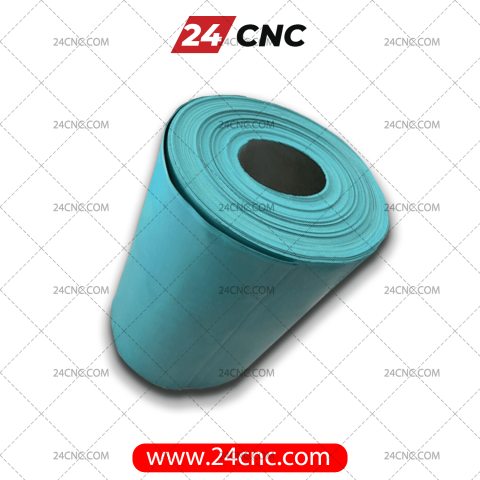
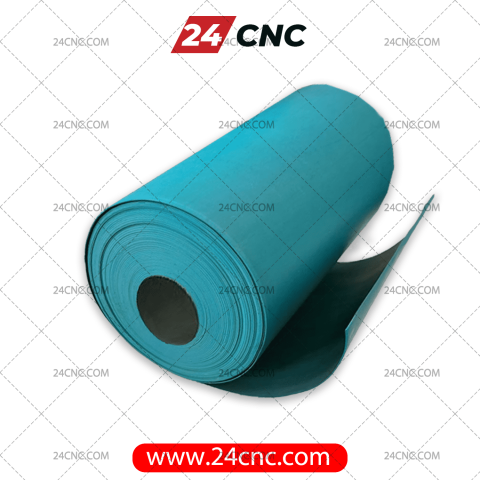
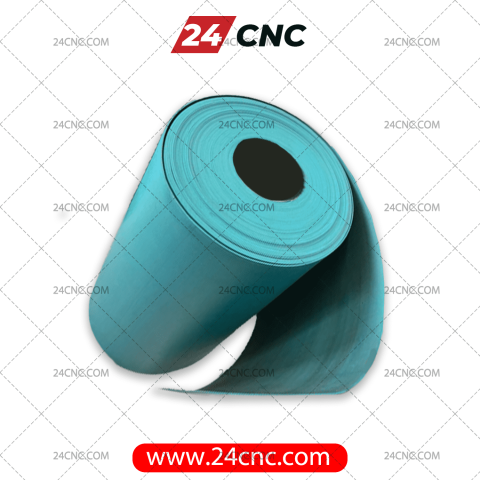
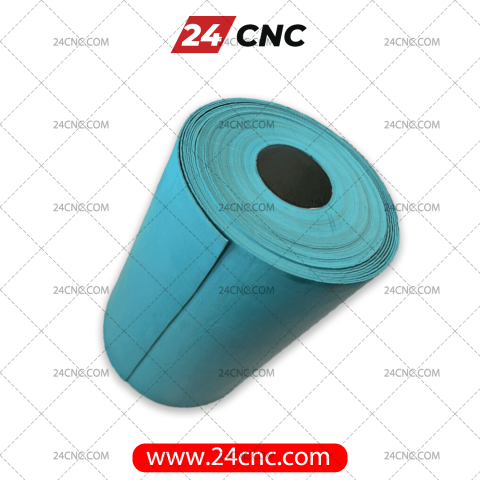
Blue Turcite (widely recognized in the industry as Turcite B or Slydway) is an advanced, self-lubricating Polytetrafluoroethylene (PTFE) based bearing material, heavily alloyed with bronze and specialized solid lubricants. It is engineered specifically to eradicate these mechanical inefficiencies. By chemically bonding Blue Turcite to the underside of machine tables, saddles, cross-slides, and gibs, machine rebuilders and maintenance engineers can drastically alter the tribological profile of the machine. Whether you are overhauling a heavy-duty horizontal boring mill, retrofitting a vintage lathe, or maintaining a high-speed vertical machining center, 24CNC offers genuine, industrial-grade Turcite replacement materials designed to restore your equipment to absolute OEM factory-level accuracy.
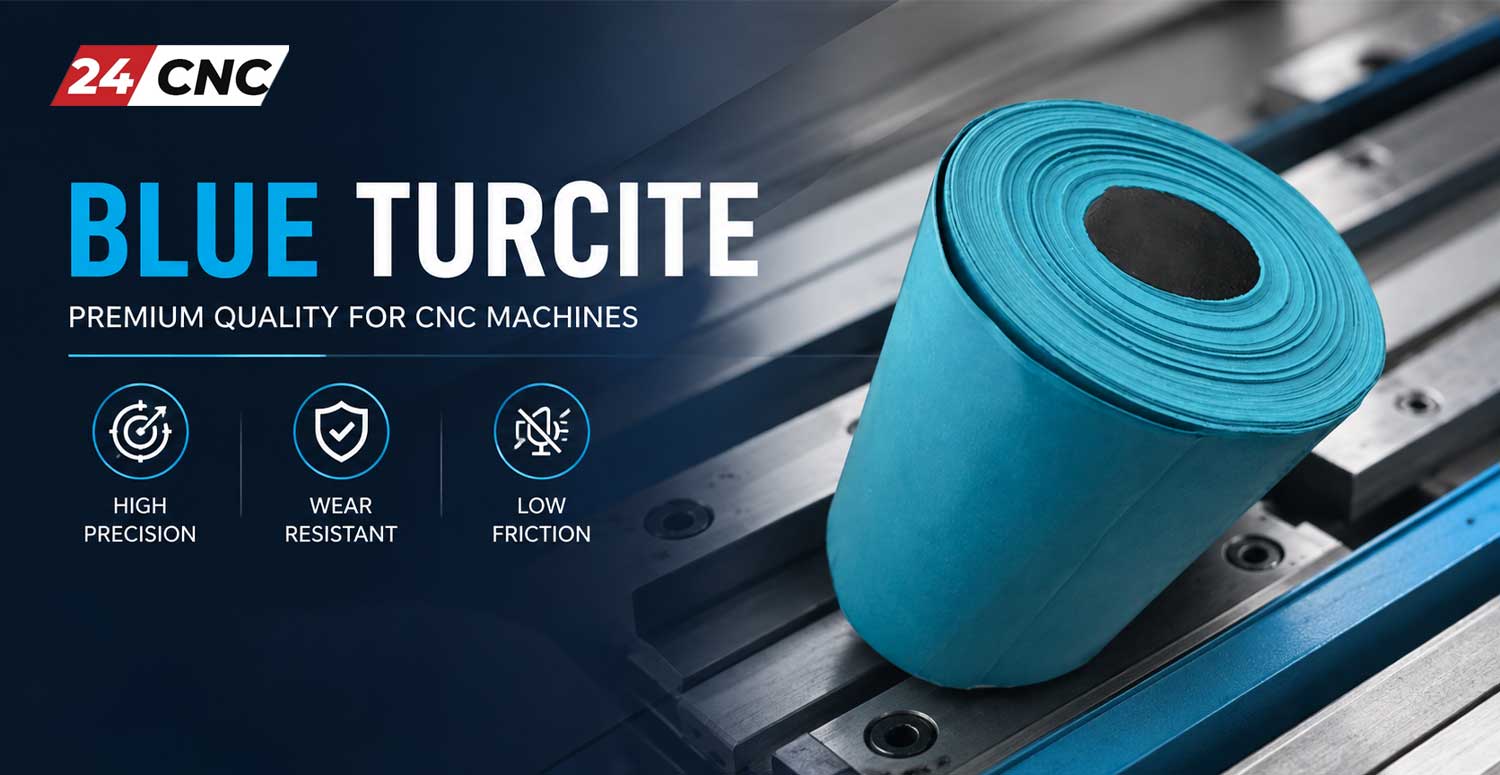
The Physics of Machining: Why Blue Turcite is Critical
To understand the necessity of Blue Turcite, we must examine the physics of friction within a CNC guideway. In a traditional sliding way system without a PTFE liner, the static friction coefficient ($\mu_s$) is significantly higher than the kinetic (dynamic) friction coefficient ($\mu_k$).
When the CNC control commands a micro-movement (e.g., $0.001\text{mm}$), the servo motor applies torque. Because $\mu_s > \mu_k$, the axis initially resists movement. The mechanical drivetrain (ballscrew, couplings) acts like a torsional spring, storing energy. When the applied force finally overcomes the static friction equation $F = \mu_s N$ (where $N$ is the normal load of the machine table), the axis “jumps” forward abruptly because the friction instantly drops to the lower kinetic value ($\mu_k$). This jump overshoots the target position, causing the control system to reverse the motor to compensate. This rapid oscillation is known as stick-slip.
The Turcite Advantage: Blue Turcite alters the frictional physics so that $\mu_s \approx \mu_k$. By equalizing the static and dynamic coefficients of friction, the transitional “jump” is entirely eliminated. The axis responds to servo commands smoothly and linearly, allowing for flawless circular interpolation and superior workpiece surface finishes.
Why Buy Blue Turcite from 24CNC?
Selecting the correct anti-friction material is arguably the most critical decision in a machine tool rebuild. Subpar, unbranded, or counterfeit guideway materials compress under heavy machining loads, suffer from rapid thermal degradation, and delaminate prematurely. Procurement officers, workshop owners, and senior maintenance engineers trust 24CNC for the following uncompromising reasons:
- Authentic OEM-Grade Composition: Our Blue Turcite is formulated with the exact ratio of virgin PTFE, sintered bronze, and friction-modifying fillers. This matrix ensures maximum wear resistance while maintaining the microporosity required to retain hydrostatic lubrication oil.
- Perfect Synergy with Drive Systems: Drastically reduced guideway friction means significantly lower continuous current draw from your electrical systems. This runs your motors cooler and extends the lifecycle of your expensive power modules (IPMs) and IGBTs.
- Chemically Etched for Permanent Adhesion: Genuine Turcite must be chemically etched on one side to accept epoxy. Our material features a deep, factory-applied sodium etch (noticeable by its dark brown/black backing) that guarantees a failure-proof molecular bond when used with the correct adhesive.
- Complete Rebuild Ecosystem: We are not merely a materials supplier; we are a comprehensive CNC solutions provider. We stock the specialized two-part industrial guideway glue required for installation, ensuring you do not experience chemical incompatibility.
- Rapid Global Shipping: Machine downtime burns through capital. We maintain an active, climate-controlled stock of all standard thicknesses and widths for immediate international dispatch.

Comprehensive Engineering Selection Guide
Specifying the correct Turcite dimensions requires careful measurement and foresight regarding the rebuild process. Follow this technical checklist before placing your order:
- Determine the Required Thickness (Scraping Allowance): Blue Turcite is available in standardized metric thicknesses (e.g., $0.8\text{mm}$, $1.2\text{mm}$, $1.6\text{mm}$, $2.0\text{mm}$, $2.5\text{mm}$, and up to $3.2\text{mm}$ for heavy boring mills). When rebuilding a machine, you must account for the cast iron removed during the grinding or planing of the machine bed. Critical Note: Always select a thickness that allows for at least $0.15\text{mm}$ to $0.30\text{mm}$ of material to be removed during the final hand-scraping process to achieve proper geometry alignment.
- Calculate Total Surface Area and Load: Measure the exact length and width of the mating surfaces on your saddle, table, or gibs. Ensure the total bearing area is sufficient to support the maximum table load plus cutting forces without exceeding the Turcite’s compressive yield strength (typically $< 10 \text{ N/mm}^2$ for continuous dynamic loads). Always order a minimum of $15\%$ extra material to account for cutting tolerances, angular ways, and edge trimming.
- Adhesive Selection: Standard hardware store epoxies will experience catastrophic shear failure under the forces of CNC machining and chemical attack from synthetic cutting coolants. You must use specialized, slow-curing, two-part epoxy resin designed explicitly for PTFE guideway bonding.
Installation Protocol: Surface Prep & Bonding
Proper installation is just as critical as the material itself. A failed bond requires a complete teardown of the machine. The standard protocol includes:
- Surface Preparation: The cast iron surface receiving the Turcite must be perfectly clean, degreased, and slightly roughened (typically sandblasted or roughly ground to a surface finish of $R_a \approx 3$ to $5 \mu\text{m}$) to provide a mechanical key for the epoxy.
- Degreasing: Use industrial acetone or a specialized solvent to remove all traces of way oil, coolant, and fingerprints. Do not use alcohol, as it can leave a residue.
- Application: Mix the guideway glue strictly according to the manufacturer’s ratio. Apply a uniform, notched-trowel layer to the cast iron, and a thin, flat layer to the etched side of the Turcite.
- Clamping & Curing: Lay the Turcite onto the glued surface and use a heavy roller to expel air bubbles. Clamp the assembly evenly using flat heavy plates or by resting the machine component on its own weight on a precision surface plate. Allow to cure at room temperature ($20^\circ\text{C}$ to $25^\circ\text{C}$) for at least 24 hours before un-clamping or machining.
- Finishing (Scraping): Once cured, the Turcite must be milled to rough thickness, and then precision hand-scraped. The goal of scraping is to create a perfectly flat bearing surface with specific “high spots” (typically 20-40 points per square inch, or PPI) and shallow oil pockets (half-mooning/flaking) to retain hydrodynamic lubrication.

Technical Specifications: Blue Turcite B
For mechanical engineers and retro-fitters validating load capacities and control loop tuning, the following tribological and mechanical properties are guaranteed for our premium Blue Turcite:
Frequently Asked Technical Questions (FAQ)
Does Blue Turcite eliminate the need for guideway lubrication?
No. While Blue Turcite contains solid lubricants and is inherently self-lubricating due to its PTFE matrix, standard CNC way lube (e.g., ISO VG 68) is still mandatory. The combination of Turcite and a proper hydrostatic oil film creates a boundary lubrication state that yields the lowest possible wear rate and protects the opposing cast iron surface from oxidation.
How does Blue Turcite react to modern synthetic coolants?
Genuine PTFE-based Turcite is practically chemically inert and highly resistant to all standard water-soluble and synthetic cutting fluids. The vulnerability typically lies in the epoxy bond line, which is why using our specified chemical-resistant guideway glue is absolutely critical to prevent delamination.
Can I use a standard milling cutter to shape Turcite after bonding?
Yes. Once the epoxy is fully cured, Turcite can be machined using standard high-speed steel (HSS) or carbide end mills, fly cutters, or planers. Ensure sharp tooling with high positive rake angles to prevent pushing or tearing the soft material. Climb milling is generally preferred to maintain an excellent surface finish prior to scraping.
What is the difference between Blue Turcite and Rulon?
Both are highly respected, filled-PTFE bearing materials designed for machine tool ways. Turcite (typically blue/green) and Rulon (typically maroon/brown) have slightly different proprietary filler blends (bronze vs. other synthetics), but functionally perform almost identically in mitigating stick-slip and providing excellent wear resistance in CNC applications.