
Showing all 9 results


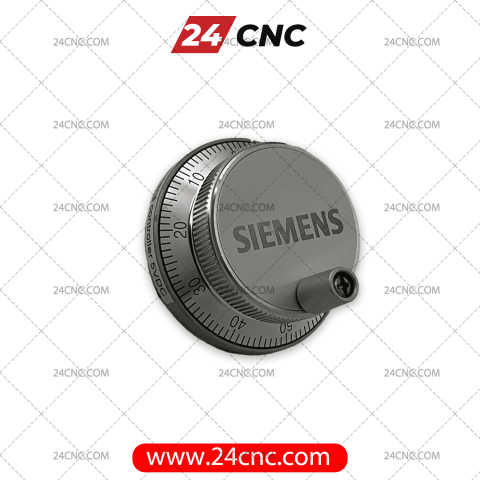


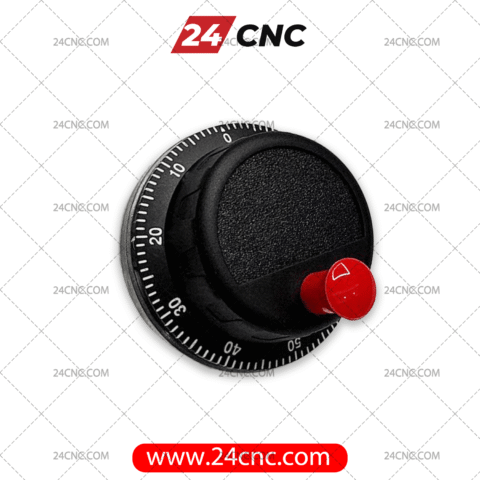
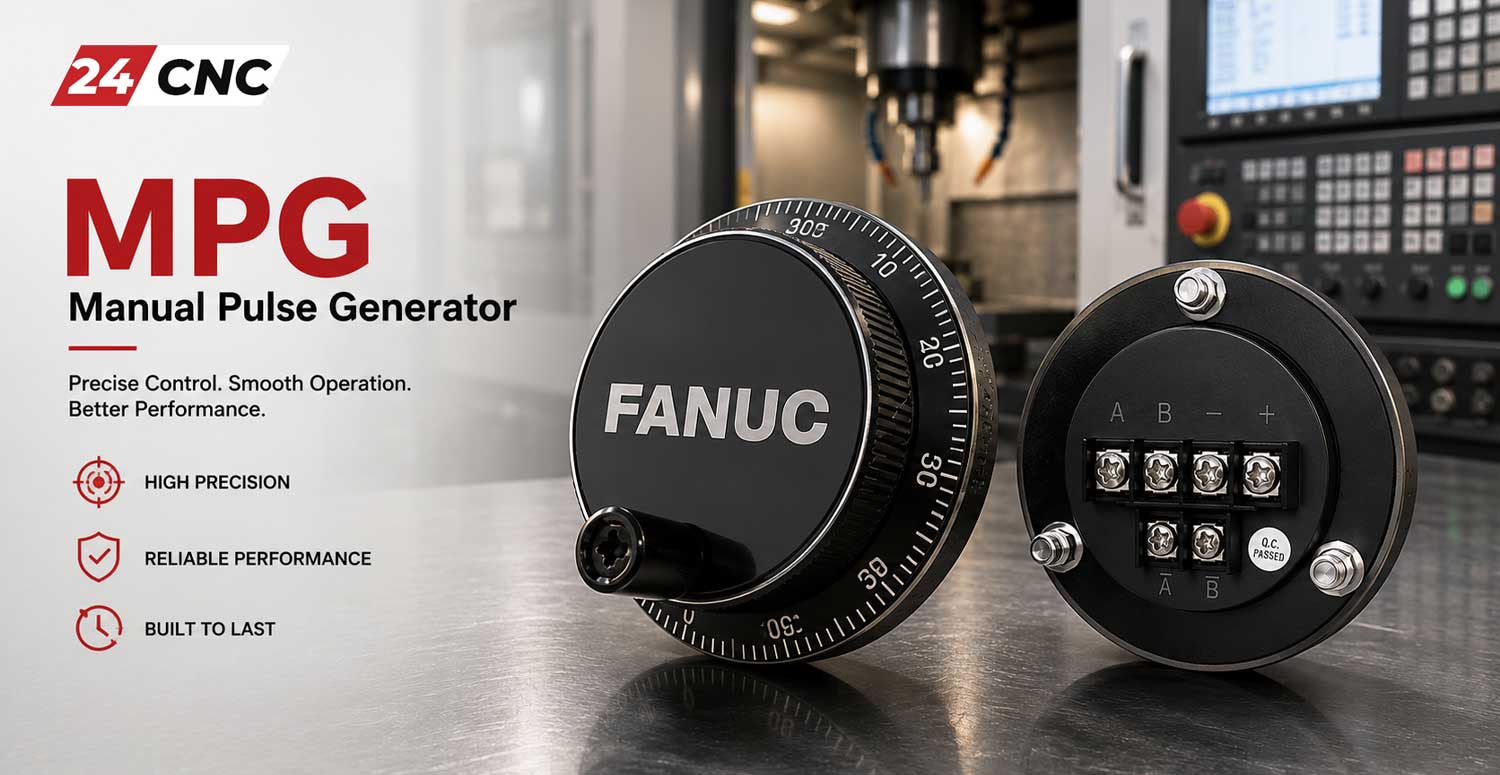
In the precision-driven environment of modern industrial machining, the MPG (Manual Pulse Generator) serves as the most critical tactile interface between the human operator and the machine tool. Often referred to simply as a CNC handwheel, electronic handwheel, or pulse generator, the MPG grants machinists the ability to manually position heavy machine axes with micrometer-level accuracy. This component is indispensable during machine setup, edge-finding, tool offset calibration, and proving out new G-code programs.
Because the MPG provides direct, unbuffered input to the machine’s axis controllers, a failing, erratic, or “bouncing” handwheel compromises this delicate control. A malfunctioning unit can lead to dangerous tool crashes, scrapped high-value workpieces, and severe mechanical damage to your spindles, ballscrews, or servo motors. When your operator reports skipped pulses or dead zones on the dial, replacing the unit with a genuine, OEM-grade component is an urgent priority.
At 24cnc.com, we specialize in minimizing your workshop downtime. Whether you need a bare pulse generator dial for a custom panel repair or a complete tethered remote pendant, we supply authentic replacement MPGs engineered to seamlessly integrate with world-class control architectures, including Fanuc, Siemens, Mitsubishi, and Heidenhain.
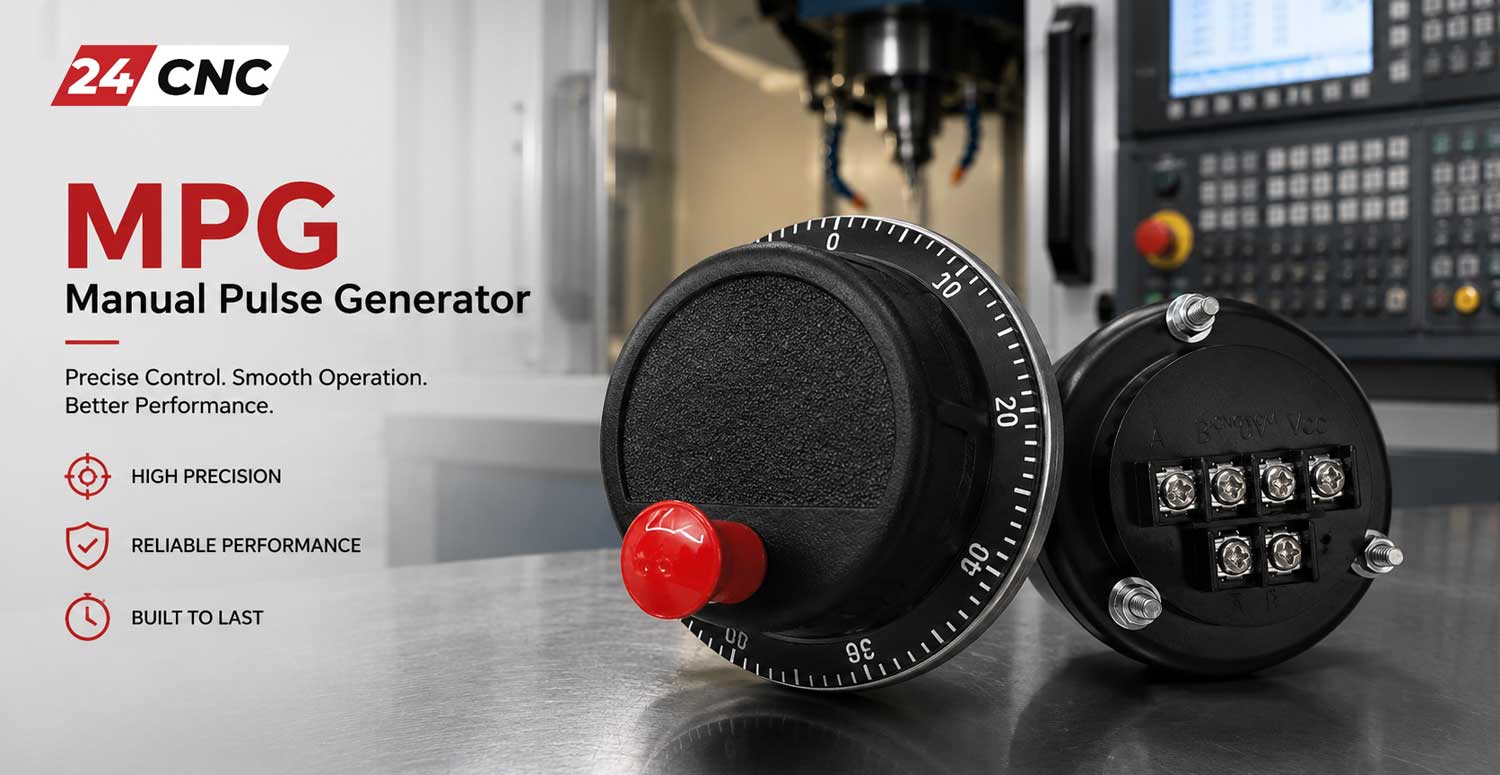
The Technical Anatomy of a Manual Pulse Generator
To understand why quality matters, it is helpful to look inside the MPG. A Manual Pulse Generator is essentially a highly specialized incremental rotary encoder optimized for slow, manual human rotation rather than high-speed motor tracking. Inside the heavy-duty outer dial lies a precision optical disk (or magnetic ring) marked with transparent and opaque lines.
As the machinist rotates the dial, an LED light source shines through this disk onto a photodetector array. This optical interaction generates precise electrical pulses—specifically, two square-wave signals known as Channel A and Channel B. These signals are offset by exactly $90^\circ$ of phase shift, known as a quadrature signal. The CNC control system reads this phase difference to determine the direction of rotation (e.g., if Channel A leads Channel B, the axis moves in the positive direction; if B leads A, the axis moves in the negative direction).
Standard industrial MPGs typically feature a resolution of $100\text{ PPR}$ (Pulses Per Revolution). The CNC controller takes these $100$ pulses and processes them through the operator’s multiplier selection switch. Depending on the setting ($x1$, $x10$, $x100$), a single tactile “click” of the handwheel dial will command the axis to move by $0.001\text{ mm}$, $0.01\text{ mm}$, or $0.1\text{ mm}$ respectively. Because of this direct mathematical link to the servo amplifier, electrical noise immunity is paramount. Counterfeit or low-tier MPGs often suffer from signal bounce, causing the machine to jump unpredictably—a catastrophic risk when jogging a $15,000\text{ RPM}$ spindle near a hardened steel fixture.
Panel-Mounted Handwheels vs. Remote Pendants
MPGs generally come in two primary form factors on the shop floor. We stock components and complete assemblies for both:
1. Panel-Mounted MPGs
These are fixed directly into the main operator console of the CNC machine. They are highly durable because they are not subjected to being dropped or dragged across the shop floor. When repairing a panel-mounted unit, procurement specialists usually only need to purchase the bare circular MPG unit (often an $80\text{mm}$ diameter module) and wire it into the existing panel switches. You may also need replacement panel selectors if the axis or multiplier switches have worn out.
2. Remote MPG Pendants
Modern machining centers, particularly large gantry mills and boring mills, utilize tethered remote handwheels (pendants). These allow the operator to walk inside the machine enclosure and stand right next to the cutting tool during setup. Pendants encapsulate the MPG dial, axis selection switches, multiplier switches, an Emergency Stop (E-Stop) button, and often a deadman safety switch. While incredibly convenient, pendants are prone to physical damage from drops and cable fatigue. For these, we supply complete pendant assemblies as well as replacement coiled handwheel cables.
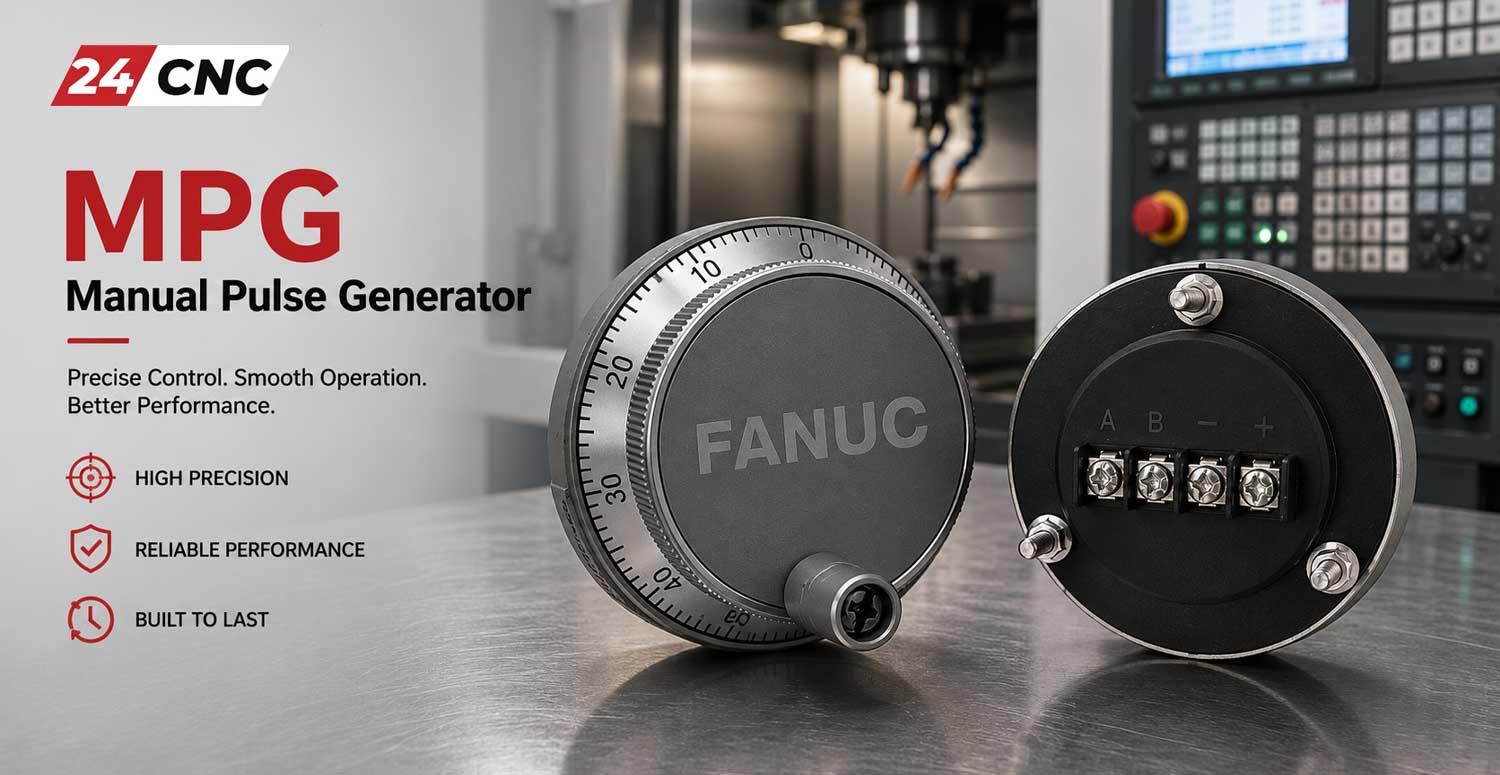
Detailed Selection Guide: How to Order the Correct MPG
Visually, almost all manual pulse generators look identical. They feature a standard $80\text{mm}$ or $60\text{mm}$ outer diameter dial, usually black or silver, with $100$ gradient markings. However, installing an MPG with the incorrect internal electronics will result in a failure to operate, or worse, it could short-circuit your CNC controller’s delicate I/O board. Follow these technical steps to identify your exact replacement part:
- Verify the Operating Voltage ($Vcc$): Look at the data sticker on the rear of your current MPG. Standard configurations operate on $5\text{V}\text{ DC}$, $12\text{V}\text{ DC}$, or $24\text{V}\text{ DC}$. For example, most modern Fanuc controllers strictly require a $5\text{V}$ supply, while some European or PLC-based retrofit systems utilize $12\text{V}$ or $24\text{V}$ logic levels (HTL).
- Determine the Output Signal Circuitry:
- Line Driver (Differential): Outputs $A, \bar{A}, B, \bar{B}$ signals. This uses the EIA-422 standard to provide high noise immunity over long cable runs. This is the standard for most Fanuc, Mitsubishi, and Siemens systems.
- Voltage Output / Open Collector: Outputs only $A$ and $B$ signals alongside the ground and power wire. This is common in older Japanese machines or simpler stepper-motor routers.
- Check the Pulse Resolution: Ensure you are matching the PPR. The global industry standard is $100\text{ PPR}$, meaning $100$ clicks per $360^\circ$ rotation. However, some specialized micro-machining or grinding centers may utilize $25\text{ PPR}$ variants.
- Measure Physical Dimensions: Verify the mounting hole pattern. The industry standard is an $80\text{mm}$ diameter, but compact consoles may require the $60\text{mm}$ version (often designated as MPG60).
Technical Comparison Table: Common MPG Wiring Configurations
| Operating Voltage | Output Circuit Type | Terminal Designations | Common System Compatibility |
|---|---|---|---|
| $5\text{V}\text{ DC}$ | Line Driver (Differential) | $Vcc, 0\text{V}, A, \bar{A}, B, \bar{B}$ | Fanuc, Mitsubishi, Siemens (Industry Standard) |
| $5\text{V}\text{ DC}$ | Voltage / TTL Output | $Vcc, 0\text{V}, A, B$ | Older Japanese Controllers, Custom Microcontrollers |
| $12\text{V} – 24\text{V}\text{ DC}$ | Open Collector / Push-Pull | $Vcc, 0\text{V}, A, B$ | Fagor, Heidenhain, PLC-based CNC Routers |
Advanced Troubleshooting: Diagnosing MPG Failures
Before purchasing a replacement, it is crucial to confirm that the MPG itself is the point of failure. Because remote pendants involve moving wires, the problem is often cable-related rather than a failure of the optical encoder. Here is how maintenance engineers can isolate the fault:
- The “Wiggle Test”: If the machine axis moves erratically or drops the signal only when the pendant cable is stretched or twisted, the issue is almost certainly a broken wire inside the coiled handwheel cable. Replacing just the cable will save you the cost of a full pendant.
- PMC/PLC Diagnostic Screens: On a Fanuc controller, you can navigate to the PMC maintenance screen (Status). Watch the diagnostic bits assigned to the MPG inputs. As you slowly turn the handwheel, you should see the $0$ and $1$ binary states toggling cleanly for the A and B channels. If the bits do not change, or flicker randomly without rotation, the MPG is likely dead.
- Multimeter Verification: If the MPG is completely unresponsive, open the pendant or panel and check the incoming power across the $Vcc$ and $0\text{V}$ terminals using a digital multimeter. If you do not have $5\text{V}\text{ DC}$ (or your machine’s specified voltage) reaching the MPG, the problem lies upstream in the CNC’s I/O module, a blown machine fuse, or a broken power wire.
Frequently Asked Questions (FAQ)
My operator dropped the pendant, and the handwheel is stiff to turn. Can it be repaired?
When an MPG takes a direct physical impact, the internal shaft connecting the dial to the optical disk can bend, or the delicate glass optical disk can shatter. Once the mechanical rotation becomes physically stiff or grinds, the unit cannot be reliably repaired and must be replaced entirely to ensure operator safety.
Can I replace the internal encoder without buying a whole new pendant?
Absolutely. If your external plastic housing, E-stop, and axis selector switches are in good working condition, you can purchase just the raw, bare MPG generator dial. You will need to desolder the wires from the broken unit and solder them to the matching terminals on the new unit. This is highly cost-effective.
Does 24cnc.com provide international shipping for replacement handwheels?
Yes. 24cnc.com is a global supplier of industrial automation components. Whether you need a simple MPG, a replacement LCD screen for your Fanuc panel, or servo drive components, we provide expedited international dispatch to get your machine back in production immediately.
Restore Precision Control to Your CNC Machine Today
Don’t risk a devastating spindle crash due to a faulty pulse generator or a degraded cable. At 24cnc.com, we have genuine, high-resolution MPGs in stock and ready to ship. Need assistance identifying your machine’s specific voltage or quadrature signal requirements? Our technical procurement team is ready to assist.