

In the high-stakes world of CNC machining, where precision is measured in microns and downtime costs thousands per hour, the servo motor is often hailed as the “muscle” of the machine. However, a muscle is useless without a nervous system to tell it where to move, how fast to go, and when to stop. This is exactly what an encoder is.
The encoder is the unsung hero of industrial automation—a sophisticated sensor that translates mechanical motion into electrical signals. Without it, your expensive CNC machine is essentially blind. Whether you are running a generic setup or a high-end system with a Fanuc™ controller, understanding the role of the encoder is essential for troubleshooting, maintenance, and optimizing performance.
In this comprehensive guide, we will dissect the anatomy of an encoder, explore the critical differences between incremental and absolute technologies, and explain why the feedback loop is the heartbeat of modern manufacturing.
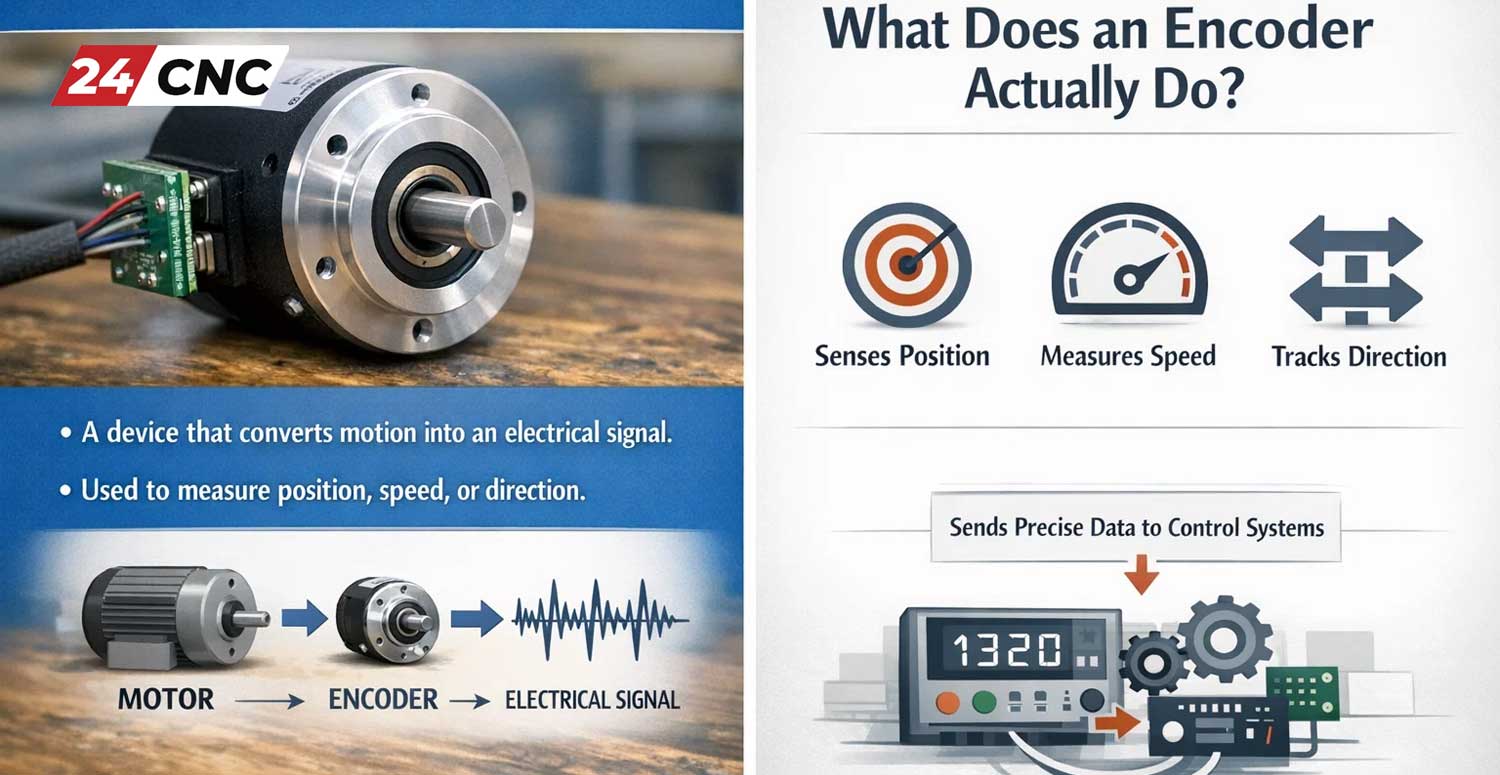
The Core Definition: What Does an Encoder Actually Do?
At its simplest level, a rotary encoder is an electro-mechanical device that converts the angular position or motion of a shaft into an analog or digital code. When attached to a servo motor, it monitors the motor’s shaft rotation and sends that data back to the CNC control system (the brain).
Think of the CNC controller as a captain shouting orders (“Move the X-axis 100mm!”). The servo motor is the crewman pulling the rope. The encoder is the observer who watches the rope and yells back, “We have moved exactly 99.8mm… okay, now 100mm!” This process creates what is known as a Closed-Loop System.
The Three Vital Data Points
A functioning encoder provides the CNC system with three critical pieces of information:
- Position: Exactly where the tool is located on the axis.
- Speed: How fast the motor shaft is spinning.
- Direction: Whether the axis is moving forward (Clockwise) or backward (Counter-Clockwise).
How Encoders Create the “Closed-Loop” Advantage
Standard stepper motors operate on an “open-loop” system—the controller sends a pulse and hopes the motor moves. If the tool hits a hard spot in the metal and the motor stalls, the controller never knows, leading to ruined parts.
Servo systems, utilized by top brands like Mitsubishi and Siemens, rely on the encoder for error correction. The signal travels from the encoder, through the encoder cable, to the servo drive (amplifier).
- Command vs. Reality: The amplifier and inverter compare the commanded position from the CNC to the actual position reported by the encoder.
- Instant Correction: If there is a discrepancy (error), the drive instantly adjusts the voltage and current to the motor to snap it back into the correct position. This happens thousands of times per second.

Types of Encoders: Incremental vs. Absolute
When selecting a motor or a replacement part, you will inevitably face the choice between two primary technologies. Understanding the difference is crucial for machine setup.
1. Incremental Encoders
An incremental encoder measures change in position. It generates a continuous stream of pulses as the shaft rotates. It essentially says, “I moved one step… I moved another step.”
The Catch: It does not know where it is when the power is turned off. Every time you power up a CNC machine with incremental encoders, you must perform a “Homing” or “Reference Return” procedure so the machine can find its zero point.
2. Absolute Encoders
An absolute encoder, commonly found in modern Fanuc encoders, assigns a unique digital code to every distinct angle of the shaft. It knows exactly where it is at all times.
The Advantage: Even if the power is cut, the encoder remembers its position (often assisted by a battery backup). When you restart the machine, you can start machining immediately without homing the axes.
Optical vs. Magnetic vs. Capacitive Sensing
How does the encoder actually “see” the movement? There are three main technologies used inside the housing:
- Optical Encoders: These use a light source (LED) and a photodetector separated by a spinning glass or plastic disk with fine lines on it. As the disk spins, it interrupts the light beam, creating pulses. These are highly accurate but sensitive to dust and vibration. High-precision units often found in Tamagawa products usually employ optical technology.
- Magnetic Encoders: These use a magnet attached to the rotating shaft and a sensor that detects changes in the magnetic field. They are incredibly rugged and resistant to oil, dirt, and vibration, making them ideal for harsh environments.
- Capacitive Encoders: Similar to digital calipers, these measure changes in capacitance. They offer a good balance of durability and accuracy.

Critical Components that Support the Encoder
An encoder does not work in isolation. For the signal to remain pure and the machine to function, the supporting hardware must be in top condition.
The Cables
The signal generated by an encoder is low voltage and highly susceptible to electrical noise (EMI). High-quality, shielded optical cables or copper twisted-pair cables are mandatory. A frayed cable is the #1 cause of “ghost” alarms where the machine errors out for no apparent reason.
The Coupling
The encoder is usually attached to the motor shaft via a flexible coupling. If this coupling slips or breaks, the motor will spin, but the encoder won’t record it. This causes a “Following Error” or “Runaway” condition where the control system shuts down the machine to prevent damage.
Technical Comparison: Incremental vs. Absolute
| Feature | Incremental Encoder | Absolute Encoder |
|---|---|---|
| Position Memory | Lost on power loss | Retained after power loss |
| Homing Required? | Yes, every startup | No (Immediate operation) |
| Output Signal | Continuous pulses (A/B/Z channels) | Unique binary word/bit-stream |
| Cost | Generally Lower | Higher |
| Common Use Case | Conveyors, simple automation, older CNCs | Robotic arms, modern CNC mills/lathes |
Frequently Asked Questions (FAQ)
Can I replace an absolute encoder with an incremental one?
Generally, no. The servo motor drive and the CNC controller are programmed to expect a specific type of signal protocol. Switching types would require replacing the drive and reprogramming the system.
Why do I get a “Battery Low” alarm on my CNC?
This refers to the battery backup for an Absolute Encoder. If this battery dies while the machine is off, the encoder will lose its position data, and you will have to perform a complex zero-point return calibration. Always replace these batteries promptly.
How do I know if my encoder is bad?
Common symptoms include: the axis oscillating or “jittering” while stopped, “feedback error” alarms, runaway axis movement, or rough motion during cuts. Often, the issue is actually a dirty connector or a bad drive-side connector rather than the encoder itself.
What is resolution in an encoder?
Resolution defines how many “slices” the encoder divides one revolution into. A higher resolution encoder allows the CNC machine to make smoother movements and hold tighter tolerances. Modern Mitsubishi encoders often have resolutions in the millions of pulses per revolution.
Conclusion: Precision Starts Here
The encoder is the bridge between the digital world of G-Code and the physical world of cutting metal. Whether you are maintaining a legacy machine with Yaskawa components or building a new system, ensuring your encoders are healthy and correctly specified is the key to profitability.
Is Your CNC Losing Precision?
A failing encoder leads to scrapped parts and costly downtime. We stock a massive inventory of authentic replacement encoders for Fanuc™, Mitsubishi, Siemens, and more.
Leave a comment
Your email address will not be published. Required fields are marked *