
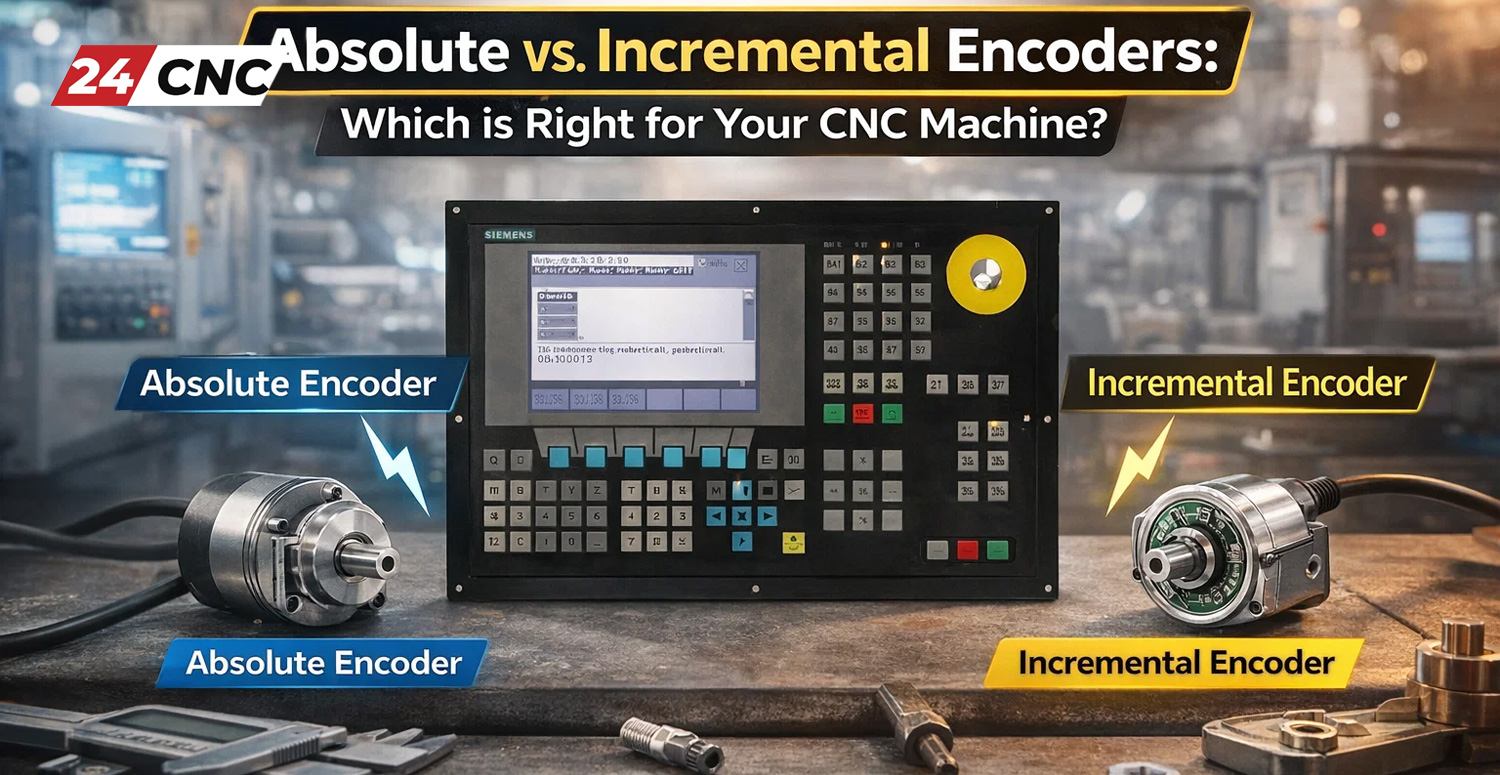
In the world of Computer Numerical Control (CNC), precision is everything. But how does your machine know exactly where the tool is located at any given millisecond? The answer lies in the feedback loop, specifically the rotary encoder. This device, usually mounted to the back of a servo motor, acts as the eyes of the control system, translating mechanical motion into electrical signals.
For engineers, retrofitters, and maintenance professionals, choosing the right feedback system is a critical decision. The debate usually narrows down to two distinct technologies: Absolute Encoders and Incremental Encoders. While both serve the same fundamental purpose—tracking position and speed—they do so in radically different ways that impact machine startup times, complexity, and reliability.
In this guide, we will dissect the architecture of both encoder types, explore their integration with major systems like Fanuc™ and Mitsubishi, and help you determine which technology is best suited for your CNC application.
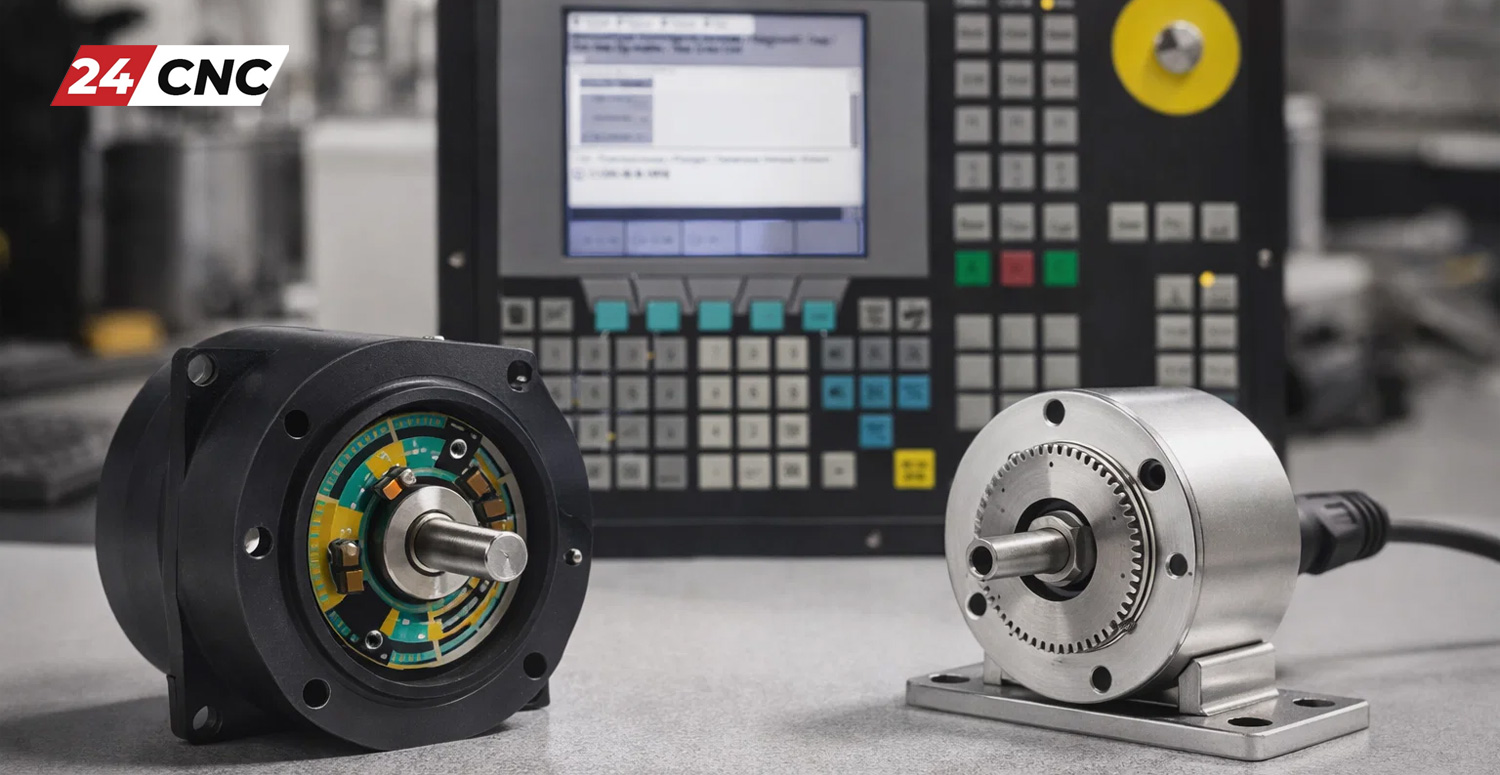
The Basics: What is a Rotary Encoder?
Before diving into the differences, it is essential to understand the shared function. A rotary encoder is an electro-mechanical device that converts the angular position or motion of a shaft into an analog or digital code. This data is sent via encoder cables to the CNC controller or servo drive.
The controller compares this “actual position” feedback with the “commanded position.” If there is a discrepancy (following error), the drive adjusts the current to the motor to correct it. Without a functioning encoder, a closed-loop CNC system cannot operate.
Deep Dive: Incremental Encoders
How They Work
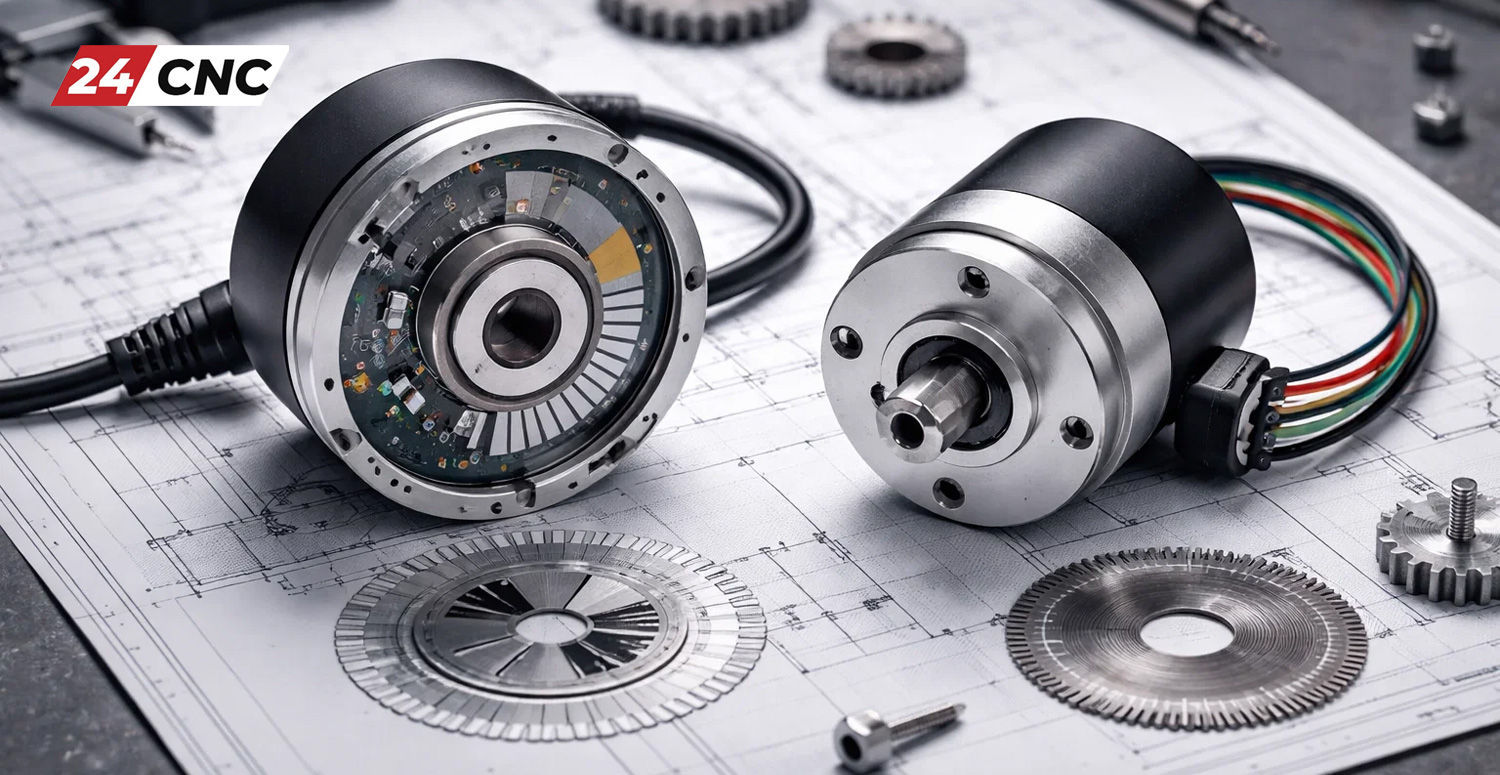
An incremental encoder works by generating a series of pulses as the shaft rotates. It typically uses a transparent disk with opaque lines (a graticule). As the disk spins, a light source and photo-detector generate a square wave signal (A and B channels) to determine direction and speed.
Critically, an incremental encoder serves as a “relative” measuring device. It knows that it moved, and how much it moved, but it does not inherently know where it is.
The “Homing” Ritual
The defining characteristic of a machine equipped with incremental encoders is the startup routine. Because the encoder loses its position data the moment power is cut, the CNC machine wakes up “blind.”
To establish a coordinate system, the operator must perform a Zero Return (Reference Return) procedure. The machine slowly moves each axis until it hits a physical limit switch or a reference pulse (Z-pulse) on the encoder. This resets the machine coordinate system to zero. For large gantries or complex multi-axis machines, this process consumes valuable production time every morning.
Pros and Cons
- Pros: generally lower cost; simpler electronics (fewer wires in older systems); highly reliable for speed control.
- Cons: Mandatory homing procedure after every power cycle; susceptible to missed pulses due to electrical noise; position is lost if power fails during machining.
Deep Dive: Absolute Encoders
How They Work
An absolute encoder is designed to assign a unique digital code to every distinct angle of the shaft. Unlike the simple pulse counting of its incremental cousin, the absolute encoder reads a complex pattern (often Gray code or binary) from the disk.
Crucially, this means the encoder knows its exact position immediately upon power-up. It does not need to count pulses from a starting point; it simply “reads” its current location.
Single-Turn vs. Multi-Turn
Standard absolute encoders are “single-turn,” meaning they know their position within 360 degrees. However, CNC axes rotate thousands of times. To track total travel, CNC systems use Multi-Turn Absolute Encoders. These devices track the total number of revolutions, even when the power is off.
Top-tier brands use specific methods to achieve this:
- Fanuc™ Pulse Coders: Most Fanuc Alpha/Beta i encoders use a battery backup system. A battery located in the servo amplifier or a separate battery box keeps the encoder’s internal memory alive during power outages.
- Mechanical Gears: Brands like Tamagawa or Heidenhain often use a geartrain inside the encoder to mechanically record rotations, eliminating the need for batteries in some models.
The “Instant-On” Advantage
The primary benefit for production environments is the elimination of the Zero Return procedure. When you power up a machine with absolute encoders, the control system reads the position data and is ready to cut chips immediately. This is vital for automatic tool changers (ATCs) and pallet changers where homing would be mechanically difficult or dangerous.
Pros and Cons
- Pros: No homing required; immediate startup; high position integrity; better safety (software limits are active immediately).
- Cons: Higher component cost; may require battery maintenance (Fanuc/Mitsubishi style); more complex communication protocols (serial data).
Critical Comparison: Operational Impact
When upgrading a machine or selecting components for a retrofit, understanding the operational differences is key. Here is how they stack up in a manufacturing environment.
1. Resilience to Noise
Incremental signals are susceptible to electrical interference (EMI). If an electrical spike mimics a pulse, the controller counts it, and the machine loses its true position (a “shift”). Absolute encoders typically use serial communication protocols (like SSI, EnDat, or Fanuc Serial), which are far more robust against noise. If a data packet is corrupted, the controller requests it again, rather than simply moving to the wrong spot.
2. Maintenance of Reference Points
With an incremental system, the “home” position is determined by a physical limit switch and a grid shift parameter. If the limit switch gets stuck or moves (due to chips or coolant), your machine’s zero point shifts. Absolute encoders define home via parameters in the controller memory. Once set, the zero point is fixed electronically and never drifts, provided the encoder is not mechanically decoupled.
3. Wiring and Cabling
Modern absolute encoders often use fewer wires than legacy incremental ones. While an old incremental encoder might need wires for A, A/, B, B/, Z, Z/, +5V, and 0V, a modern serial absolute encoder might only need two pairs for data and power. However, high-quality shielded cables are mandatory for reliable serial communication.

Technical Comparison Table
| Feature | Incremental Encoder | Absolute Encoder |
|---|---|---|
| Startup Routine | Mandatory “Zero Return” (Homing) | Instant startup (Position known) |
| Power Loss Behavior | Position is lost immediately | Position is retained (Battery/Mechanical) |
| Signal Type | Pulse Stream (A/B/Z Quadrature) | Digital Code / Serial Data |
| Cost | Generally Lower | Higher (Complex electronics) |
| Common Applications | Simple conveyors, Basic Speed Control | CNC Lathes, VMCs, Robotics, 5-Axis |
| Interference Immunity | Moderate (Susceptible to missed pulses) | High (Data checking protocols) |
Brand-Specific Considerations
Fanuc Systems
In the Fanuc ecosystem, terms like “Pulse Coder” are used. A standard Fanuc Pulse Coder (like the Alpha i series) is inherently an absolute device. However, it can be used as an incremental encoder if the battery is not connected. This flexibility allows one motor model to serve multiple purposes. If you see an APC (Absolute Pulse Coder) alarm on your screen (Alarm 300 series), it usually indicates a battery voltage drop in the absolute feedback circuit.
Mitsubishi Systems
Similar to Fanuc, Mitsubishi servos often utilize high-resolution absolute encoders (up to 22-bit or higher). These provide incredibly smooth motion control due to the massive number of feedback points per revolution. When replacing these units, it is critical to perform the absolute position initialization procedure, as the encoder needs to “learn” its relationship to the machine home position.
Frequently Asked Questions (FAQ)
Can I replace an Incremental Encoder with an Absolute one?
This is not a plug-and-play swap. The CNC controller and servo drive must support absolute feedback. Additionally, the wiring harness is likely different, and the system parameters will need significant modification to recognize the new data protocol. It is generally a complex retrofit.
Why does my Fanuc machine ask to “Reference Return” if it has Absolute Encoders?
If the absolute position data is lost (usually due to dead batteries while the machine was off), the system defaults to an “unreferenced” state. You will see an APC alarm (Alarm 300). You must replace the batteries and perform a Zero Return once to re-establish the absolute coordinates.
Are Absolute Encoders more expensive to maintain?
Slightly. The primary maintenance cost is the periodic replacement of backup batteries (usually every year or two). However, the cost of these batteries is negligible compared to the production time gained by eliminating daily homing routines.
Which encoder is better for a Hobby CNC router?
For hobbyists using stepper motors, open-loop is common (no encoder). If upgrading to servos, incremental encoders are the standard choice due to lower cost and simpler integration with hobby-grade controllers like Mach3 or GRBL, which may not support complex absolute serial protocols.
Conclusion: Making the Right Choice
The choice between Absolute and Incremental encoders ultimately depends on your application’s requirements for efficiency and budget.
If you are building a simple automated jig or a budget-conscious retrofit where a 2-minute startup routine is acceptable, an incremental encoder offers a robust and cost-effective solution. However, for industrial machining centers, high-speed turning centers, and any environment where “time is money,” the absolute encoder is the undisputed standard. The ability to resume machining instantly after a power failure or E-stop without re-homing is a productivity advantage that pays for the hardware difference many times over.
Need a Replacement Encoder Fast?
Whether you need a legacy Incremental unit or a modern Fanuc Beta i Absolute Pulse Coder, we have the stock to minimize your downtime.
Leave a comment
Your email address will not be published. Required fields are marked *