
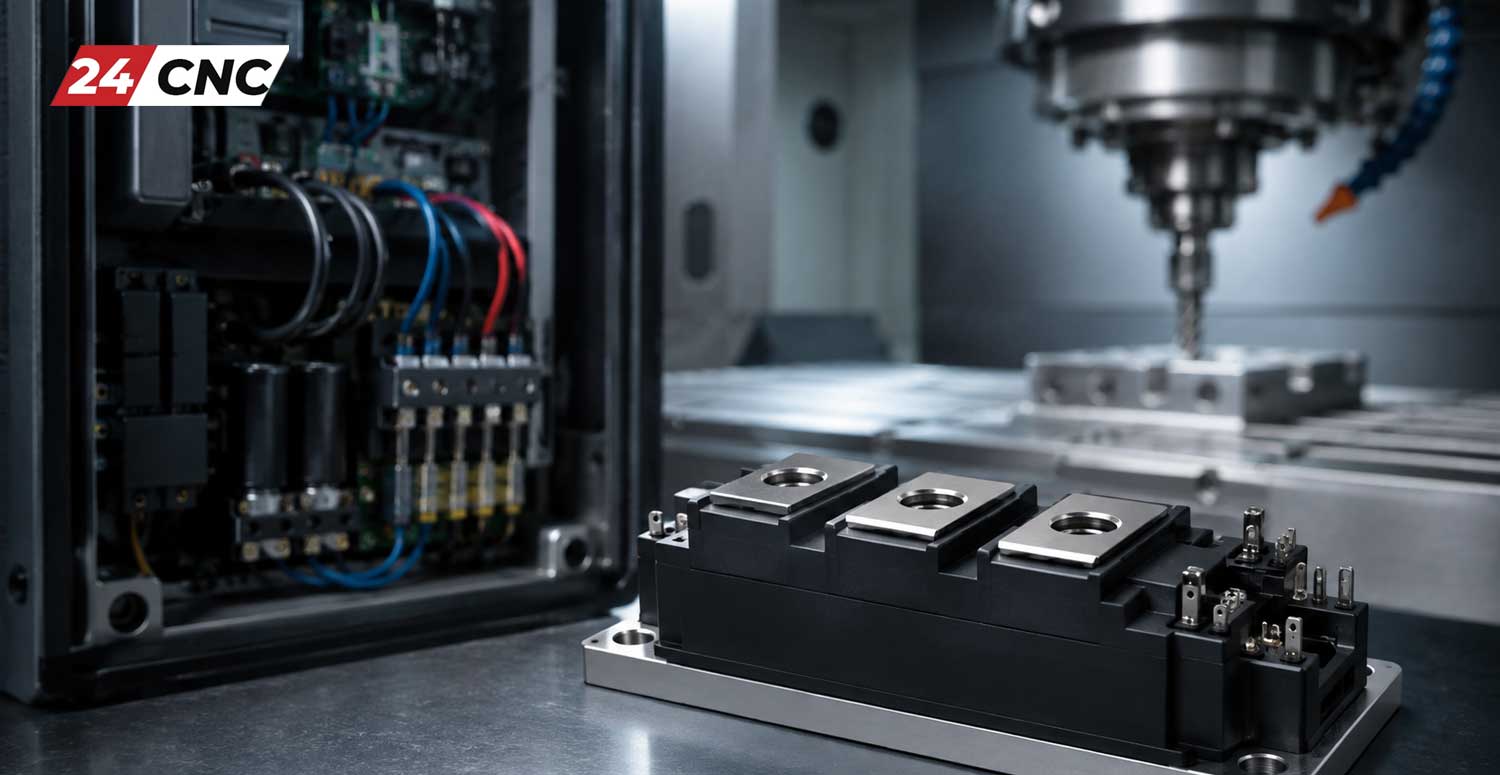
In the high-stakes environment of industrial automation, CNC (Computer Numerical Control) machines are expected to deliver microscopic precision while manipulating immense mechanical forces. Behind the smooth, powerful movements of a machine tool’s axes and spindles lies a complex electrical ecosystem. If you strip away the metal covers of a CNC servo amplifier or drive, you will find the critical component responsible for directing raw electrical power to the motors: the IGBT module.
For maintenance engineers diagnosing drive faults, procurement specialists sourcing replacement components, and workshop owners looking to understand machine downtime, understanding IGBT modules in CNC drives is essential. This comprehensive guide will explore the physics behind these electronic switches, their specific role within CNC motion control, how to identify failures, and best practices for testing and replacement.
What is an IGBT Module?
IGBT stands for Insulated-Gate Bipolar Transistor. In the simplest terms, an IGBT is a high-speed, high-power electronic switch. It combines the best characteristics of two different types of transistors:
- MOSFET (Metal-Oxide-Semiconductor Field-Effect Transistor): Known for its fast switching speeds and requiring very little power to turn on (high input impedance).
- BJT (Bipolar Junction Transistor): Known for its ability to handle very high currents and voltages with low power loss during conduction.
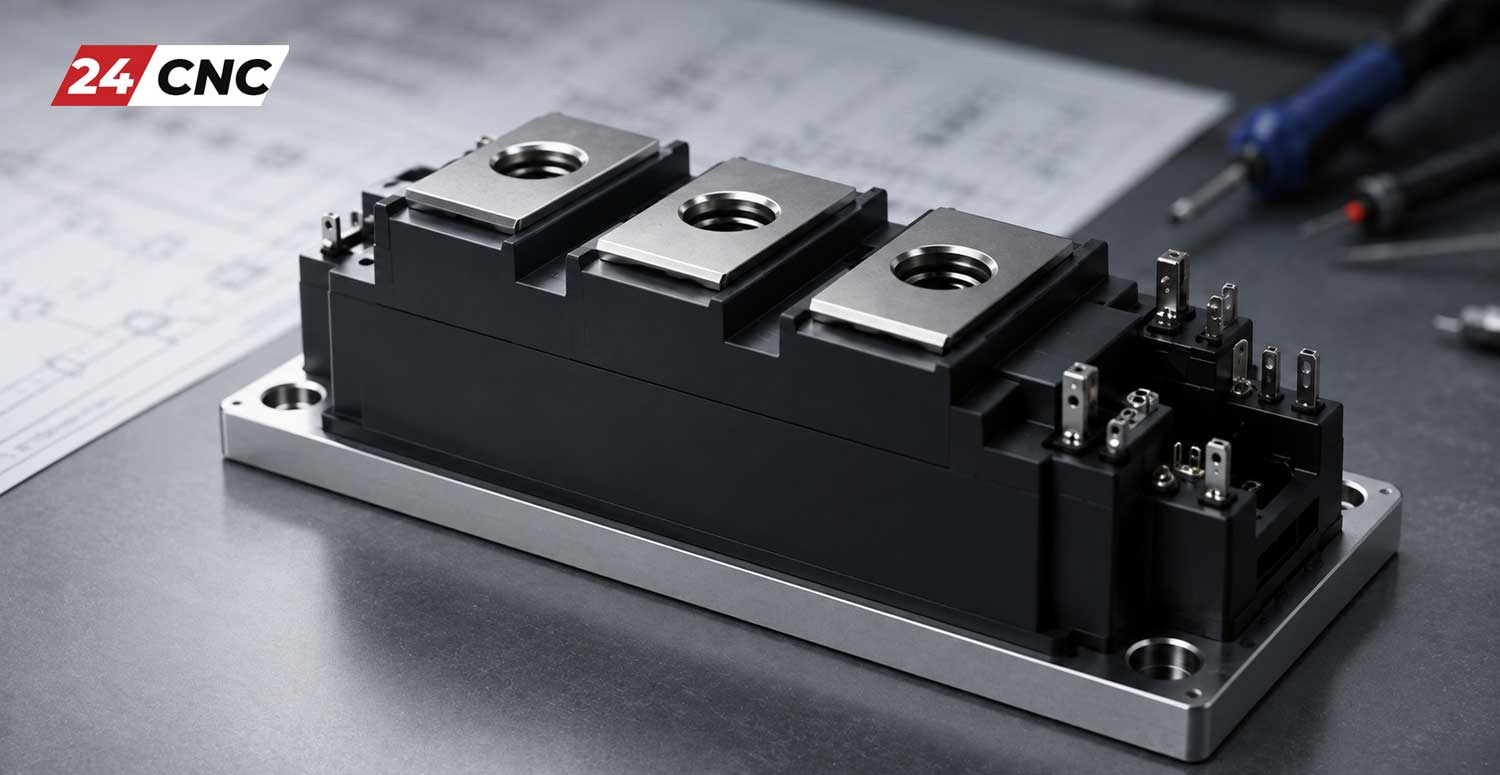
By merging these technologies, the IGBT provides an ideal solution for industrial power electronics. It can switch extremely high voltages and currents on and off thousands of times per second, controlled by a very small voltage signal from the CNC controller. In modern CNC applications, these transistors are rarely sold as single discrete components. Instead, they are packaged into IGBT Modules or Intelligent Power Modules (IPMs), which combine multiple IGBTs (typically six for a 3-phase motor), freewheeling diodes, and often the gate drive circuitry into one thermally optimized package.
How IGBTs Work Inside a CNC Drive
To understand the function of an IGBT, you must understand the basic architecture of a CNC amplifier. Whether it is a spindle drive or a servo drive, the process of controlling a motor involves three main electrical stages:
1. The Rectifier Stage
The drive takes incoming AC power from the factory floor (e.g., 3-phase 220V or 380V) and passes it through a diode bridge rectifier. This converts the alternating current (AC) into raw direct current (DC).
2. The DC Bus (DC Link)
The raw DC voltage is smoothed out by large capacitors. This creates a stable reservoir of high-voltage DC power, often referred to as the DC Bus. The voltage here is typically derived by the equation $V_{dc} \approx V_{ac} \times \sqrt{2}$. For a 220V system, the DC bus is roughly 310V to 325V.
3. The Inverter Stage (The IGBT’s Domain)
This is where the magic happens. A standard CNC servo motor requires 3-phase AC power to run, but the drive only has DC power available. The IGBT module is used to invert the DC back into AC. It does this through a process called Pulse Width Modulation (PWM).
The CNC controller sends low-voltage firing signals to the IGBT’s gate. The IGBTs switch the high DC voltage on and off at incredibly high frequencies (often between 4 kHz and 16 kHz, known as the switching frequency, $f_{sw}$). By varying the width of these high-voltage pulses, the IGBT module simulates a smooth, sinusoidal AC waveform that drives the motor. Because they switch so fast and handle so much current, the internal power loss ($P_{loss}$) generates significant heat, which is why IGBT modules are always mounted to massive aluminum heatsinks.
Key Specifications of IGBT Modules
When selecting or replacing an IGBT in a CNC amplifier or inverter, several technical specifications must perfectly match the requirements of the drive:
- Collector-Emitter Voltage ($V_{CES}$): The maximum voltage the IGBT can block when it is turned off. A 200V-class drive typically uses 600V rated IGBTs, while a 400V-class drive uses 1200V rated IGBTs to provide a safety margin against voltage spikes.
- Continuous Collector Current ($I_C$): The maximum continuous current the module can carry. This is directly related to the horsepower or kilowatt rating of the drive.
- Switching Frequency ($f_{sw}$): How fast the module can turn on and off without overheating. Higher frequencies result in smoother motor movement and less audible noise but generate more heat in the drive.
- Thermal Resistance ($R_{th}$): A measure of how efficiently the module transfers heat from the internal silicon chips to the external baseplate. Efficient thermal dissipation is critical for longevity.
Common Causes of IGBT Failure in CNC Machines
IGBT modules are robust, but they operate under extreme electrical and thermal stress. When a CNC machine throws an overcurrent or short-circuit alarm, the IGBT is often the culprit. Understanding why they fail can help prevent future breakdowns.
1. Thermal Overload (Overheating)
Heat is the number one enemy of silicon components. If the cooling fans on a Fanuc drive fail, or if the heatsink becomes clogged with oily workshop dust, the IGBT cannot dissipate its heat. The silicon junctions eventually melt, causing a catastrophic short circuit.
2. Voltage Spikes and Transients
Industrial power grids are notoriously noisy. Lightning strikes, switching heavy loads, or sudden deceleration of large spindle motors (regenerative energy) can cause massive voltage spikes on the DC bus. If this voltage exceeds the $V_{CES}$ rating of the IGBT, it will punch through the silicon structure and destroy the component.
3. Motor and Cable Short Circuits
The IGBT is directly connected to the servo motor via the power cables. If the motor windings break down and short to ground, or if coolant penetrates the motor power connector, the resulting short circuit will pull an infinite amount of current through the IGBT. While modern Intelligent Power Modules (IPMs) have internal short-circuit protection, a severe short can still blow the IGBT before the protection circuit reacts.
Diagnosing a Faulty IGBT Module
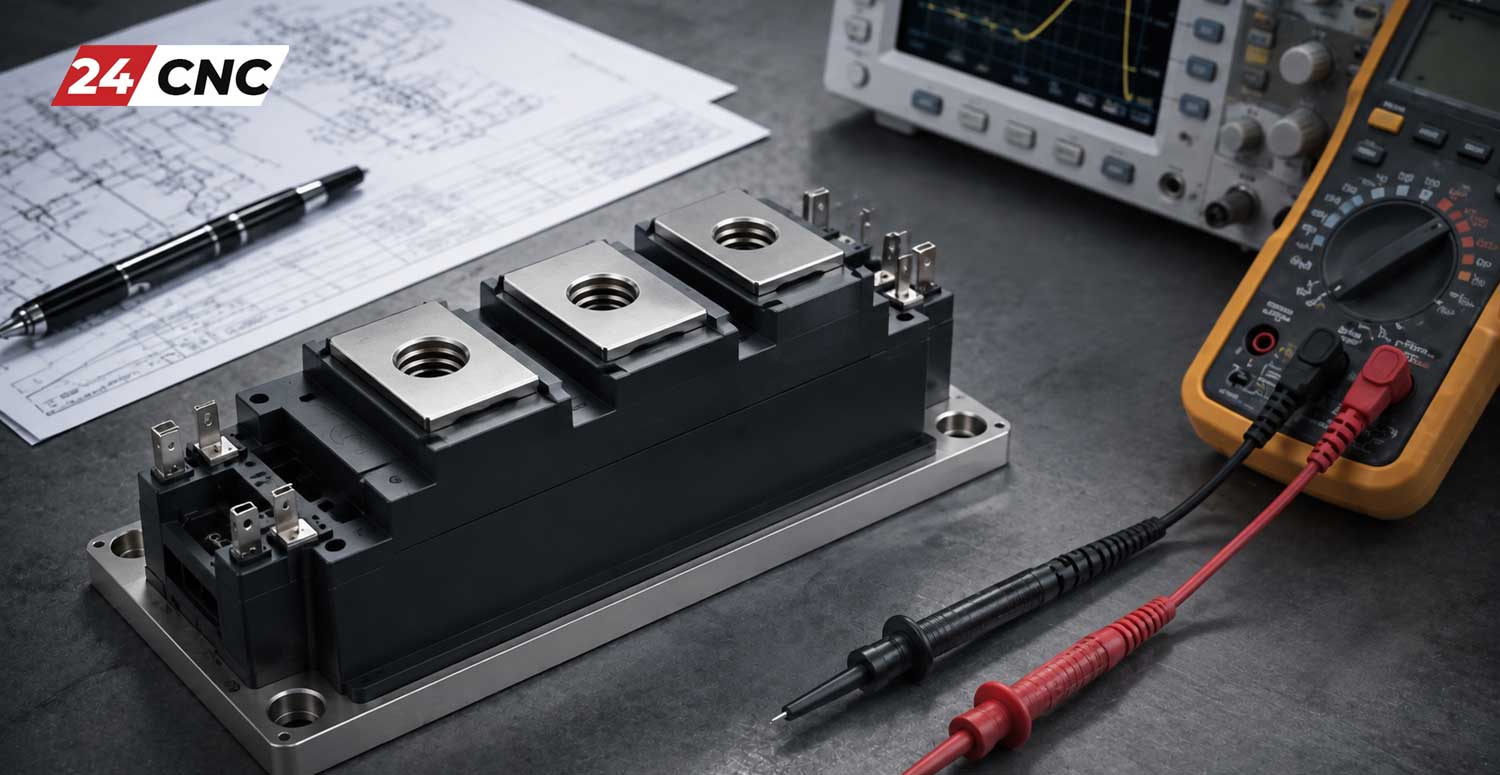
If you are experiencing drive alarms and suspect a blown IGBT, you can perform a static check using a standard digital multimeter. Note: Always ensure all power is disconnected and the DC bus capacitors are fully discharged before testing.
To learn more about tracking down drive faults, refer to our guide on how to diagnose and troubleshoot CNC servo amplifier alarms. Generally, testing an IGBT involves:
- Setting your multimeter to the “Diode Test” function.
- Testing between the Collector and Emitter terminals to check the internal freewheeling diode. You should see a standard diode voltage drop (e.g., 0.3V to 0.7V) in one direction, and an open circuit (OL) in the reverse direction.
- Testing between the Gate and the Emitter. This should always measure as an open circuit (high resistance). If you read a short circuit (close to zero ohms) here, the internal gate oxide layer is ruptured, and the module is dead.
Technical Comparison: IGBT vs. MOSFET vs. BJT
To understand why IGBTs are the standard in CNC drives, let’s compare them to the other common types of power transistors.
| Characteristic | MOSFET | BJT (Bipolar Transistor) | IGBT (Used in CNC) |
|---|---|---|---|
| Voltage & Current Range | Low to Medium (Excellent below 200V) | High Voltage, High Current | High Voltage, High Current (Standard 600V – 3300V) |
| Switching Speed | Extremely Fast (MHz range) | Slow | Medium to Fast (Typical 4kHz – 20kHz) |
| Drive Circuit Complexity | Simple (Voltage controlled) | Complex (Current controlled) | Simple (Voltage controlled gate like a MOSFET) |
| Conduction Losses (Heat) | High at high voltages ($R_{DS(on)}$ increases) | Low | Low (Like a BJT, highly efficient for CNC loads) |
Intelligent Power Modules (IPMs) and Hybrid ICs
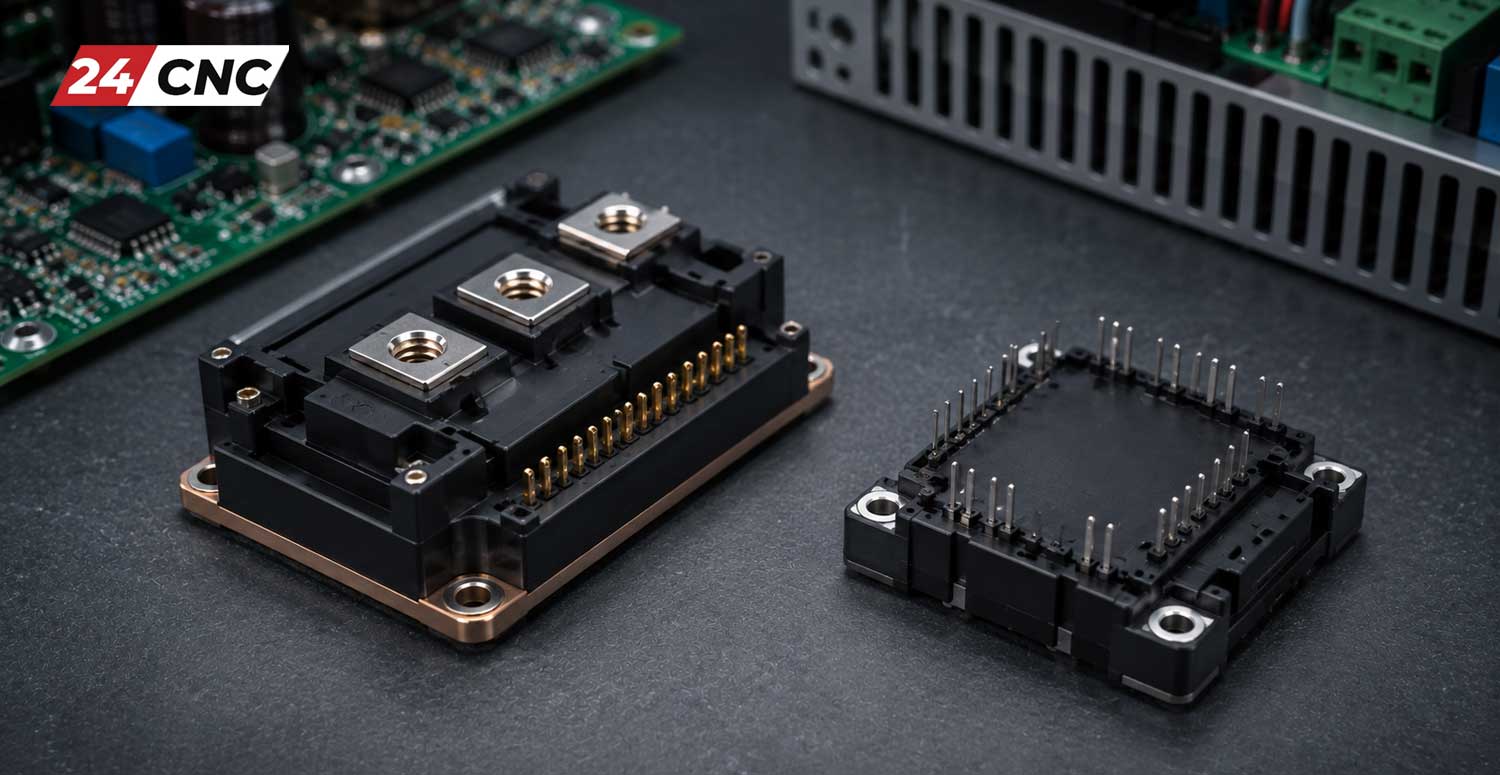
In modern CNC equipment, especially compact servo drives from brands like Mitsubishi or Fanuc, you will often find that the IGBTs are packaged into Intelligent Power Modules (IPMs). An IPM takes a standard IGBT module and embeds a Hybrid IC (Integrated Circuit) directly inside the package.
This hybrid IC contains the gate driving circuitry, overcurrent protection, short-circuit protection, and thermal monitoring. If the IPM detects that the internal temperature is too high or the current is spiking dangerously, the internal IC will shut down the IGBTs immediately and send an alarm signal back to the main control board, often saving the drive from catastrophic explosion.
Frequently Asked Questions (FAQ)
Can I replace just one blown IGBT inside a module?
No. IGBT modules are encapsulated and sealed at the factory. If one transistor within the 6-pack module fails, the entire module must be desoldered or unbolted from the drive and replaced as a single unit.
Why did my new IGBT blow immediately after installation?
This is a common issue. If the original IGBT blew due to a shorted servo motor or a damaged gate-drive circuit on the main board, simply replacing the IGBT without fixing the root cause will instantly destroy the new module. Always test the motor and inspect the gate firing circuit (using an oscilloscope) before powering up a repaired drive.
Do I need to apply thermal paste when installing a new IGBT?
Absolutely. A very thin, even layer of high-quality thermal compound must be applied between the IGBT baseplate and the drive’s aluminum heatsink. Without it, microscopic air gaps will prevent heat transfer, causing the new module to overheat and fail quickly.
How do I know the correct part number for my module?
The part number is laser-etched or stickered directly on the plastic housing of the IGBT. It is crucial to match this exact number (e.g., Fuji Electric, Mitsubishi, or Infineon part numbers) to ensure identical voltage, current, and gate capacitance characteristics.
Need High-Quality IGBT Modules for Your CNC Drives?
Don’t let a blown power module keep your production line at a standstill. At 24CNC, we stock a vast inventory of genuine, industrial-grade IGBTs and Intelligent Power Modules for Fanuc, Mitsubishi, Siemens, and more.
Leave a comment
Your email address will not be published. Required fields are marked *