
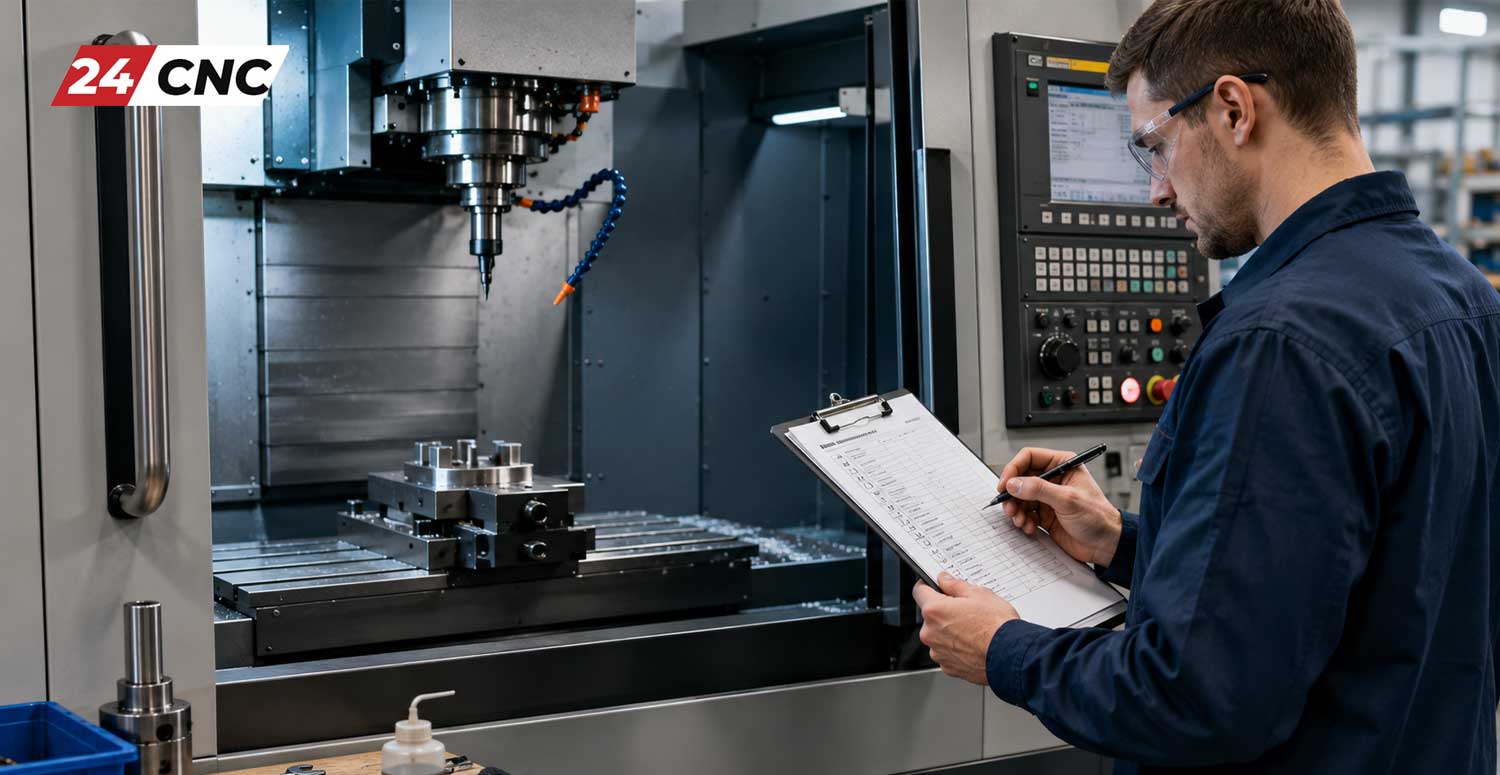
Operating a profitable machine shop relies on one absolute truth: if the spindle isn’t turning, you aren’t making money. Unexpected downtime is the quiet killer of manufacturing profitability. The most effective way to ensure your shop operates at peak efficiency, maintains tight tolerances, and protects its bottom line is by implementing a strict, comprehensive CNC Machine Maintenance Checklist covering daily, weekly, and monthly tasks.
Every modern CNC machine—whether it is a 3-axis mill, a complex 5-axis trunnion, or a high-speed turning center—is a complex integration of mechanical hardware, hydraulic systems, and sensitive electronics. Understanding the essential components of your CNC machine is the first step, but actively maintaining them is what separates successful businesses from struggling ones. When tolerances are measured in microns, even a microscopic layer of rust or a slightly clogged filter can lead to scrapped parts and blown profit margins.
In this comprehensive guide, we will break down the exact maintenance procedures required to keep your machinery in flawless condition, extend its lifespan by thousands of hours, and drastically reduce the need for emergency repairs.
Why Preventive Maintenance is the Ultimate ROI Generator
Many shop owners view maintenance as a chore that takes operators away from producing billable parts. This is a critical mathematical error. Reactive maintenance (fixing things only when they break) is exponentially more expensive than preventive maintenance. Furthermore, poorly maintained machines lose their accuracy, leading to a higher scrap rate and damaged reputations with clients.
To put this into perspective, we can calculate the return on investment (ROI) for preventive maintenance using a simple formula:
$$ROI = \frac{Estimated Downtime Loss – Preventive Maintenance Cost}{Preventive Maintenance Cost} \times 100$$
If a broken ball screw causes 3 days of downtime resulting in $\$6,000$ in lost revenue and a $\$4,000$ emergency repair bill, your total loss is $\$10,000$. If spending $15$ minutes a day and $\$50$ a month on proper lubrication could have prevented this, the mathematical justification for a strict maintenance schedule becomes undeniable.
Additionally, tracking your Mean Time Between Failures (MTBF) helps quantify the health of your equipment:
$$MTBF = \frac{Total Operational Time}{Number of Failures}$$
By strictly following a daily, weekly, and monthly checklist, you push your MTBF higher, ensuring predictable production schedules and reliable delivery times for your customers.

Daily CNC Machine Maintenance Checklist
Daily tasks should be performed by the machine operator either at the beginning of their shift or during the machine shutdown procedure. These checks take less than 15 minutes but are the frontline defense against catastrophic failures. A well-trained operator uses their eyes, ears, and hands to gauge the health of the machine daily.
- Check Lube Levels (Way Lube and Pneumatic Oil): Verify that the way lube (spindle oil, hydraulic oil) is at the appropriate level. Running a machine dry will destroy the linear guideways and ball screws in a matter of hours. Ensure the pneumatic lubricator cup has oil to keep air valves shifting smoothly.
- Clean Chips from the Enclosure and Way Covers: Do not let chips build up over telescopic way covers. Hot chips can melt through wiper seals, allowing coolant and fine metal dust to enter the ball screw housing. Clear the table and fixtures completely using a washdown hose rather than just an air gun, which can blast chips past seals.
- Manage Coolant Health (Concentration and Tramp Oil): Use a refractometer to ensure your coolant is mixed to the manufacturer’s recommended Brix percentage (usually between $6\%$ and $10\%$). Improper coolant levels lead to premature tool wear and rust on the machine table. Additionally, run your oil skimmer daily to remove “tramp oil” (way lube that drips into the coolant tank) to prevent anaerobic bacterial growth and foul odors.
- Wipe Down the Spindle Taper and Tool Holders: Use a dedicated spindle taper wiper to remove any oil, coolant, or micro-chips. A dirty taper causes tool runout, which degrades part finish, breaks micro-endmills, and damages the delicate spindle bearings.
- Inspect the Control Panel and HMI: Ensure the LCD screen and the physical keyboards and keypads are free of heavy coolant residue. Aggressive cutting fluids can degrade rubber membranes over time.
- Empty the Chip Conveyor / Bin: Prevent overflow, which can back up into the machine casting, jam the conveyor motor, and block coolant return drains causing the tank to run dry and cavitate the high-pressure pump.
- Listen to the Machine: Run a warm-up spindle cycle. Listen for unusual grinding, whining, or vibration. Early detection of spindle bearing failure often starts as a faint harmonic whine.
Weekly CNC Machine Maintenance Checklist
Weekly tasks require a slightly deeper inspection. These are best performed at the end of the week before shutting the shop down for the weekend, ensuring the machine sits clean and protected over non-operational days.
- Clean or Replace Cabinet Filters: The electrical cabinet houses your drives, power supplies, and main control boards. The cooling fans pull air through filters to keep these components from overheating. Clogged filters are the number one cause of drive failures. Vacuum them out or wash them if they are reusable polyurethane foam.
- Check Pneumatic Systems and Air Pressure: Verify that your incoming shop air is clean, dry, and regulated to the correct PSI (typically around $85-90$ PSI depending on the machine). Empty the water trap on the machine’s air regulator. Moisture in the pneumatic lines will rust the internal directional valves and cause automatic tool change (ATC) failures.
- Inspect Way Covers and Wipers: Fully extend the machine axes (X, Y, and Z) and visually inspect the telescopic covers. Look for dents, tearing rubber wipers, or sluggish movement. If the covers bind, they need immediate repair before they crush under rapid rapid-traverse speeds.
- Clean and Inspect the Tool Changer (ATC): Remove any chips or debris from the automatic tool changer carousel. Clean the tool holder gripping mechanisms (fingers or pots). Inspect the pull studs (retention knobs) on your tool holders for fretting or excessive wear. A snapped pull stud during a tool change is a catastrophic event.
- Inspect the Handwheel (MPG): The Manual Pulse Generator is handled constantly. Check its cable for any fraying, exposed shielding, or sharp kinks that could lead to intermittent connection issues, which might cause axes to jump unexpectedly during manual setup.
- Check Spindle Chiller Fluid: If your machine is equipped with a high-speed spindle, it likely has a dedicated chiller unit. Check the fluid level and ensure the radiator fins are blown clear of shop dust.
Monthly and Bi-Annual CNC Machine Maintenance Tasks
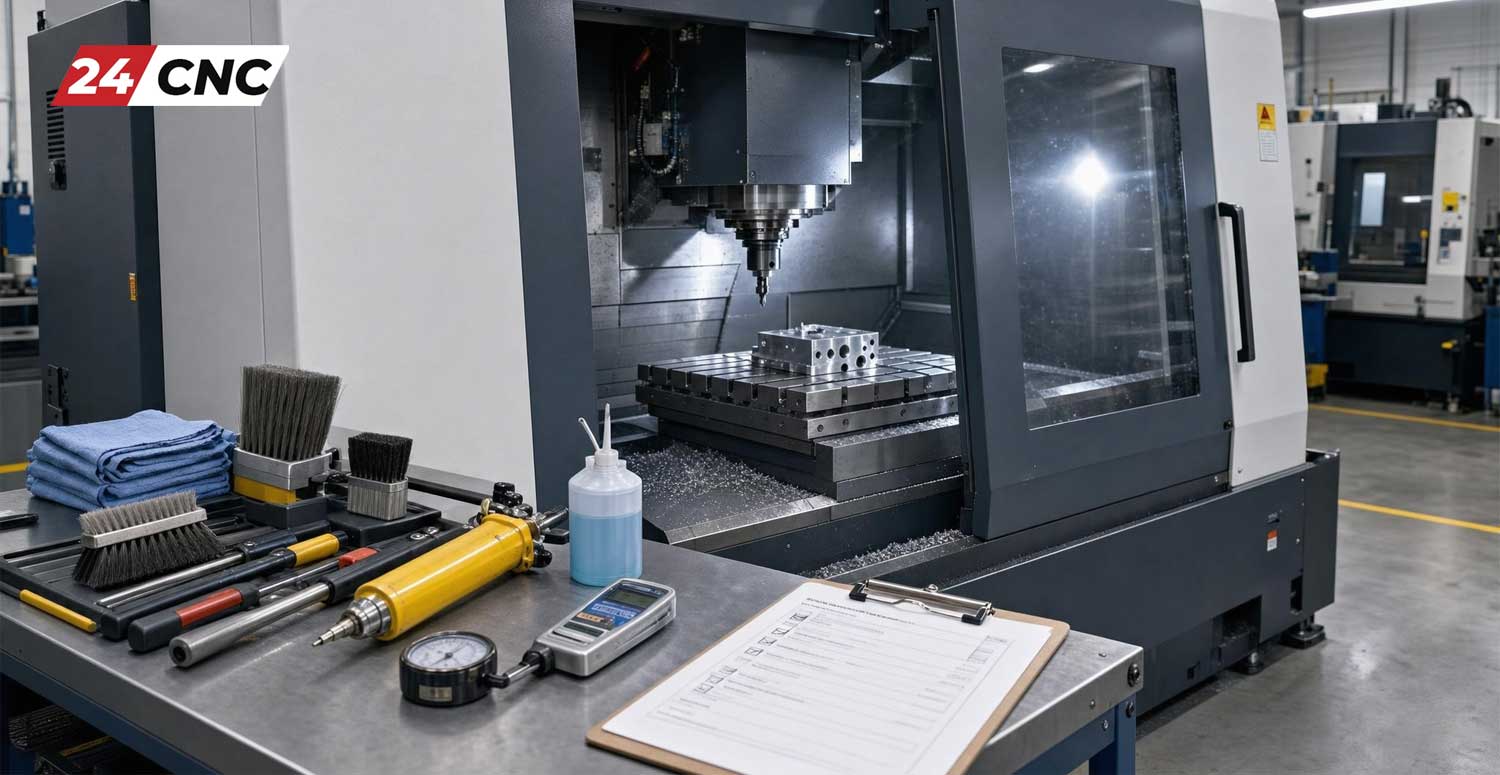
Monthly and bi-annual maintenance should be scheduled downtime. This is when shop managers or dedicated maintenance technicians dive into the electrical, mechanical, and structural health of the machine. This level of maintenance is what pushes a machine’s lifespan past the 15-year mark.
Electrical Cabinet and Control System Inspection
Power off the machine at the main breaker and perform a visual inspection of the main electrical cabinet. Look for any scorch marks, swollen capacitors on the power supply units, or loose terminal block connections (vibration loosens screws over time). Heat is the enemy of electronics. Verify that the drive controller fans mounted directly to your servo amplifiers and spindle drives are spinning freely and not making grinding noises.
Ensure that you have recent backups of your machine parameters, macros, and pitch error compensation tables on an external USB or secure server. Whether you run a Fanuc™ controller, a Siemens controller, or Mitsubishi, a dead CMOS battery can wipe your machine’s SRAM memory, turning it into an expensive paperweight until parameters are painstakingly manually restored. Batteries should be replaced annually with the machine powered ON.
Mechanical, Hydraulic, and Geometric Checks
Over time, the physical geometry of your machine can drift due to minor crashes, heavy roughing cuts, or simply the concrete foundation settling.
- Check Machine Level: Use a precision machinist level (accurate to $0.0005$ inches per foot) to verify the machine casting has not twisted. An unlevel machine cannot interpolate perfect circles and will suffer from accelerated wear on the linear guides. Adjust the leveling feet as necessary.
- Hydraulic System Maintenance: For CNC lathes with hydraulic chucks and tailstocks, check the hydraulic oil condition. If it is milky, water has contaminated the system. Replace the inline hydraulic filters to maintain clamping pressure.
- Inspect Belts and Pulleys: Check the tension and condition of spindle drive belts and axis servo belts. Fraying or loose belts cause backlash and vibration that transfers directly into your machined parts, destroying surface finish.
- Encoder Verification: If you notice dimensional drift in your parts or following errors on the screen, your feedback system may be failing. Understanding how to troubleshoot inaccurate readings from a rotary encoder is vital. Check the encoder cables for ingress of coolant, which can short out the optical sensor signal.
- Ball Bar Testing (Bi-Annual): Hire a technician or use your own equipment to perform a Renishaw ball bar test. This maps the exact geometry of the machine during circular interpolation, revealing hidden backlash, servo mismatch, and scale errors.
Seasonal and Predictive Maintenance Considerations
Beyond the standard calendar checklist, advanced machine shops adapt their maintenance to the seasons and adopt modern predictive techniques.
Seasonal Shifts: In the winter, shop temperatures drop, causing hydraulic fluids and way lubes to thicken. Allow machines longer warm-up cycles before running at $100\%$ rapid speeds to prevent blowing way lube lines. In the summer, ambient heat combined with cutting heat puts immense strain on electrical cabinets. Ensure shop ventilation is adequate and chiller set points are tracking ambient temperatures properly to prevent spindle thermal growth.
Predictive Maintenance (Industry 4.0): Moving beyond preventive maintenance, predictive maintenance utilizes sensors to predict failures *before* they happen. Installing vibration sensors on spindle housings can detect degrading bearings months before they fail. Using a thermal imaging camera on the electrical cabinet during a heavy cut can identify failing contactors or IGBT modules that are generating excess heat due to internal resistance.
Technical Comparison: Proactive Maintenance vs. Reactive Repair
To further illustrate the importance of these daily, weekly, and monthly checklists, let’s look at a technical comparison of what happens when you maintain a component versus letting it run to failure.
| Component | Proactive Checklist Action | Reactive Failure Scenario | Cost Impact |
|---|---|---|---|
| Servo Amplifier / Drive | Monthly filter change and fan inspection. Vacuuming cabinet dust. | Overheating blows the internal circuitry, requiring a complete drive rebuild or replacement. | Extremely High (Downtime + Replacement Drive) |
| Ball Screws & Linear Ways | Daily way lube check. Weekly wiper inspection. Clearing chips. | Dry running strips the ball bearings, causing massive backlash and geometric failure. | High (Requires laser calibration and mechanical rebuild) |
| Rotary Encoders / Scales | Bi-annual cable inspection and ensuring housing is free of coolant. | Coolant shorts the rotary encoder, causing runaway axes and severe machine crashes. | High (Tooling, Workpiece, and Spindle Damage) |
| Electrical Fuses | Keeping spares of standard fuses in the shop inventory. | A $5 blown fuse stops production for 2 days while waiting for expedited shipping. | Medium (Lost production time and missed deadlines) |
| Spindle Drawbar / Belleville Washers | Annual drawbar force test using a dynamometer. | Loss of clamping force causes the tool to pull out during a heavy cut, destroying the part and spindle taper. | Extremely High (Spindle regrind or replacement) |
Sourcing Reliable Spares for Routine Maintenance
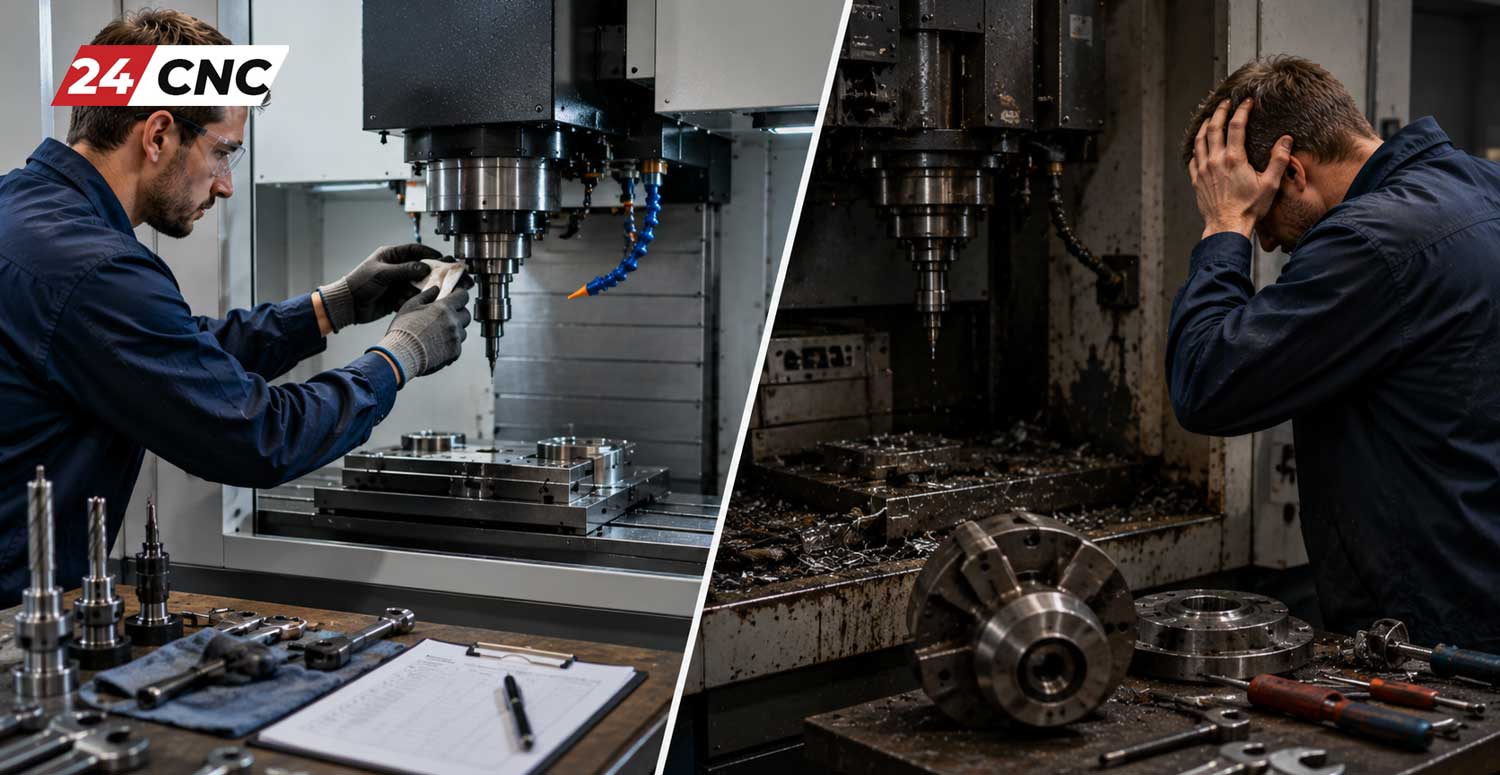
A crucial part of any maintenance checklist is having the right parts on hand before you need them. Treating electronic components like consumable end-mills is a strategic advantage. You should always maintain a small, climate-controlled stock of essential spares.
For shops running industry-standard equipment, knowing exactly where to buy high-quality CNC parts online minimizes panic during a breakdown. Keep extra cabinet fans, a spare power supply, replacement limit sensors, and a backup MPG handwheel in your tool crib. When a minor component fails during a late-night shift, your operator can swap it out in minutes rather than halting production until the morning. Establish a relationship with a reliable supplier so that when major components like servos or drives fail, you have a direct line to fast replacements.
Frequently Asked Questions (FAQ)
How often should I change the coolant in my CNC machine?
Complete coolant sump cleanouts should generally happen every 6 to 12 months, depending on the material you cut and how well you maintain daily concentration levels. If the coolant smells rancid (like rotten eggs) or separates, it must be changed immediately to prevent rust on the machine and severe bacterial infections (dermatitis) for your operators.
What is the most commonly overlooked CNC maintenance task?
Cleaning and replacing electrical cabinet cooling fans and filters. Dust and oily vapor bypass clogged filters, coating delicate servo drives and main boards. This traps heat and leads to premature thermal failure of expensive IC chips and drives. Replacing a $20 filter can save a $3,000 drive.
How do I know if my CNC machine needs a geometry check?
If your parts are suddenly coming out tapered, if you cannot interpolate a perfectly round hole (circles look slightly oval), or if you experience unexplained chatter and tool wear on one side of a cut, your machine may be out of level, or your spindle may have lost tram due to a minor crash.
Why are my control panel buttons sticking or failing to register?
Coolant and cutting oils degrade the rubber membranes and plastics used in standard keypads over time. The oil penetrates the seal and shorts the contact pad. Prevent this by having operators wipe their hands or use clean gloves. If buttons fail entirely, you will need to replace the specific keyboard membrane or tactile switches behind the panel.
When should I replace my CNC backup batteries?
Always replace CNC control and absolute encoder batteries once a year. Do not wait for the low battery alarm on the screen. CRITICAL: Always replace the batteries while the main power to the machine is turned ON. If you remove batteries while power is off, you will instantly lose all parameter and position data.
Conclusion: Build a Culture of Total Productive Maintenance (TPM)
Implementing a strict CNC machine maintenance checklist is not just about turning wrenches and topping off oil; it is about building a culture of accountability within your machine shop. This concept is often referred to as Total Productive Maintenance (TPM). In a TPM environment, machine operators are empowered to take ownership of their equipment. They are trained to perform daily and weekly checks, freeing up dedicated maintenance staff to focus on complex diagnostics, monthly alignments, and strategic upgrades.
When operators take pride in the cleanliness and functionality of their machines, scrap rates plummet, tool life extends, and overall profitability soars. A clean machine makes it incredibly easy to spot an oil leak, a loose bolt, or a fraying wire before it becomes a disaster. Print out your daily, weekly, and monthly checklists, place them in protective plastic sleeves, attach them to clipboards on every single machine in your facility, and make them a strict, non-negotiable part of your daily production process.
Don’t Let a $10 Part Cost You $10,000 in Downtime
Proactive maintenance requires the right parts at the right time. Prepare for the inevitable by maintaining a strategic inventory of critical spares. Stock your tool crib with premium industrial electronics, cooling fans, encoders, fuses, and replacement drives to ensure your spindles never stop turning.
Leave a comment
Your email address will not be published. Required fields are marked *