

When designing, building, or upgrading a CNC machine, few components dictate the final accuracy of your workpieces as heavily as the linear motion system. At the heart of this system lies the ball screw—a mechanical marvel that translates rotational motion into linear motion with minimal friction. However, not all ball screws are created equal. If you have spent any time sourcing parts for industrial automation, you have likely encountered the great debate: C3 vs C5 vs C7 ball screw precision grades.
Understanding these precision grades is absolutely vital. As one of the most essential components of a CNC machine, choosing the wrong grade can lead to unacceptable tolerances, scrapped parts, or unnecessary overspending. In this comprehensive guide, we will break down the JIS (Japanese Industrial Standard) ball screw grading system, analyze the differences between rolled and ground manufacturing processes, and help you determine exactly which grade is right for your specific engineering application.

Understanding the JIS Ball Screw Grading System
The “C” grades assigned to ball screws—typically ranging from C0 to C10—are defined by the Japanese Industrial Standard (JIS B1192). This standard specifies the permissible lead error and positional accuracy of the screw over a specific length of thread, usually measured over a 300\text{ mm} travel distance. The lower the number, the higher the precision, the tighter the tolerance, and, predictably, the higher the cost.
Lead accuracy is fundamentally the difference between the theoretical distance the ball nut should travel per revolution and the actual distance it does travel. When a machine is interpolating complex geometries across multiple CNC machine axes, even microscopic errors compound rapidly. Therefore, matching the precision grade to your required machining tolerance is the first step in successful mechanical design.
The Manufacturing Process: Rolled vs. Ground Ball Screws
Before diving into the specific C3, C5, and C7 grades, we must address how these screws are manufactured, as the production method directly dictates the achievable grade.
Rolled Ball Screws (Cold Forging)
Rolled ball screws are produced by forcing a raw steel blank through rotating dies under immense pressure. This cold-forging process physically deforms the metal to create the thread profile. It is a highly efficient, fast, and cost-effective manufacturing method. Furthermore, the cold rolling process aligns the grain structure of the steel, resulting in a very durable surface with excellent wear resistance.
However, the violent nature of cold forging introduces internal stresses into the material, which can cause slight warping. While post-process straightening is performed, the process inherently cannot achieve the microscopic perfection required for ultra-high-precision applications. Most C7 and C10 ball screws are rolled.
Ground Ball Screws (Abrasive Machining)
Ground ball screws start their life similarly to rolled screws or are rough-cut on a lathe. But instead of cold forging, the final thread profile is meticulously carved away by a high-precision abrasive grinding wheel. This process removes material without inducing the massive structural stresses of rolling. Because grinding is a slow, highly controlled process, manufacturers can achieve exceptionally tight tolerances and incredibly smooth surface finishes.
The grinding process allows for the creation of C5, C3, C1, and even C0 ball screws. Because of the time and specialized machinery required, ground ball screws are significantly more expensive than their rolled counterparts.
Deep Dive: C7 vs C5 vs C3 Precision Grades
Let us examine the three most common grades used in industrial and prosumer CNC applications.
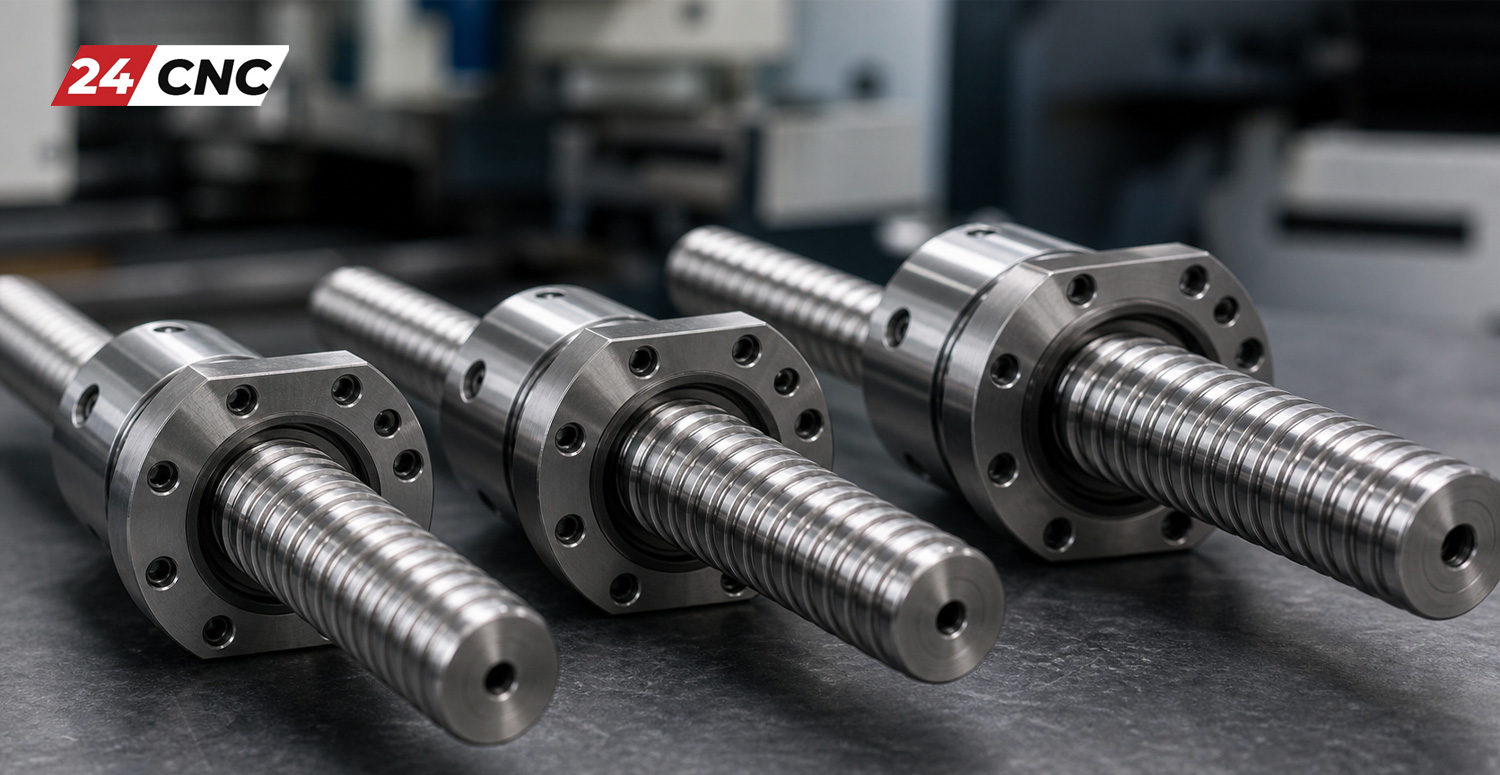
C7 Ball Screws: The Industry Standard for General Automation
The C7 grade is the undisputed king of the hobbyist, prosumer, and general automation worlds. Almost exclusively manufactured via the cold-rolling process, the C7 ball screw offers an outstanding balance between cost and performance.
- Tolerance: A C7 ball screw has a permissible lead error of roughly \pm 50\text{ \mu m} (microns) per 300\text{ mm} of travel. To put that in perspective, 50\text{ \mu m} is about 0.05\text{ mm} or 0.0019\text{ inches}.
- Backlash: Rolled C7 screws generally have single ball nuts with standard-sized bearings. Because the threads are not ground to absolute perfection, applying heavy preload to eliminate backlash can cause uneven wear or binding. Expect a standard backlash of around 0.015\text{ mm} to 0.03\text{ mm}.
- Ideal Applications: Woodworking CNC routers, plasma cutters, 3D printers, laser cutters, automated packaging machinery, and general pick-and-place robotics. If your final product tolerance allows for deviations of a few hundredths of a millimeter, C7 is the most logical and economical choice.
C5 Ball Screws: The Golden Mean
The C5 grade sits right at the critical transition point between standard machinery and high-precision machine tools. C5 ball screws can be either ultra-precision rolled or, more commonly, ground. They are the go-to choice when C7 simply isn’t accurate enough, but the budget cannot accommodate aerospace-grade components.
- Tolerance: A C5 ball screw typically boasts a lead error of just \pm 18\text{ \mu m} per 300\text{ mm} of travel (0.018\text{ mm}). This is nearly three times more accurate than a C7 screw.
- Backlash & Preload: Because the thread profile on a C5 screw is highly consistent, manufacturers can safely implement double ball nuts or use oversized balls to create a “preloaded” system. Preloading effectively eliminates axial play (zero backlash) while maintaining smooth operation.
- Ideal Applications: Standard CNC milling machines for metalworking, CNC lathes, precision XY stages, and industrial automation where repeatability is critical. If you are milling aluminum or steel parts that must fit together seamlessly, C5 is highly recommended.
C3 Ball Screws: Uncompromising Precision
When you enter the territory of the C3 grade, you are dealing exclusively with high-end, precision-ground ball screws. These components are masterpieces of mechanical engineering, designed for environments where thermal expansion, microscopic deflection, and infinitesimal errors matter.
- Tolerance: A C3 ball screw features an incredible lead error tolerance of just \pm 8\text{ \mu m} per 300\text{ mm} of travel (0.008\text{ mm}).
- Backlash & Preload: C3 systems are heavily preloaded and meticulously matched with their ball nuts at the factory. They offer true zero-backlash performance with incredibly smooth, rigid, and predictable motion profiles.
- Ideal Applications: Aerospace component manufacturing, medical device machining, high-end 5-axis CNC machining centers, semiconductor manufacturing equipment, and precision mold-making. C3 is required when your final part tolerances are measured in the single digits of microns.
Technical Comparison Table: C3 vs C5 vs C7
| Precision Grade | Tolerance (per 300mm) | Manufacturing Method | Backlash / Preload | Relative Cost |
|---|---|---|---|---|
| C7 | \pm 50\text{ \mu m} (0.050\text{ mm}) | Cold Rolled | Standard clearance; difficult to heavily preload | (Low) |
| C5 | \pm 18\text{ \mu m} (0.018\text{ mm}) | Precision Rolled or Ground | Zero backlash achievable; supports heavy preload | (Medium to High) |
| C3 | \pm 8\text{ \mu m} (0.008\text{ mm}) | Precision Ground | True zero backlash; ultra-rigid preloaded nut | (Very High) |
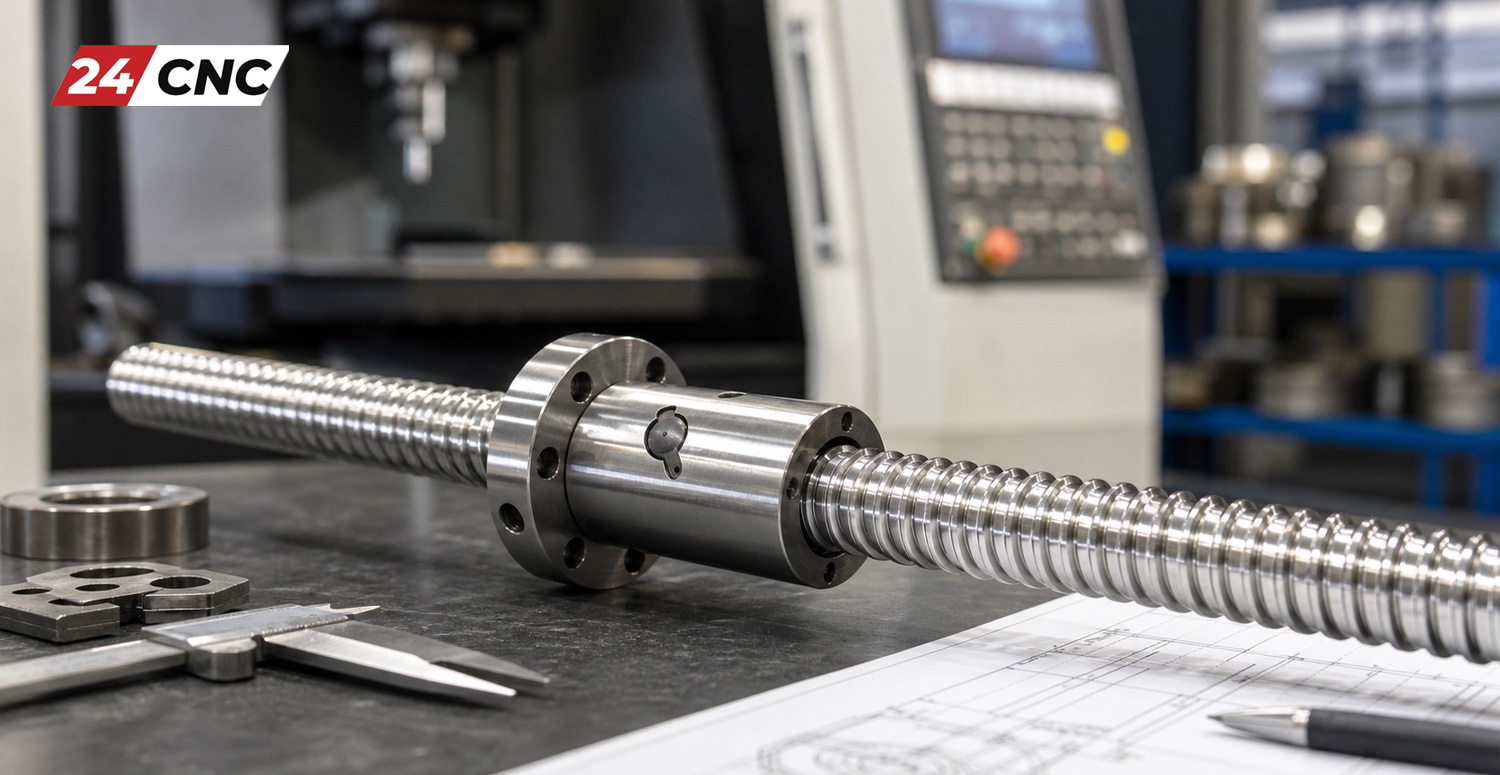
Key Factors in Choosing the Right Ball Screw
When engineering a mechanical system, looking at lead accuracy in a vacuum is a mistake. Several other critical factors interplay with the ball screw grade to dictate the final performance of your machine.
1. Synergy with Servo Motors and Encoders
A precision C3 ball screw is virtually useless if it is driven by a cheap, inaccurate motor. High-grade ball screws must be paired with industrial servo motors capable of micro-stepping or high-resolution positioning. Furthermore, the controller must receive accurate positional data. While modern servo motors have built-in encoders, ultra-high-precision machines often use a secondary external rotary encoder or linear glass scales to provide absolute closed-loop feedback, correcting even the \pm 8\text{ \mu m} deviations of a C3 screw.
2. Rigidity and Thermal Expansion
Friction generates heat. As a ball screw operates at high speeds, its temperature rises, causing the steel to expand. In a 1000\text{ mm} screw, a temperature rise of just 10^\circ\text{C} can cause linear expansion that dwarfs the manufacturing tolerances of a C3 grade screw. For this reason, high-end CNC machines often stretch the ball screw during installation to compensate for future thermal expansion, or utilize hollow ball screws with internal coolant flow.
3. Lubrication and Maintenance
Tighter tolerances require cleaner environments and better lubrication. A C7 rolled screw can handle a bit of dust and basic grease on a woodworking router. However, a C3 ground ball screw requires strict maintenance regimens, high-quality way oil, and robust wiper seals. Debris entering a highly preloaded C3 nut will cause catastrophic failure much faster than in a loosely toleranced C7 nut.
4. Controller Compensation
Advanced CNC controllers can actually map and compensate for the lead errors of a ball screw. This technique, known as “pitch error compensation” or “backlash compensation,” allows a well-calibrated machine using a C5 or C7 ball screw to achieve real-world accuracies much higher than their raw mechanical specs suggest. However, compensation cannot fix poor rigidity or unpredictable, varying backlash caused by uneven thread rolling.
Frequently Asked Questions (FAQ)
Can I upgrade my CNC router from C7 to C3 ball screws?
Technically yes, but it is rarely cost-effective for a standard router. The extreme precision of a C3 screw will be wasted if your machine’s frame flexes, your linear rails have play, or your spindle has runout. For most routers, upgrading to a double-nut C7 or a C5 grade is the most logical maximum upgrade path.
Does a C7 ball screw have zero backlash?
No. While they can be ordered with oversized balls to reduce play, a standard single-nut C7 rolled ball screw will have slight backlash (typically around 0.02\text{ mm}). If you need zero backlash on a C7, you must use a double-nut configuration with a spring or spacer preload, though this will increase friction and wear compared to a ground C5.
Why are ground ball screws (C3/C5) so much more expensive?
The abrasive grinding process is incredibly slow and requires massively expensive, highly specialized machinery operated in temperature-controlled environments. Rolled screws (C7) are cold-forged rapidly, making mass production cheap and efficient.
What happens if I use C7 ball screws for machining steel?
You can absolutely machine steel with C7 ball screws. The limitation will be your final surface finish and tolerance. For general brackets, plates, and hobbyist parts, C7 is fine. However, if you are machining mating aerospace components or engine blocks, the 50\text{ \mu m} lead error and inherent backlash of the C7 will likely push your parts out of acceptable tolerance limits.
Conclusion: Making the Right Investment
The choice between C3, C5, and C7 ball screw precision grades ultimately boils down to matching the mechanical realities of the component to the business realities of your project. If you are building automated equipment, 3D printers, or woodworking routers, the C7 rolled ball screw offers unbeatable value and durability.
For those stepping into serious metalworking, precision milling, or upgrading industrial machinery, the C5 ground ball screw hits the sweet spot—providing zero backlash and excellent tolerances without breaking the bank. Finally, for the pioneers in micro-machining, medical, and aerospace fields, the uncompromising, glass-smooth perfection of the C3 ground ball screw is non-negotiable.
Remember, a ball screw is only one piece of the puzzle. The fundamental principles of what is CNC machining dictate that the entire machine operates as a unified system. High precision grades demand equally rigid frames, flawless linear guides, and state-of-the-art closed-loop electronics.
Need High-Precision CNC Components?
Whether you are upgrading a router or rebuilding an industrial 5-axis milling center, we supply the professional-grade parts you need to achieve flawless accuracy.
Shop High-Quality CNC Parts Today
Worldwide Shipping | Expert Technical Support | Industrial Grade Quality
Leave a comment
Your email address will not be published. Required fields are marked *