
In the world of heavy CNC machining, precision and durability are not just goals; they are absolute necessities. The ability of a machine to hold tight tolerances under immense cutting forces is what separates a high-performance asset from a workshop liability. At the heart of this capability lies the linear motion system, and specifically, the linear guides. These components are the unsung heroes that guide the machine’s axes, ensuring every movement is smooth, accurate, and repeatable. However, not all linear guides are created equal, especially when dealing with the extreme demands of heavy-duty applications.
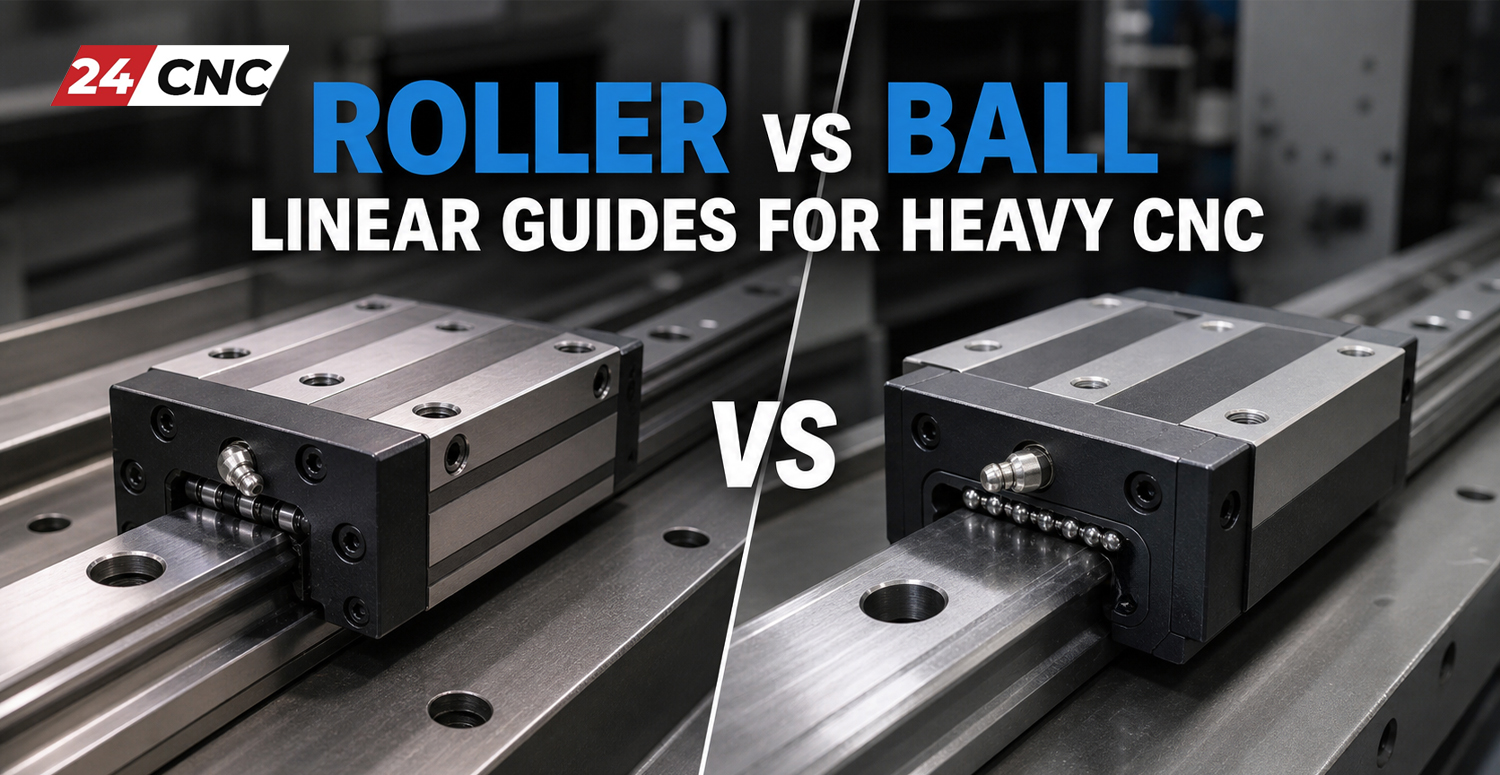
The primary debate in this high-stakes environment centers on two types of rolling elements: balls and rollers. Choosing between Roller Linear Guides and Ball Linear Guides is one of the most critical design and maintenance decisions for any heavy CNC machine. This choice directly impacts the machine’s rigidity, load capacity, speed, and ultimate machining performance. This guide will provide a comprehensive, in-depth analysis to help you understand the fundamental differences and make the most informed decision for your specific application.
Understanding the Core of CNC Precision: What are Linear Guides?
Before diving into the “roller vs. ball” comparison, it’s essential to understand what linear guides are and why they are so crucial. A linear guide, also known as a linear guideway or profiled rail guide, is a system that allows a machine component (like a spindle head or a worktable) to move smoothly and accurately along a single axis. They are a fundamental part of the essential components of a CNC machine.
The Role of Linear Guides in CNC Machine Performance
The primary function of a linear guide system is to bear loads and guide movement with minimal friction. In a heavy CNC context, they must perform several critical roles:
- Support High Loads: They must support the weight of the moving components plus the significant, often dynamic, forces generated during aggressive cutting operations.
- Ensure High Rigidity: They must resist deflection and vibration under load. Any “give” or flex in the guide system translates directly into tool chatter, poor surface finish, and dimensional inaccuracy.
- Maintain Precision: They must guide the axis with extreme straightness and positional accuracy, often measured in microns, over millions of cycles.
- Enable Smooth Motion: They must provide low, consistent friction to allow for high-speed, responsive axis movements controlled by the servo motors and drives.
Key Components of a Linear Guide System
A typical system consists of two main parts:
- The Rail: A hardened, precision-ground steel rail that is bolted to the machine’s frame. It features precisely shaped grooves that act as raceways.
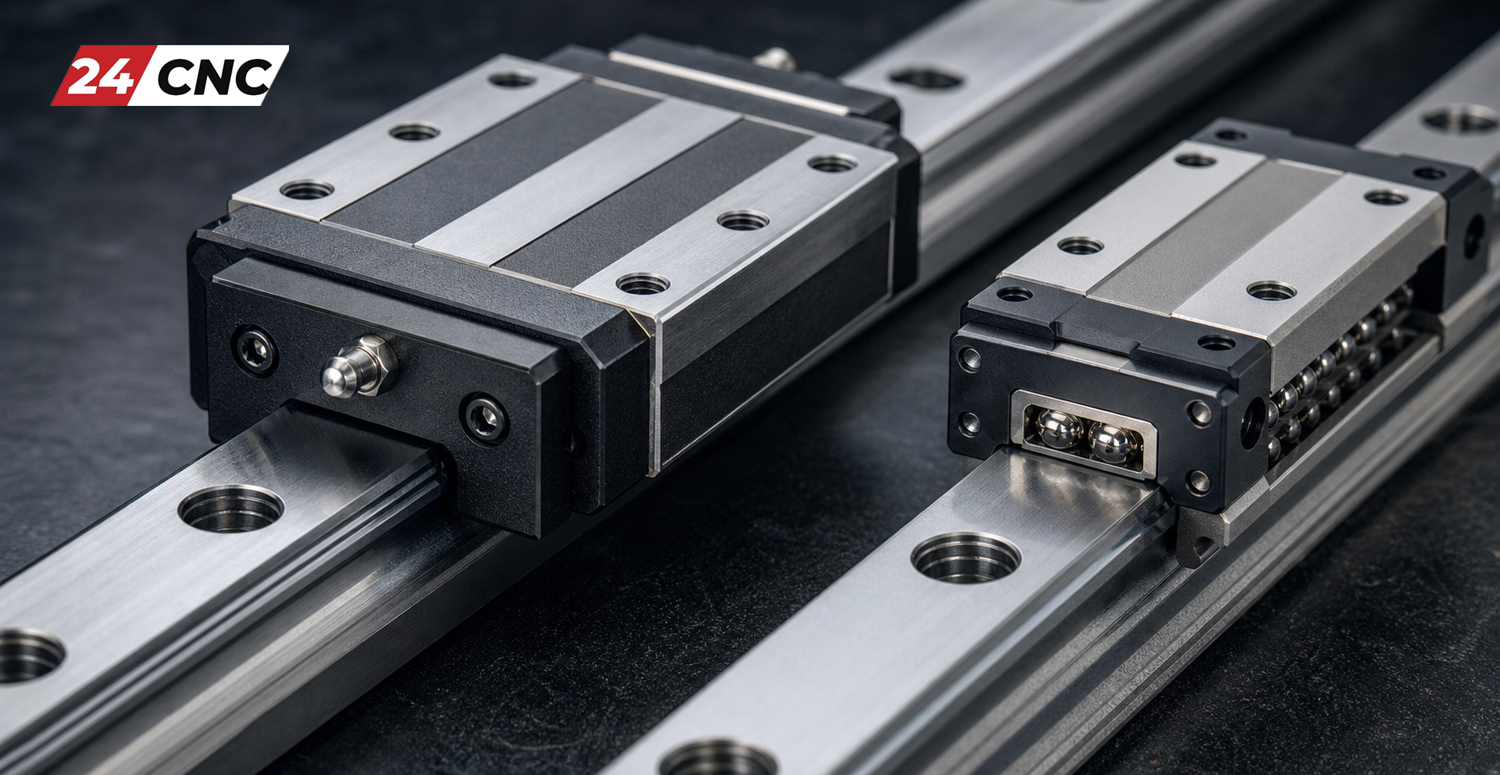
- The Carriage (or Block): A block that slides along the rail. It contains the recirculating rolling elements (either balls or rollers) that interface with the raceways on the rail, allowing for low-friction movement.
Ball Linear Guides: The Classic Choice for Speed and Precision
Ball-type linear guides are the most common and well-known type. They have been the standard for a wide range of automation and machine tool applications for decades due to their balanced performance and cost-effectiveness.
How They Work: Point Contact and Recirculating Balls
The defining characteristic of a ball linear guide is its use of spherical steel balls as the rolling elements. These balls recirculate within the carriage, moving between the grooves on the rail and a return path inside the carriage. The key concept here is “point contact.” Theoretically, a perfect sphere contacts a perfect flat or grooved surface at an infinitesimally small point. While some elastic deformation under load creates a tiny contact patch, this point contact is fundamental to its performance.
Advantages of Ball Linear Guides
- Low Friction & Smoothness: The point contact results in very low rolling friction, allowing for extremely smooth motion and the ability to achieve very high travel speeds and accelerations.
- Good All-Around Performance: They offer a great balance of load capacity, rigidity, and speed for general-purpose and high-speed machining applications.
- Cost-Effective: Generally, ball linear guides are less expensive than their roller counterparts of the same size.
Limitations in Heavy-Duty Scenarios
The “point contact” principle is also the source of their primary limitation in heavy CNC applications. The small contact area means that the load is concentrated on a very small point on both the ball and the raceway. This leads to high Hertzian stress. When subjected to very high or shock loads typical of heavy milling or turning, this can lead to:
- Brinelling (permanent deformation) of the raceways.
- Reduced rigidity as the balls elastically deform more under load.
- A significantly shorter operational lifespan compared to a more robust alternative.

Roller Linear Guides: The Champion of Rigidity and Load Capacity
When the application demands the utmost in rigidity and load-bearing capability, roller-type linear guides are the undisputed champions. They are specifically engineered to handle the punishing environment of heavy-duty and ultra-high-precision machining.
How They Work: Line Contact and Recirculating Rollers
Instead of spherical balls, roller guides use cylindrical (or barrel-shaped) rollers as the rolling elements. This seemingly simple change from a ball to a roller fundamentally alters the guide’s performance characteristics. The key concept for rollers is “line contact.” A cylinder contacts a flat surface along a line, not a point. This drastically increases the contact area between the rolling element and the raceway.
Key Advantages for Heavy CNC Machining
- Massively Higher Load Capacity: Due to line contact, roller guides can have significantly higher basic dynamic and static load ratings than a ball guide of the same size—often 1.5x to 2x higher.
- Exceptional Rigidity: The larger contact area means much less elastic deformation under load. This results in superior stiffness and resistance to deflection, which is critical for minimizing tool vibration and achieving high-quality surface finishes during heavy cuts.
- Superior Shock Load Absorption: The line contact distributes shock loads over a larger area, making the system far more durable and resistant to damage from unexpected forces.
Potential Trade-offs to Consider
While superior in load and rigidity, roller guides are not without their trade-offs. The increased contact area of the line contact leads to slightly higher rolling friction compared to ball guides. This can result in lower maximum travel speeds and can generate more heat in very high-speed, continuous-motion applications. Furthermore, they are typically more expensive due to the more complex manufacturing and grinding processes required for the rollers and their corresponding raceways.
Head-to-Head Technical Comparison: Roller vs. Ball for Heavy CNC
To make a clear decision, it’s best to compare these two technologies side-by-side based on the parameters that matter most in heavy CNC machining.
| Feature | Roller Linear Guides | Ball Linear Guides |
|---|---|---|
| Load Capacity | Very High to Exceptional. Ideal for extreme loads. | Moderate to High. Sufficient for many applications but limited in heavy-duty scenarios. |
| Rigidity & Stiffness | Exceptional. Minimal deflection under load due to line contact. Reduces vibration. | Good. More prone to elastic deformation under heavy or shock loads compared to rollers. |
| Accuracy & Precision | Very High. The high rigidity helps maintain geometric accuracy during cutting. | Very High. Can sometimes offer slightly better smoothness for ultra-fine finishing tasks. |
| Max Speed & Acceleration | Good to High. Generally lower maximum speeds than ball guides due to higher friction. | Excellent. Lower friction allows for higher speeds, ideal for rapid traverse. |
| Friction & Heat Generation | Slightly higher due to line contact. Can be a factor in ultra-high-speed continuous motion. | Very low. Generates less heat, making them suitable for high-duty cycle, high-speed applications. |
| Lifespan & Durability (in Heavy Apps) | Excellent. Far more resistant to damage from shock loads and overloading. | Good, but can be prone to premature failure if consistently overloaded or subjected to shock. |
| Cost | Higher. The investment is justified by performance and longevity in demanding applications. | Lower. More cost-effective for applications where extreme rigidity is not the primary concern. |
Application-Specific Recommendations: When to Choose Roller vs. Ball
Scenarios Ideal for Roller Linear Guides
For heavy CNC machines, the choice often leans towards rollers. You should strongly specify or prioritize roller guides for:
- Large Gantry Mills & Routers: Especially on the Y-axis and Z-axis, where cutting forces and the weight of the gantry and spindle demand maximum rigidity.
- Heavy-Duty CNC Lathes & Turning Centers: To withstand the immense forces involved in turning large-diameter workpieces.
- Vertical Machining Centers (VMCs) and Horizontal Machining Centers (HMCs) used for heavy material removal (e.g., “hogging out” large pockets in steel or titanium).
- Grinding Machines: Where stiffness is paramount to achieving the required surface finish and dimensional accuracy.
- Any machine where shock loads are common, such as those involved in interrupted cutting.
Scenarios Where Ball Linear Guides Still Excel
Ball guides remain the superior choice in several contexts, even within the CNC industry:
- High-Speed Finishing Machines: Where federates are high but cutting forces are low, the lower friction and higher speed capabilities of ball guides are advantageous.
- Smaller CNC Machines & Engravers: Where loads are moderate and cost is a more significant factor.
- Coordinate Measuring Machines (CMMs): Where motion must be as frictionless and smooth as possible and loads are negligible.
- Automation & Robotics: In pick-and-place or assembly applications where speed and low drag are more important than load capacity.

Maintenance and Preload: Optimizing Your Linear Guide Performance
Regardless of which type you choose, its performance and lifespan are heavily dependent on proper maintenance and configuration. Two aspects are particularly critical.
The Critical Role of Preload
Preload is an internal force applied to the rolling elements within the carriage to eliminate internal clearance. This is done to increase the system’s rigidity. A properly preloaded guide will have less deflection under load. Both ball and roller guides are available in various preload classes (e.g., light, medium, heavy). For heavy CNC applications, a medium or heavy preload is almost always required. It’s crucial to understand how to choose linear guide preload correctly, as too much preload can increase friction and heat, while too little will compromise rigidity.
Lubrication and Contamination Protection
Consistent and clean lubrication is the lifeblood of any linear guide. It prevents metal-to-metal contact, reduces friction and wear, and helps dissipate heat. Regular maintenance checks, as part of a broader CNC machine maintenance checklist, are vital. Furthermore, the seals on the carriage are critical for keeping contaminants like metal chips and coolant out of the precision raceways. Damaged seals are a primary cause of premature guide failure.
Frequently Asked Questions (FAQ)
Can I replace ball guides with roller guides on my CNC machine?
It depends. If the roller guide has the same physical dimensions (rail width, block height, hole pattern), it is often possible. However, you must ensure the entire system, including the drive motors and ball screws, can handle the slightly higher friction. It’s a common and highly effective upgrade for improving a machine’s rigidity.
Are roller guides always better for heavy loads?
For static and dynamic loads, yes. Their fundamental design (line contact) gives them a much higher load rating and stiffness for a given size. For applications defined by “heavy loads,” rollers are almost always the superior technical choice.
What’s more important: rigidity or accuracy?
They are interconnected. A guide can be manufactured to be geometrically accurate, but if it is not rigid, it will deflect under load, and that accuracy will be lost during the actual machining process. For heavy CNC, rigidity is arguably the more critical factor as it enables the machine to maintain its accuracy while working.
How do I know if my linear guides are worn out?
Signs of worn guides include increased operational noise (rumbling or grinding), visible play or slop in the axis (you can feel it by trying to manually push/pull on the carriage), poor surface finish on parts, and difficulty holding tight tolerances. Regular inspection and following a proper maintenance schedule is key.
Conclusion: Making the Right Choice for Your Heavy CNC Application
For designers, builders, and maintainers of heavy CNC machinery, the choice between roller and ball linear guides is clear-cut based on the application’s primary demand.
Choose Roller Linear Guides when your top priorities are maximum load capacity, unyielding rigidity, and durability under shock loads. They are the definitive choice for heavy milling, turning, and grinding applications where performance cannot be compromised. The higher initial cost is an investment that pays dividends in improved part quality, reduced tool chatter, and longer machine life.
Choose Ball Linear Guides when your application prioritizes speed, low friction, and cost-effectiveness, and where loads are moderate and predictable. They remain the perfect solution for high-speed finishing, general automation, and lighter-duty CNC machines.
Ultimately, selecting the right component is about understanding the physics of your application. For the punishing world of heavy CNC, the superior rigidity and load capacity of roller linear guides make them the clear engineering choice for achieving peak performance and reliability.
Need High-Quality CNC Parts or Expert Advice?
From high-rigidity linear guides to servo drives and controllers, finding the right components is key to your machine’s performance. At 24CNC, we specialize in providing top-tier, reliable CNC parts to keep your operations running at peak efficiency.
Leave a comment
Your email address will not be published. Required fields are marked *