

In the world of CNC machining and industrial automation, the servo motor is the muscle, and the encoder is the nervous system. When your machine crashes or throws an alarm, knowing how to test a servo motor and encoder with a multimeter is a critical skill. It can save you thousands of dollars in unnecessary replacement parts and hours of diagnosing the wrong component.
Whether you are dealing with a standard industrial setup or specific systems like Fanuc or Mitsubishi, the fundamental electrical principles remain the same. This guide will walk you through the static and dynamic tests you can perform using a standard digital multimeter to determine if your servo motor or encoder is dead or salvageable.
Safety First: Preparation Before Testing
Before touching any terminals, safety is paramount. Servo drives contain capacitors that store high voltage even after power is removed.
- Power Down: Turn off the main breaker to the CNC machine.
- Discharge: Wait at least 5 to 10 minutes for the internal capacitors in the amplifier and inverter modules to discharge.
- Disconnect: Physically disconnect the power cables (UVW) and the feedback cables from the drive side to isolate the motor.
Part 1: How to Test Servo Motor Windings
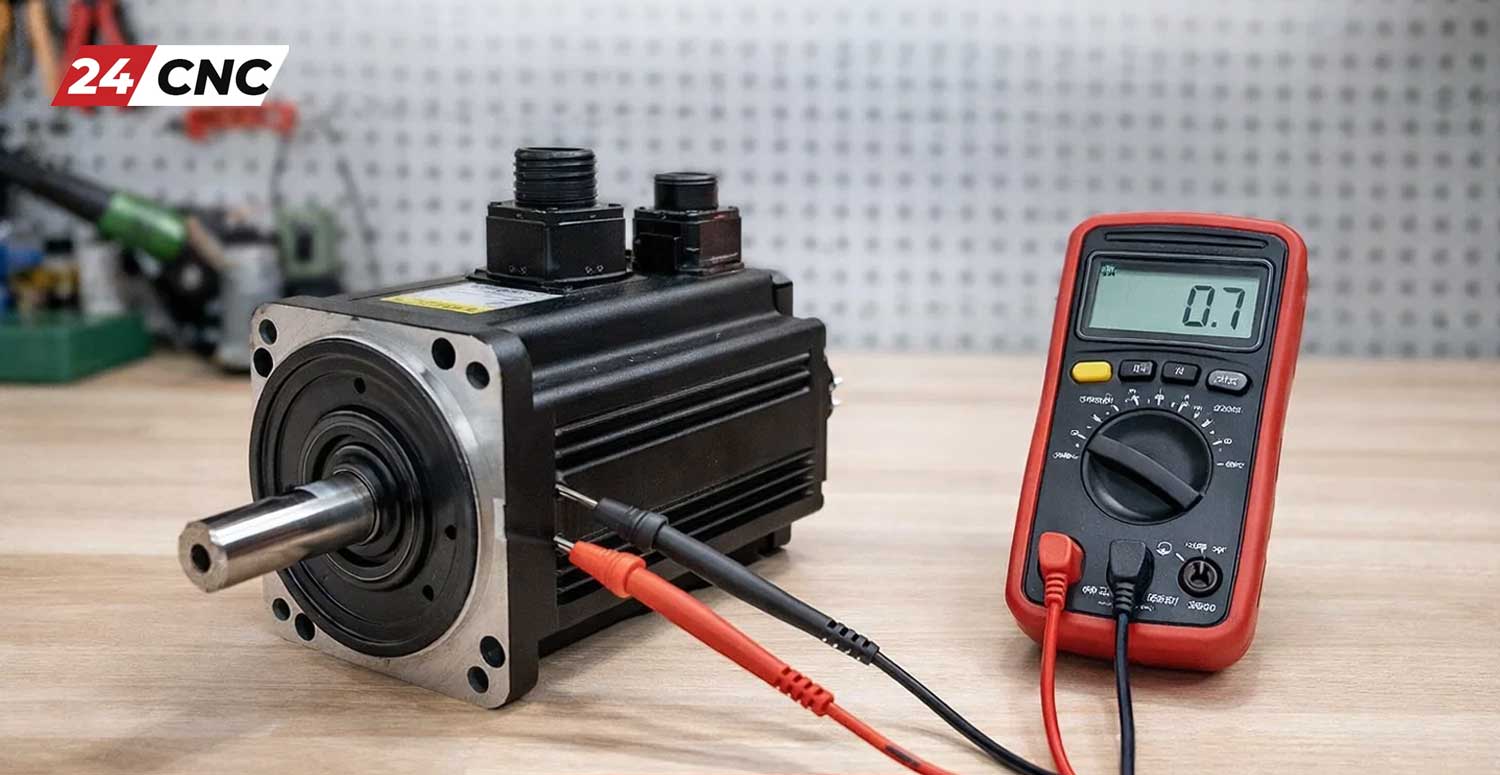
The servo motor itself is a 3-phase AC permanent magnet motor. The most common failures are shorted windings, open windings, or a ground fault (short to the case). Here is how to check them.
1. Testing Winding Resistance (Phase-to-Phase)
Set your multimeter to the lowest Ohms (Ω) setting. You will be measuring the resistance between the three power leads: U, V, and W.
- Measure resistance between U and V.
- Measure resistance between V and W.
- Measure resistance between W and U.
The Verdict: The readings should be very low (usually between 0.5 Ω and 5.0 Ω depending on motor size) and, most importantly, balanced. If you read 1.2 Ω on U-V but 40 Ω or “OL” (Open Loop) on V-W, the motor windings are burnt or broken. If you need a replacement, browse our catalog of servo motors.
2. Testing Insulation (Phase-to-Ground)
This checks if the internal insulation has melted, causing the copper winding to touch the motor casing.
- Set your multimeter to the highest resistance setting (Mega Ohms) or use a dedicated Megohmmeter for better accuracy.
- Place the black probe on the Motor Case (ground) or the green ground wire.
- Touch the red probe to the U, V, and W terminals sequentially.
The Verdict: You want to see “OL” or infinity. A reading below 10 Megohms usually indicates broken insulation or contamination by coolant. This is a common killer of Fanuc servo motors in older CNC mills.
Part 2: How to Test the Servo Encoder
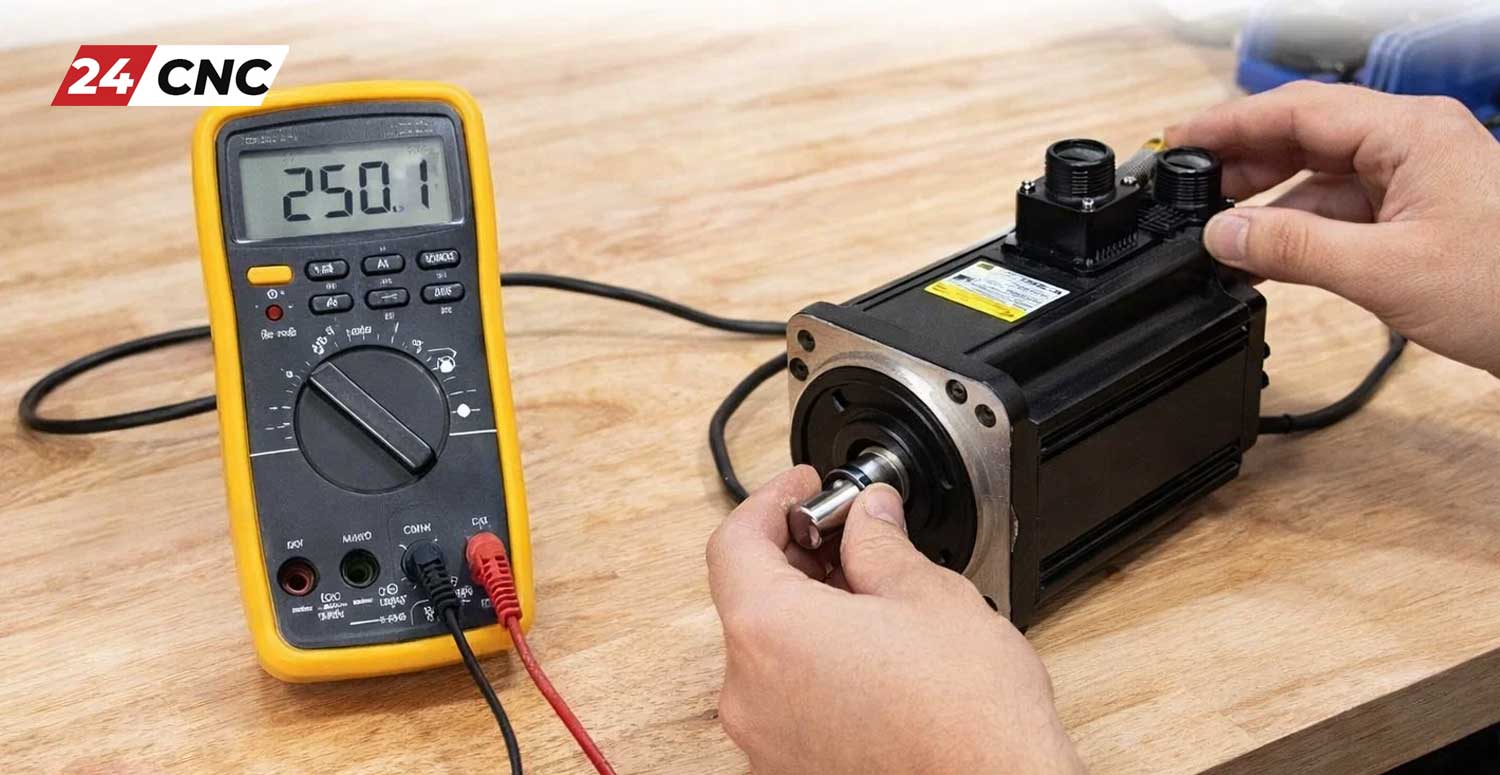
Testing an encoder with a standard multimeter is more limited than using an oscilloscope, but you can verify basic functionality. An encoder failure usually manifests as a “feedback error” or “position deviation” alarm on the control system.
1. Checking Voltage Supply
Most encoders require a clean 5V DC or sometimes 24V DC power supply to operate.
- With the machine powered on (but servo off/emergency stop active), locate the encoder pinout.
- Measure DC Voltage between the +5V (or VCC) and 0V (GND) pins on the connector.
- If you have 0V, the issue might be the encoder cable or the drive’s power output, not the encoder itself.
2. Incremental Encoder Signal Test
If you have an incremental encoder (common on older Yaskawa or generic setups), you can check the pulse output.
- Set the multimeter to DC Volts.
- Connect probes to Channel A (or B) and Ground.
- Slowly rotate the motor shaft by hand.
- You should see the voltage toggle between High (approx 5V) and Low (approx 0V). If the voltage stays constant at 5V or 0V while spinning, the channel is dead.
Note: Serial/Absolute encoders (like those found on modern Mitsubishi encoders) communicate via data packets. A multimeter shows a fluctuating average voltage (usually around 2.5V), but this does not guarantee the data is correct.
Don’t Forget the Cables
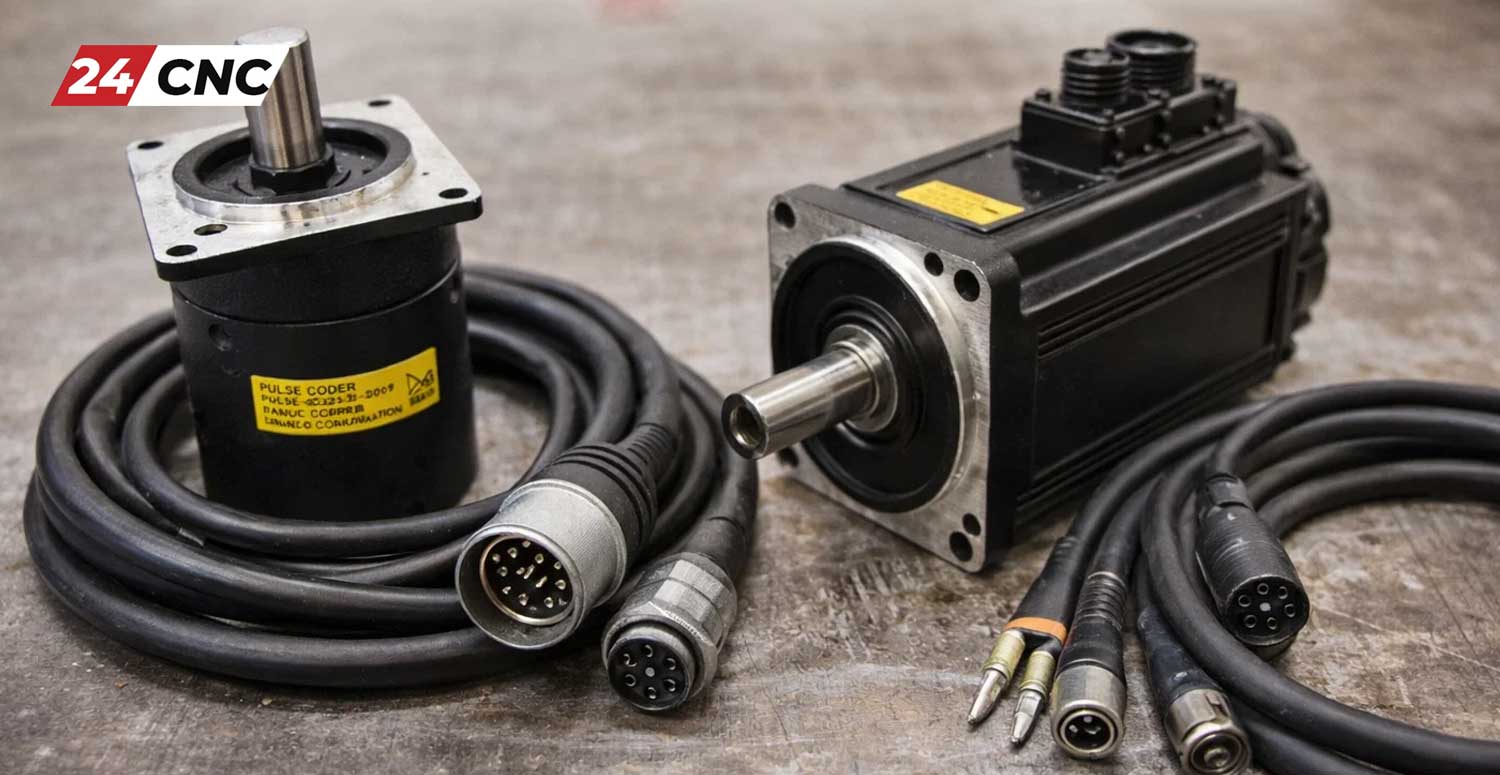
Often, the motor and encoder are fine, but the cables moving in the drag chain have snapped internally. Always perform a continuity test on your power and encoder cables from end-to-end while wiggling them to detect intermittent breaks.
Troubleshooting Summary Table
| Component | Test Method | Healthy Result | Faulty Result |
|---|---|---|---|
| Motor Windings (U-V-W) | Resistance (Ohms) | Balanced Low Resistance (e.g., 1.5Ω across all pairs) | Open (OL) or Imbalanced (>10% difference) |
| Motor Ground | Insulation Test | Infinite (OL) or >100 MΩ | Continuity or Low Resistance (<1 MΩ) |
| Encoder Power | DC Voltage | Steady 5V or 24V | 0V or erratic voltage |
| Encoder Signal | DC Volts (Slow Turn) | Toggles High/Low (Incremental) | Stuck High or Low |
Frequently Asked Questions (FAQ)
Can I test a servo motor by connecting it directly to AC power?
No! Never connect a servo motor directly to mains voltage. Servo motors require a specific drive/amplifier to commutate the phases. Connecting it directly will likely destroy the magnets and burn the windings.
Why does my servo motor smell like ozone?
An ozone or burning smell usually indicates a short circuit within the windings or the insulation breaking down. If you smell this, perform an insulation resistance test immediately and check the cooling fan to ensure the motor wasn’t overheating.
Can I repair a broken encoder myself?
Generally, no. Encoders rely on precise optical disks or magnetic scales aligned to the micron. Disassembling an encoder usually results in losing the commutation alignment. It is safer to buy a replacement rotary encoder that matches your specifications.
What if the motor tests good but the drive still alarms out?
If the motor and cable verify as healthy, the issue is likely the drive itself. The IGBTs (power transistors) inside the drive may be blown. You can check our stock of IGBT modules or consider replacing the entire Fanuc drive unit.
Need Replacement Parts Fast?
If your diagnostic tests confirm a dead motor or encoder, don’t let machine downtime eat your profits. We stock a vast range of CNC parts ready for immediate shipping.
Leave a comment
Your email address will not be published. Required fields are marked *