
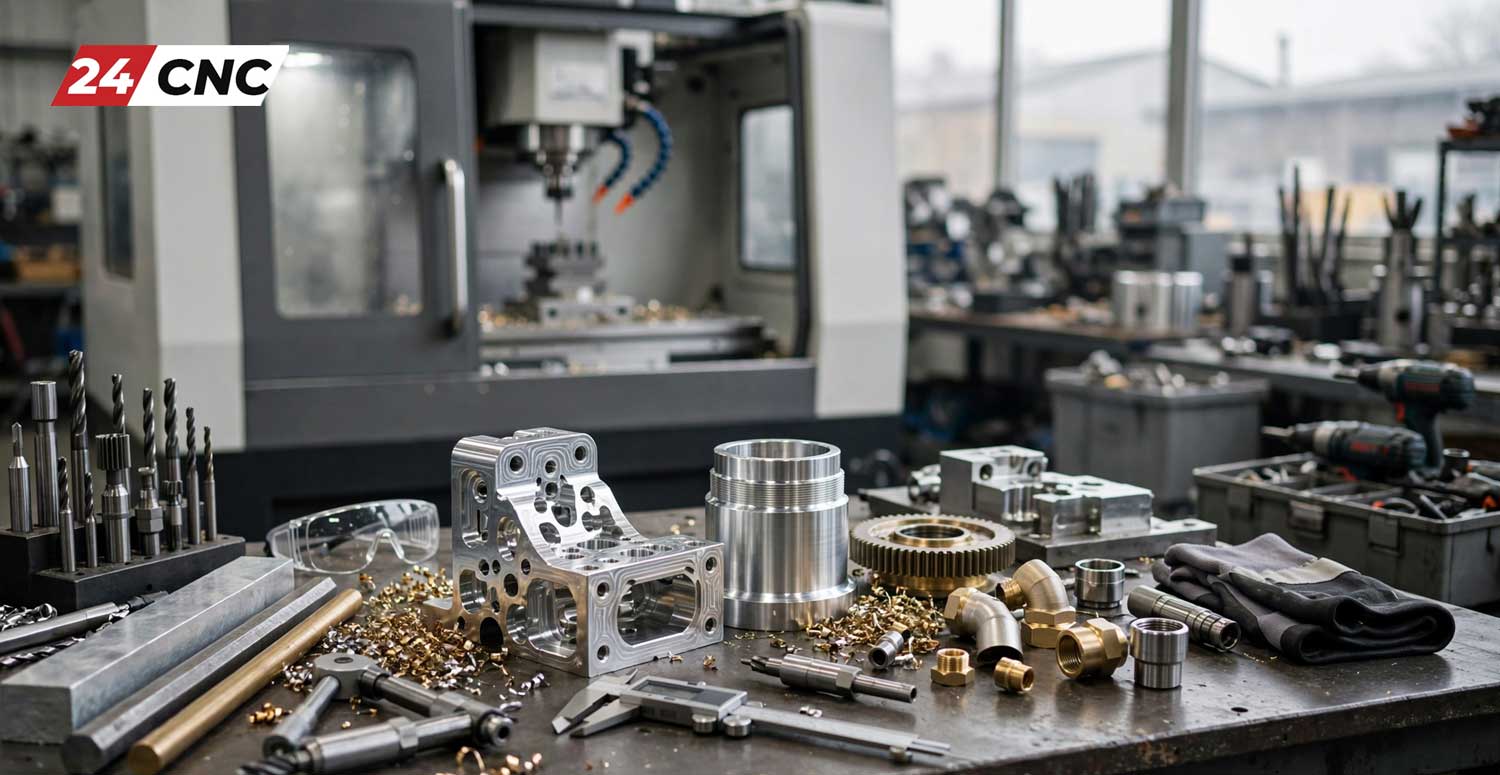
Whether you are a mechanical engineer designing a next-generation aerospace prototype, a procurement officer sourcing manufacturing services for consumer electronics, or a workshop owner analyzing overheads and quoting strategies, you have likely asked yourself this fundamental question: Why are CNC machined parts so expensive? When compared to other modern manufacturing methods like FDM 3D printing, or high-volume processes like plastic injection molding and die casting, Computer Numerical Control (CNC) machining often carries a significant premium price tag.
However, this cost is by no means arbitrary. It is the direct and logical result of the incredible precision, mechanical durability, and technological sophistication involved in the subtractive manufacturing process. CNC machining is capable of holding microscopic tolerances in some of the hardest materials known to man, but that capability requires immense resources. In this comprehensive pillar guide, we will break down the true, hidden costs behind CNC machining. By understanding the intricate variables that dictate pricing—ranging from massive capital equipment investments to the nuances of geometric complexity and tight tolerances—you can make far more informed decisions and optimize your product designs to reduce manufacturing expenses without ever compromising on quality.
1. The Immense Cost of Capital Equipment and Infrastructure
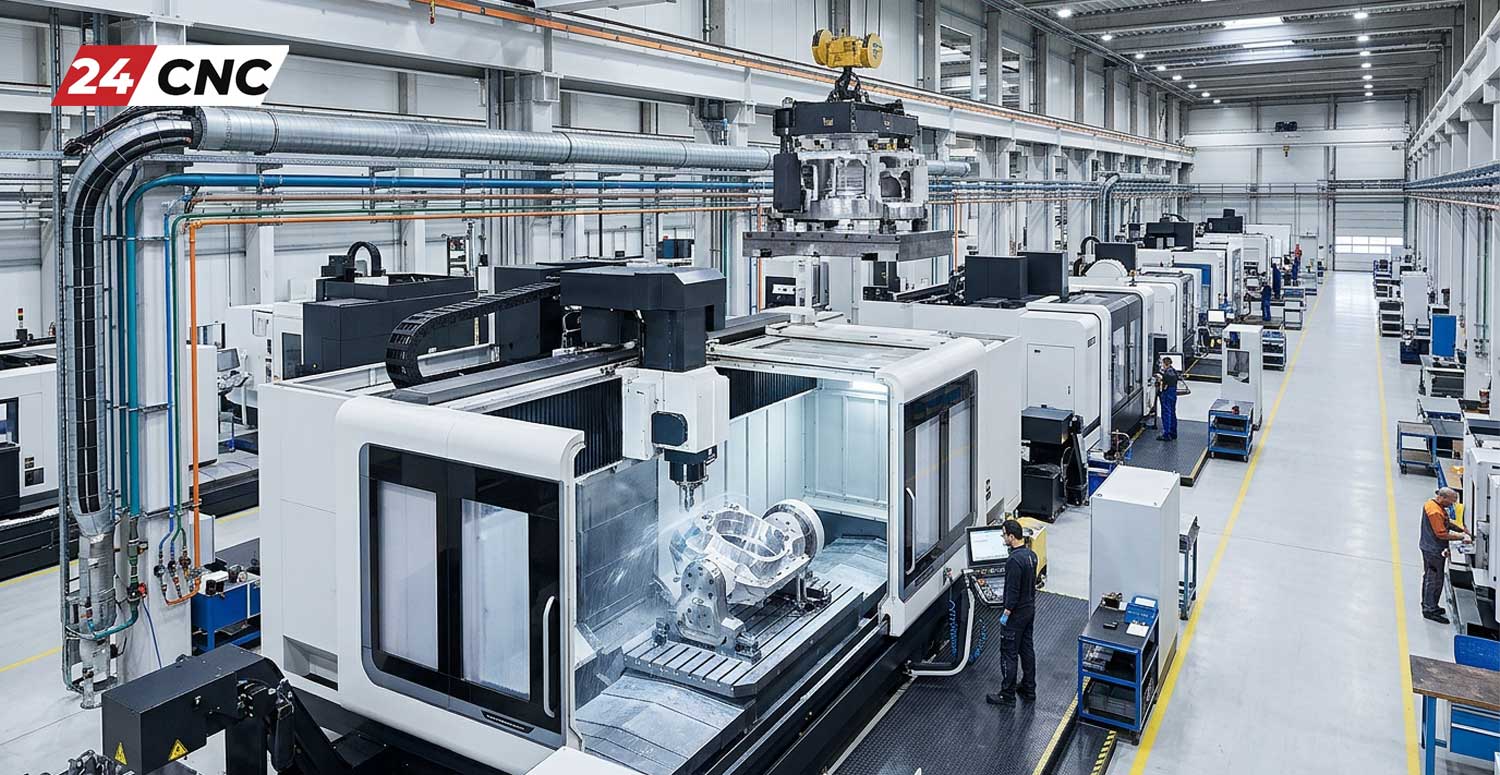
The most foundational reason for the high cost of CNC parts is the machinery itself. Industrial-grade CNC mills, lathes, Swiss machines, and Mill-Turn centers are massive, highly sophisticated pieces of engineering. A state-of-the-art 5-axis CNC machining center from top-tier brands can easily cost anywhere from hundreds of thousands to well over a million dollars. This immense capital investment must be amortized over the operational life of the machine, which translates directly into a high hourly rate ($R_{machine}$) charged to the customer for machine time.
Furthermore, the base price of the machine is just the beginning. These machines rely on ultra-premium components to function reliably under continuous, heavy loads. High-speed spindles capable of 20,000+ RPM, heavy-duty ball screws, linear guideways, and advanced Siemens controllers or Fanuc systems ensure that the machine can execute complex, multi-axis G-code with flawless accuracy. Upgrading, powering, cooling, and maintaining these industrial powerhouses significantly drives up the baseline cost of production. A spindle replacement alone can cost tens of thousands of dollars. Machine shops must factor these maintenance contingencies, along with high electricity consumption and expensive industrial floor space, into every quote they generate.
2. Setup Time, Engineering Labor, and The Low-Volume Penalty
Unlike desktop 3D printing, where a digital file is simply sliced in a few minutes and sent directly to the printer, CNC machining requires a highly meticulous, labor-intensive setup process. The setup involves highly skilled labor and expensive engineering time. Before a CNC machine cuts a single chip of metal, several critical steps must be executed flawlessly by machinists and manufacturing engineers:
- CAD/CAM Programming: A skilled CNC programmer must translate the 3D CAD (Computer-Aided Design) model into a series of highly optimized toolpaths (G-code) using expensive CAM (Computer-Aided Manufacturing) software like Mastercam or NX. This requires a deep, intuitive understanding of cutting speeds, feed rates, tool deflection, and material science.
- Workholding and Fixturing: The raw material (often called a billet or blank) must be securely clamped into the machine. Complex parts frequently require the machine shop to custom-machine “soft jaws” or design specialized modular fixtures just to hold the part securely without distorting it during the heavy forces of machining.
- Tool Loading, Presetting, and Calibration: The operator must meticulously select and load the correct end mills, face mills, drills, and taps into the machine’s automatic tool changer (ATC). Each tool must be precisely measured for length and diameter offsets using a tool presetter to ensure the machine knows exactly where the cutting edge is in 3D space.
Because setup time is a fixed cost, it heavily impacts the price of low-volume orders and prototypes. To illustrate this mathematically, we can look at the basic unit cost formula for a production run:
Where $C_{unit}$ is the total cost per part, $C_{setup}$ represents the total engineering and physical setup cost, $V$ is the volume (number) of parts being produced, $T_{machining}$ is the exact time it takes to machine one single part, and $R_{machine}$ is the hourly operational rate of the CNC center. If your production volume ($V$) is only 1 or 2 parts, the entirety of that expensive setup cost ($C_{setup}$) falls squarely on those few units, making one-off prototypes exceptionally expensive. As volume increases into the hundreds or thousands, the setup cost is amortized, and the price per part drops dramatically.
3. Geometric Complexity and the “Time is Money” Principle
The age-old business phrase “time is money” is nowhere more applicable than on the floor of a CNC machine shop. The longer a part takes to machine, the more expensive it will inevitably be. A part’s geometric complexity directly correlates with its machining time. Features like deep internal cavities, incredibly thin walls, internal undercuts, non-standard threading, and complex organic 3D surfaces require specialized tooling, much slower cutting speeds to prevent vibration (chatter), and multiple physical setups.
One of the most common cost-drivers in design is the “internal corner problem.” Because rotating milling tools are inherently cylindrical, they cannot cut a perfectly sharp internal 90-degree corner. The smaller the radius a designer specifies in a corner, the smaller the tool the machinist must use. Smaller tools break easily, cannot remove material quickly, and require many more passes to clear a pocket. This drastically increases $T_{machining}$.
Furthermore, machining a highly complex part on a standard 3-axis vertical mill might require the operator to stop the machine and manually flip and re-indicate the part three, four, or even five times to reach all sides. Each flip is a brand new setup carrying additional labor costs and risking a loss of precision. Utilizing a 5-axis machine can reduce these manual setups, allowing the machine to reach almost all sides of the part in a single operation. However, as established earlier, the hourly rate for a 5-axis machine is substantially higher. Complex geometries also demand continuous, rapid, and precise multi-axis interpolations driven by high-end servo motors, adding to the general wear and tear on the machine’s expensive drive systems.
4. Tolerances, Precision, and the Cost of Quality Assurance
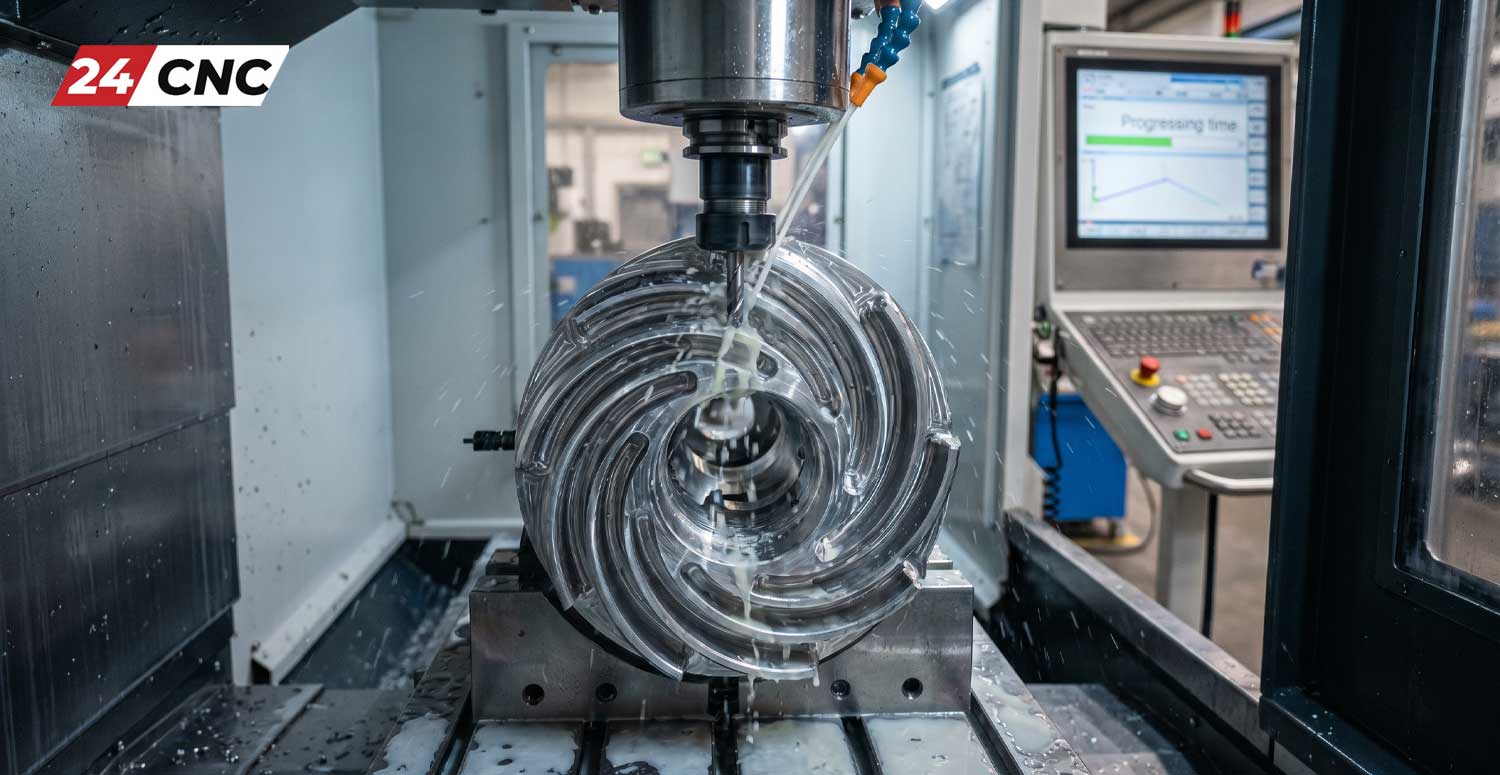
In the realm of engineering, tolerances define the acceptable, allowable variation in a physical dimension. Standard CNC machining tolerances are usually quite good, generally hovering around $\pm 0.125 \text{ mm}$ ($\pm 0.005 \text{ inches}$). If your design strictly demands a much tighter tolerance, such as $\pm 0.01 \text{ mm}$ (a fraction of the thickness of a human hair) for aerospace bearings or optical mounts, the cost to manufacture that part will skyrocket.
Why does precision cost so much? Achieving ultra-tight tolerances requires the machinist to alter their entire strategy. They must take much slower, shallower finishing passes. It may require purchasing specialized, highly rigid carbide cutting tools. The shop must implement rigorous temperature control (HVAC) to prevent the metal part and the machine itself from thermally expanding or contracting during the cutting process. Furthermore, it relies heavily on the absolute accuracy of the machine’s internal feedback loops, which depend on high-resolution industrial encoders to report exact axis positions back to the main controller.
Finally, tight tolerances drastically increase the cost of Quality Assurance (QA). Parts must be meticulously measured in temperature-controlled metrology labs using expensive Coordinate Measuring Machines (CMMs) or laser scanners. The tighter the tolerance band, the higher the inherent scrap rate (the number of parts that fail inspection and must be thrown away), a risk factor which the manufacturer must price into the initial quote.
5. Material Selection, Machinability, and Wastage
CNC machining is inherently a subtractive process. You start with a solid block (billet) of raw material and violently remove everything that isn’t the final part. In many aerospace, automotive, or structural components, it is not uncommon to machine away $70\%$ to $90\%$ of the original block’s mass. You are ultimately paying for the raw material that ends up as metal chips on the shop floor.
More importantly, the physical and chemical properties of the chosen material drastically affect the machining time and tool wear rate—a metric known as the “machinability rating.” Aluminum alloys (like 6061-T6) are relatively inexpensive and cut smoothly like butter, allowing for highly rapid machining feeds and speeds. Conversely, materials like Titanium alloys, Inconel, hardened Tool Steels, or even certain engineering plastics (like PEEK) are not only very expensive to purchase by the pound, but they are notoriously difficult to cut.
Tough superalloys work-harden as they are cut, generating immense heat. They require specialized coated carbide tooling, highly concentrated coolant delivery systems, and very slow feed rates to prevent the cutting tools from shattering, melting, or dulling prematurely. A tool that might last for 100 hours cutting Aluminum might only last 30 minutes cutting Inconel. The cost of replacing these expensive cutting tools is factored directly into the cost of your parts.
6. Post-Processing and Surface Finishes
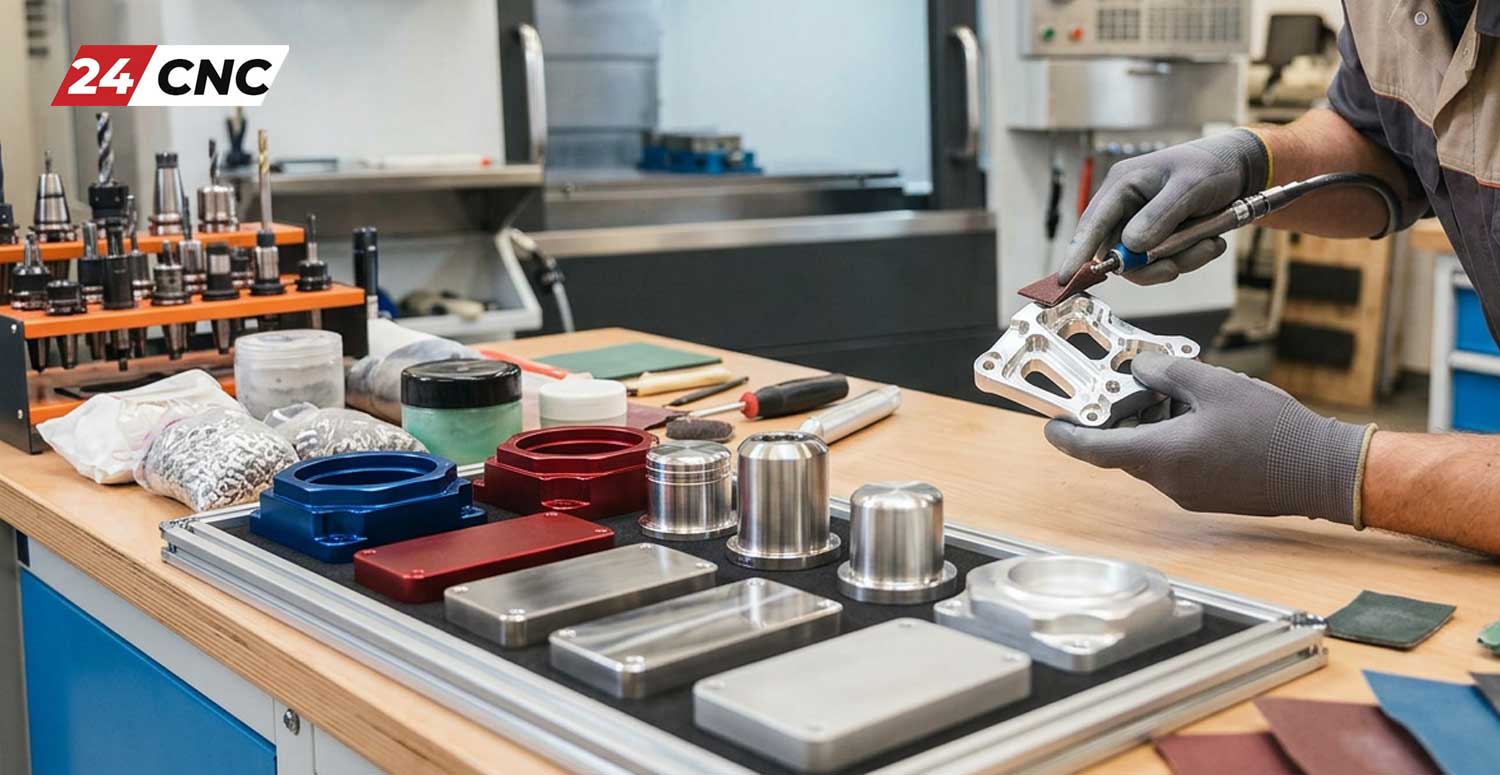
The machining process is rarely the final step. The surface finish and post-processing treatments required by the engineering drawing add significant secondary costs. A standard “as-machined” finish (where minor tool marks are visible) is the most economical option. However, many parts require secondary operations for aesthetics, wear resistance, or corrosion protection.
Processes such as bead blasting, tumbling, Type II or Type III hardcoat anodizing, powder coating, nickel plating, or manual mirror-polishing all require extra handling, shipping to specialized sub-contractors, and additional QA inspections. Heat treating a steel part to increase its Rockwell hardness scale also adds cost and can sometimes warp the part, requiring a final, highly expensive precision grinding operation to bring the part back into tolerance.
Cost Breakdown: A Technical Comparison Matrix
To better visualize and understand how different engineering factors influence the final cost of a CNC machined part, refer to the technical comparison table below.
| Cost Factor | Low Cost Impact (Economical) | High Cost Impact (Expensive) | Technical Reasoning |
|---|---|---|---|
| Material Type | Aluminum 6061, Brass, Delrin (Plastics) | Titanium, Inconel, 316 Stainless, Hardened Tool Steel | Harder/tougher metals cause rapid tool wear, generate excessive heat, and require significantly slower cutting speeds. |
| Tolerances (GD&T) | Standard ISO 2768 ($\pm 0.125 \text{ mm}$) | Ultra-Tight ($\pm 0.01 \text{ mm}$ or better) | Tight tolerances require extra spring-passes, strict thermal control, expensive CMM inspection, and increase scrap rates. |
| Machine Complexity | 3-Axis Vertical Milling / 2-Axis Turning | Simultaneous 5-Axis Milling / Multi-Spindle Mill-Turn | Advanced machines carry drastically higher hourly rates due to massive capital depreciation and maintenance costs. |
| Production Volume | High Volume Production (1,000+ parts) | Low Volume / Rapid Prototypes (1-10 parts) | Fixed CAM programming and physical setup costs are amortized over larger batches, lowering the per-unit cost. |
| Internal Corners | Large radii (allows for large, rigid tooling) | Perfectly sharp 90-degree internal corners | Sharp corners require EDM (Electrical Discharge Machining) or tiny, fragile end mills that machine very slowly. |
Frequently Asked Questions (FAQ)
How can I design my parts to reduce CNC machining costs?
To minimize manufacturing costs, you must practice Design for Manufacturability (DFM). Design your parts with standard tolerances unless critical for function. Avoid deep, narrow pockets (rule of thumb: depth should not exceed 4x the tool diameter). Eliminate perfectly sharp internal corners by adding the largest radius possible. Use highly machinable materials like Aluminum whenever the structural requirements allow, and try to design the part so it can be machined entirely from one or two setups.
Why is 5-axis machining more expensive than standard 3-axis?
5-axis machines are significantly more expensive to purchase, maintain, and insure. The CAM programming software required to generate simultaneous 5-axis toolpaths is highly advanced and expensive, and the risk of a catastrophic machine crash is much higher. While 5-axis machining saves time by eliminating multiple manual flip setups for complex parts, the baseline hourly rate for running a 5-axis machine is substantially steeper than a 3-axis mill.
Does the surface finish heavily affect the final price?
Yes, significantly. A standard “as-machined” finish is always the most economical. Requesting secondary operations like bead blasting, anodizing, powder coating, or manual mirror-polishing adds entirely new manufacturing steps. This increases labor costs, extends the lead time, and requires additional handling and inspection.
Why are prototypes so much more expensive per unit than mass production?
This comes down to the setup cost amortization. Whether you make one part or one thousand parts, the CAM programmer still has to write the code, and the machinist still has to set up the fixtures and load the tools. For a prototype, $100\%$ of that setup cost is applied to a single unit. In mass production, that same setup cost is divided by thousands, making the setup cost per unit practically negligible.
Conclusion: Optimizing Your Machining Strategy
The persistent question of “Why are CNC machined parts so expensive?” ultimately resolves into a complex matrix of heavy capital investment, highly skilled engineering labor, the unyielding physical limitations of material science, and the strict demands of precision mechanical engineering. By deeply understanding these primary cost drivers—setup time, material waste, tight tolerances, and machine complexity—you can approach your next engineering project with a mindset geared toward Design for Manufacturability (DFM). Strategically optimizing your CAD designs will ensure you get the immense structural integrity and repeatable precision of CNC machining, without paying for unnecessary overhead or over-engineered features.
Keep Your CNC Machines Running Profitably
Machine downtime is the biggest, most destructive hidden cost in the manufacturing industry. Whether you need reliable replacement drives, advanced controllers, or high-precision feedback sensors, ensuring your capital equipment operates flawlessly is the absolute key to maintaining healthy profit margins and delivering parts on time.
Leave a comment
Your email address will not be published. Required fields are marked *