
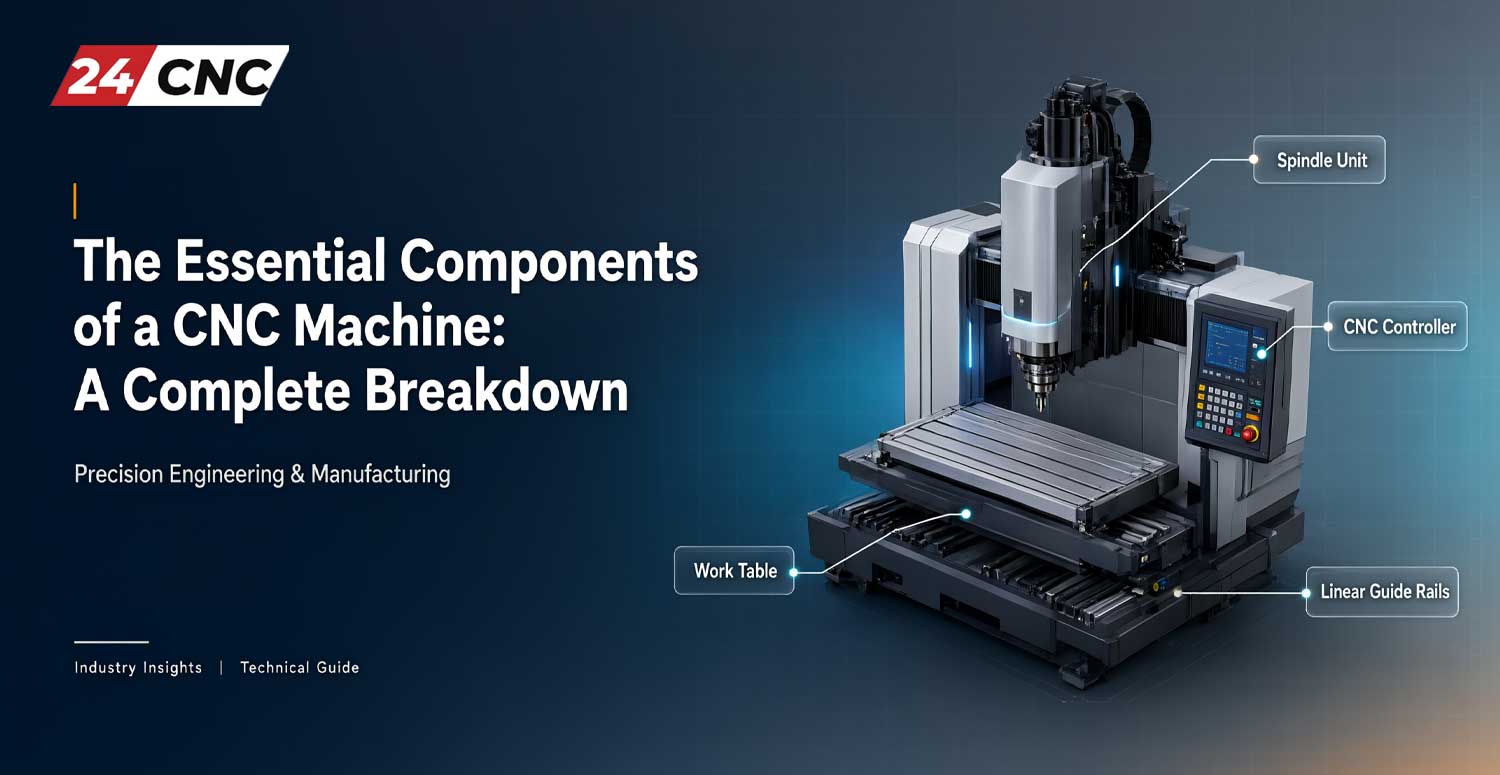
Computer Numerical Control (CNC) machinery has revolutionized industrial manufacturing, bringing unparalleled precision, speed, and efficiency to the global production floor. Whether you are operating a multi-axis milling center, a high-speed lathe, a plasma cutter, or a sophisticated EDM machine, the underlying architecture relies on a vast and complex network of electronic, mechanical, and hydraulic parts working in perfect synchronization. Understanding the essential components of a CNC machine is absolutely crucial for maintenance engineers, procurement specialists, workshop owners, and technicians to accurately diagnose faults, source reliable replacement parts, and minimize devastatingly costly downtime.
In this extensive, complete breakdown, we will dissect the anatomy of a CNC machine from top to bottom. We will explore the critical subsystems that transform digital G-code instructions into physical, micron-level movements. By deeply understanding how the “brain,” “muscle,” “senses,” and “nervous system” of these machines operate, you can make highly informed, strategic decisions when upgrading, maintaining, or repairing your critical industrial equipment.
The precision of a CNC machine is heavily dependent on the mechanical pitch of the lead screws and the electronic encoder feedback. The theoretical resolution can be determined using the following formula:
$$Resolution = \frac{P}{N_e \times G}$$
Where $P$ is the ball screw pitch (in mm), $N_e$ is the number of pulses per revolution of the encoder, and $G$ is the mechanical gear ratio. Upgrading your feedback system directly improves this value, greatly enhancing overall machining accuracy and surface finish quality.
1. The Brain: Advanced Control Systems and Processing Units
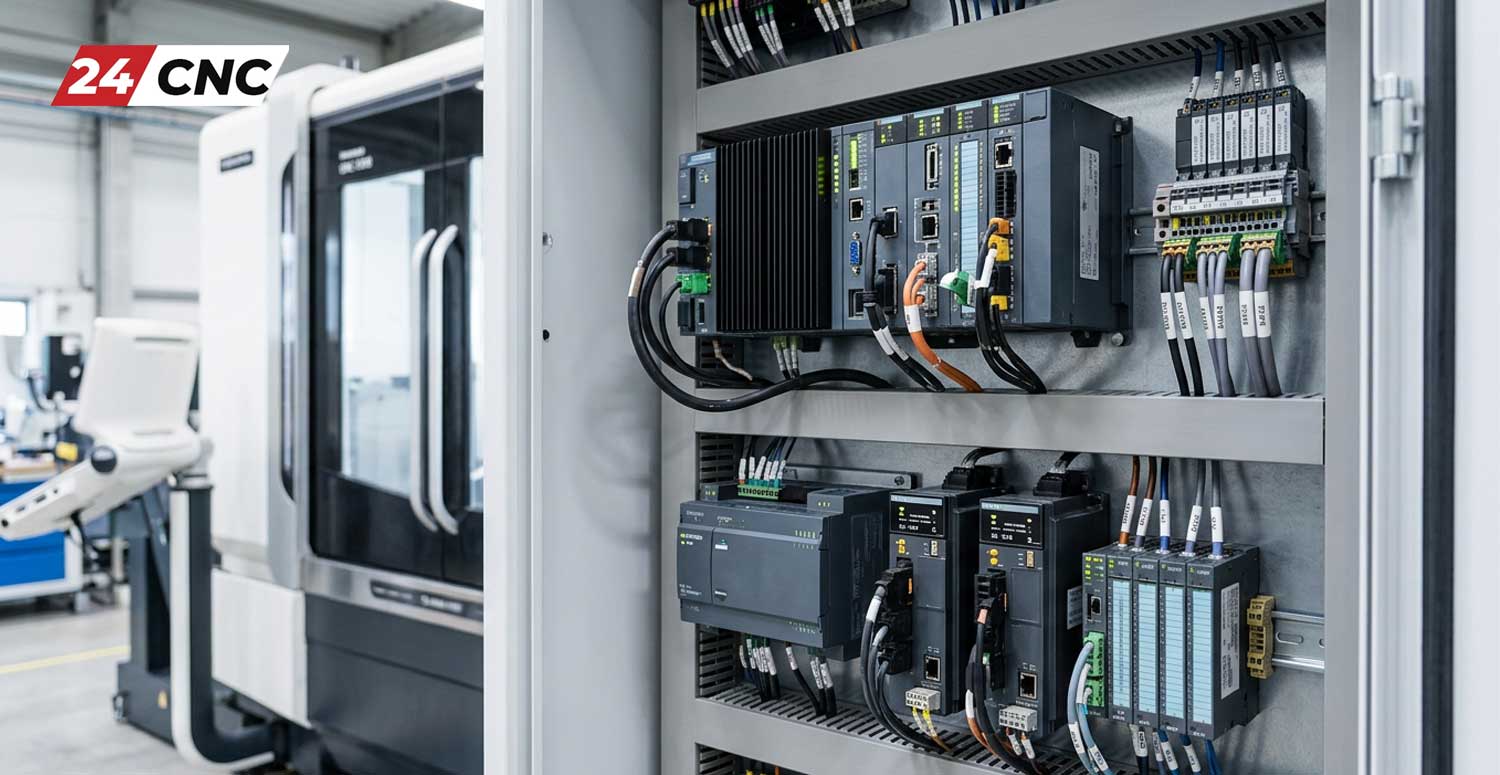
The operational core and “brain” of any automated machine tool is its master controller. This system is responsible for reading the programmed code (usually G-code and M-code) and converting it into precise electrical signals that dictate the speed, position, and coordination of all axes simultaneously.
CNC Main Boards and Core Processing
At the center of the control unit are the CNC control systems and main processing boards. These are not standard PCs; they are specialized, industrial-grade computers designed to handle intense, real-time mathematical processing without freezing or lagging. A failure here brings the entire machine to an immediate halt. Industry giants like Fanuc™, Siemens, Mitsubishi, and Heidenhain dominate this space, each offering proprietary logic architectures and ecosystems.
For instance, a Fanuc™ controller is universally renowned for its bulletproof reliability, massive legacy support, and tight closed-loop integration. Conversely, a Siemens controller (like the Sinumerik series) often provides highly advanced, flexible programming environments, stunning 3D simulation interfaces, and superior capabilities for complex multi-tasking machines (like mill-turns).
Input/Output (I/O) Modules and Relays
To interact with external peripheral devices—such as limit switches, proximity sensors, coolant pumps, and automatic tool changers—the main CPU board relies on Input/Output modules. These modules act as vital translators between the low-voltage, high-level logic of the CPU and the higher-voltage physical hardware. They ensure that auxiliary functions activate precisely when commanded by the M-codes. A blown I/O relay can stop a tool change mid-cycle, requiring careful multimeter troubleshooting to isolate.
2. The Muscle: Motion Control Systems and Kinematics
Once the control system processes the complex trajectory commands, it must physicalize them. This is the heavy-lifting job of the motion control system, which consists primarily of servo motors, spindle motors, and their corresponding intelligent drives.
Precision Servo Motors
Unlike standard AC induction motors that simply spin when power is applied, servo motors are meticulously designed for highly dynamic, high-torque applications requiring precise angular positioning. They drive the heavy ball screws that physically move the machine tables and cutting heads. Different manufacturers offer specialized motors explicitly tailored and magnetically tuned to their control systems. A Fanuc servo motor, for example, is specifically wound to respond instantly to the proprietary PWM signals generated by Fanuc drives, ensuring zero lag in complex circular interpolation.
Spindle Motors: The Cutting Force
While servos move the axes, the spindle motor rotates the cutting tool (in a mill) or the workpiece (in a lathe). Spindle motors must deliver massive torque at low RPMs for heavy roughing cuts, while remaining perfectly balanced for ultra-high RPM finishing passes. They are often liquid-cooled or force-air cooled to manage the extreme heat generated during continuous operation.
Amplifiers and Inverters (Servo & Spindle Drives)
Motors cannot operate on raw, unmodulated facility power; they require incredibly precise current and frequency modulation. Amplifiers and inverters act as the critical middleman between the main power supply and the motor. They receive low-voltage digital command signals via fiber optics or serial cables from the main controller and amplify them into the high-current, 3-phase electrical pulses needed to turn the motor shaft with extreme rigidity. Matching the drive to the motor is an absolute necessity; pairing a Mitsubishi motor with a Mitsubishi drive ensures seamless communication, accurate auto-tuning, and optimal torque delivery across the entire speed range.
3. The Senses: High-Fidelity Feedback Devices
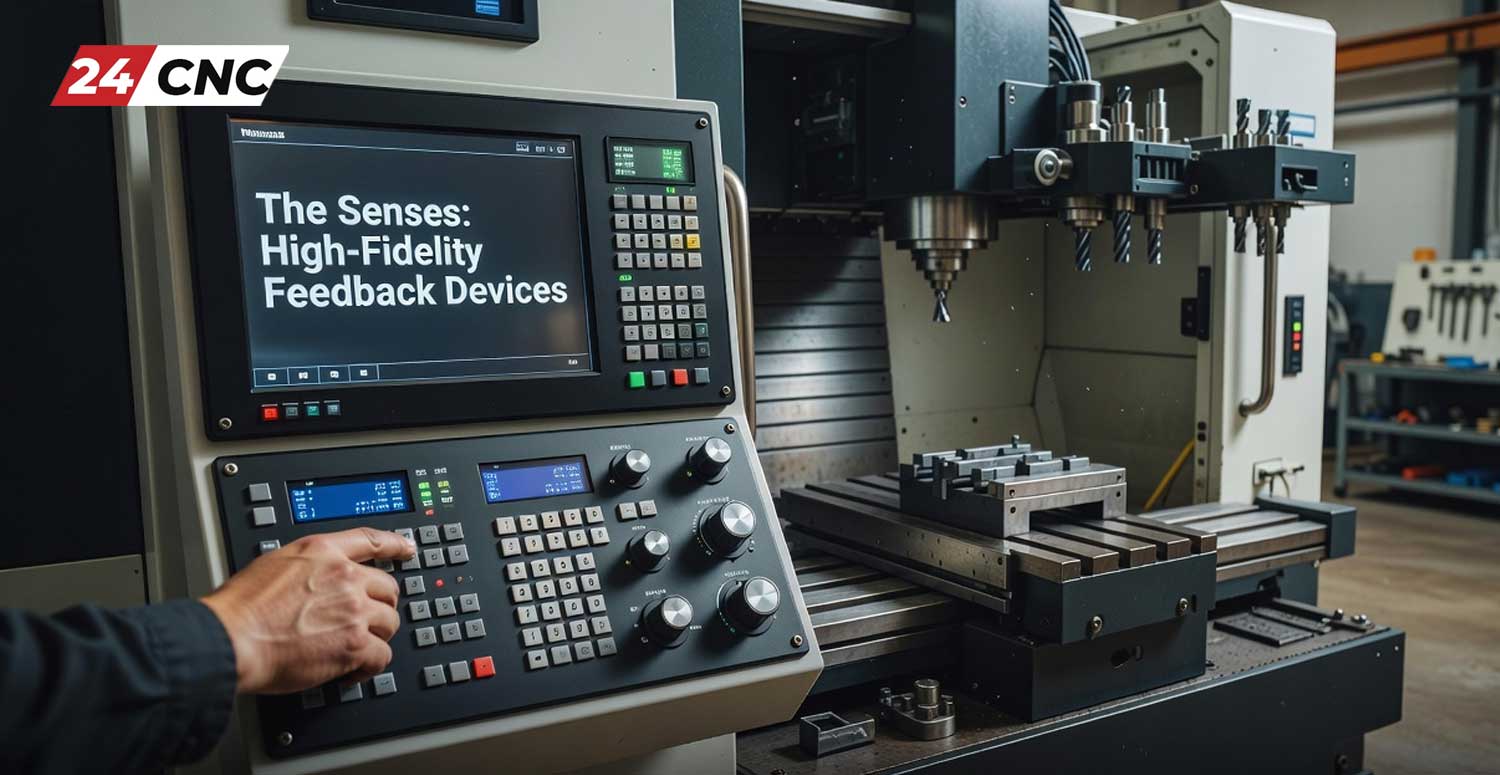
For a CNC machine to maintain its micron-level accuracy, it must operate in a rigorous “closed-loop” system. This means the controller is not just blindly sending movement commands; it needs constant, real-time feedback on where the physical axes actually are, comparing that physical reality to the programmed target.
Rotary and Absolute Encoders
The primary sensor used for this critical positional feedback is the rotary encoder. Usually mounted directly on the tail end of the servo motor, or sometimes directly on the ball screw, encoders read the rotational position and speed. They achieve this using an optical disc or magnetic field, sending hundreds of thousands of pulses back to the controller every single second.
To truly grasp their immense importance, it is helpful to understand the function of an encoder in industrial automation systems. High-resolution feedback ensures that even the smallest mechanical deviations (due to friction, heat expansion, or cutting forces) are corrected instantly by the servo drive. When sourcing replacements, ensuring you have the exact Fanuc encoder or a perfectly matched equivalent part is vital for preventing catastrophic following errors.
Linear Scales
For ultra-precision machining (like aerospace or medical parts), rotary encoders are sometimes not enough due to ball screw thermal expansion or backlash. In these cases, Linear Scales (often made by Heidenhain or Renishaw) are bolted directly to the machine casting and moving table. They measure the absolute true physical position of the table, bypassing any mechanical inaccuracies in the drive train.
4. The Nervous System: Infrastructure, Wiring, and Power
No electronic component, regardless of how advanced, can function without clean, perfectly stable power and reliable, interference-free data transmission. The electrical infrastructure of a CNC machine is often severely overlooked by operators until a catastrophic failure or mysterious intermittent alarm occurs.
Industrial Power Supplies (PSU)
Industrial power supplies convert incoming raw facility AC voltage (which is often dirty and fluctuating) into the perfectly stable DC voltages (typically 24V, 15V, and 5V) required by the sensitive logic boards, I/O relays, drives, and optical sensors. Voltage fluctuations or a failing capacitor inside a PSU can cause bizarre logic errors, corrupted memory, or permanent component burnout, making robust power regulation absolutely essential.
Shielded Industrial Cables and Protective Fuses
The high-speed transmission of power and data relies on specialized, highly shielded cables. Because CNC machines generate significant electromagnetic interference (EMI) and radio frequency interference (RFI) from their heavy drives and spindles, using properly rated encoder cables and power cables is strictly non-negotiable to prevent signal degradation and data loss.
Furthermore, protecting these massively expensive circuits from sudden current spikes or short circuits is managed by rapid-response semiconductor fuses (such as Daito fuses). These fuses act as the crucial sacrificial barrier during electrical faults, blowing instantly to save a $5,000 drive from destruction.
5. The Mechanical Skeleton: Castings, Ways, and Ball Screws
While 24CNC focuses on the electronic components, it’s vital to acknowledge the mechanical foundation that houses them.
Machine Bed and Castings
The frame of the machine is usually cast iron or polymer concrete. It provides the massive rigidity required to absorb brutal cutting vibrations. A weak casting will result in poor surface finishes and rapid tool wear, regardless of how good the electronics are.
Linear Guide Ways and Box Ways
The axes glide on precision ways. Box ways offer immense rigidity for heavy cutting, while linear guide rails (using recirculating ball bearings) offer higher rapid speeds and less friction.
Precision Ball Screws
The rotary motion of the servo motor is converted into linear motion by the ball screw. These are precision-ground screws running through a nut packed with ball bearings, providing virtually zero backlash and incredibly smooth motion.
6. The Human-Machine Interface (HMI)
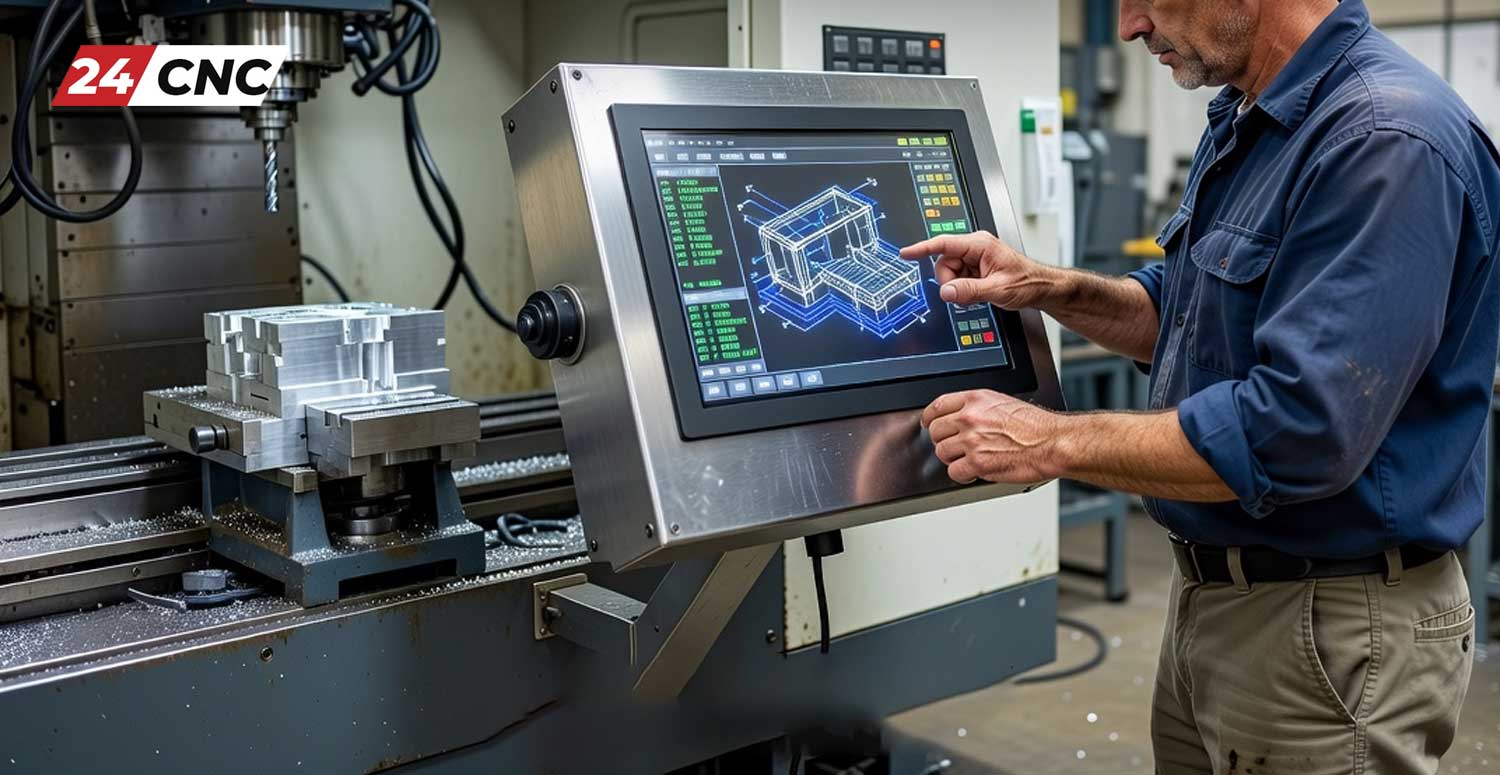
Finally, the operator must be able to interact with, program, and monitor the machine tool. This interface is the bridge between human intent and mechanical action.
- Industrial Displays: Industrial LCD monitors (and older CRT screens) provide the visual readout of absolute/relative coordinates, active G-code, tool offsets, and critical system alarms.
- Manual Control (MPG): For careful setup, edge finding, and tool touching-off, operators rely heavily on Manual Pulse Generators (MPG). These electronic handwheels allow precise micro-stepping of the axes (often down to 0.001mm per click) completely independent of the main program.
- Keyboards & Operator Panels: Ruggedized, membrane-sealed keyboards and operator panels are designed to withstand aggressive cutting fluids, oil mist, and sharp metal chips while allowing rapid data entry and machine overrides.
Technical Comparison: Diagnosing Core CNC Modules
Understanding the specific role of each electronic subsystem drastically reduces troubleshooting time. Use this quick reference table to distinguish between primary components and their failure signatures.
Comprehensive Frequently Asked Questions (FAQ)
What is the most common electronic component to fail in an older CNC machine?
Moving parts and high-heat electronics are the most susceptible over a 10+ year lifespan. Servo amplifiers (specifically drying electrolytic capacitors and failing IGBT modules), cooling fans, and rotary encoders (due to extreme vibration or microscopic fluid contamination) typically require replacement most often. CRT screens also fade and burn out, often requiring LCD retrofits.
Can I safely use a different brand of servo drive with my existing controller?
Generally, absolutely not. Control systems use highly proprietary, encrypted communication protocols (like Fanuc’s FSSB or Siemens’ DRIVE-CLiQ) to talk to the servo drives. Mixing a Fanuc controller with a Yaskawa or Siemens drive is functionally impossible without a complete, hugely expensive third-party retrofit board, which is rarely worth the engineering time. Stick to OEM replacements.
Why is proper shielding on cabling so absolutely critical in a CNC environment?
CNC environments are extremely hostile regarding electrical noise. Spindle drives generate massive electromagnetic interference (EMI). If delicate encoder feedback cables and low-voltage data cables are not heavily shielded and properly grounded at both ends, this EMI can corrupt the 5V signal pulses. The controller interprets this noise as movement, leading to massive positional errors, rejected parts, and terrifying high-speed machine crashes.
How do I know if my CNC power supply is failing?
Failing power supplies often cause “ghost” errors. If you experience random reboots when a heavy cut starts, alarms that clear themselves upon restarting the machine, or if multiple unrelated drives throw undervoltage alarms simultaneously, the main DC power supply is highly suspect. Always check the output voltages with a calibrated multimeter under load.
Keep Your Production Line Moving Uninterrupted
Industrial downtime costs thousands of dollars per hour. Whether you urgently need a replacement main CPU board, a high-precision rotary encoder, or a rebuilt, reliable servo drive, we have the genuine industrial electronics you need to get back to making chips.
Leave a comment
Your email address will not be published. Required fields are marked *