
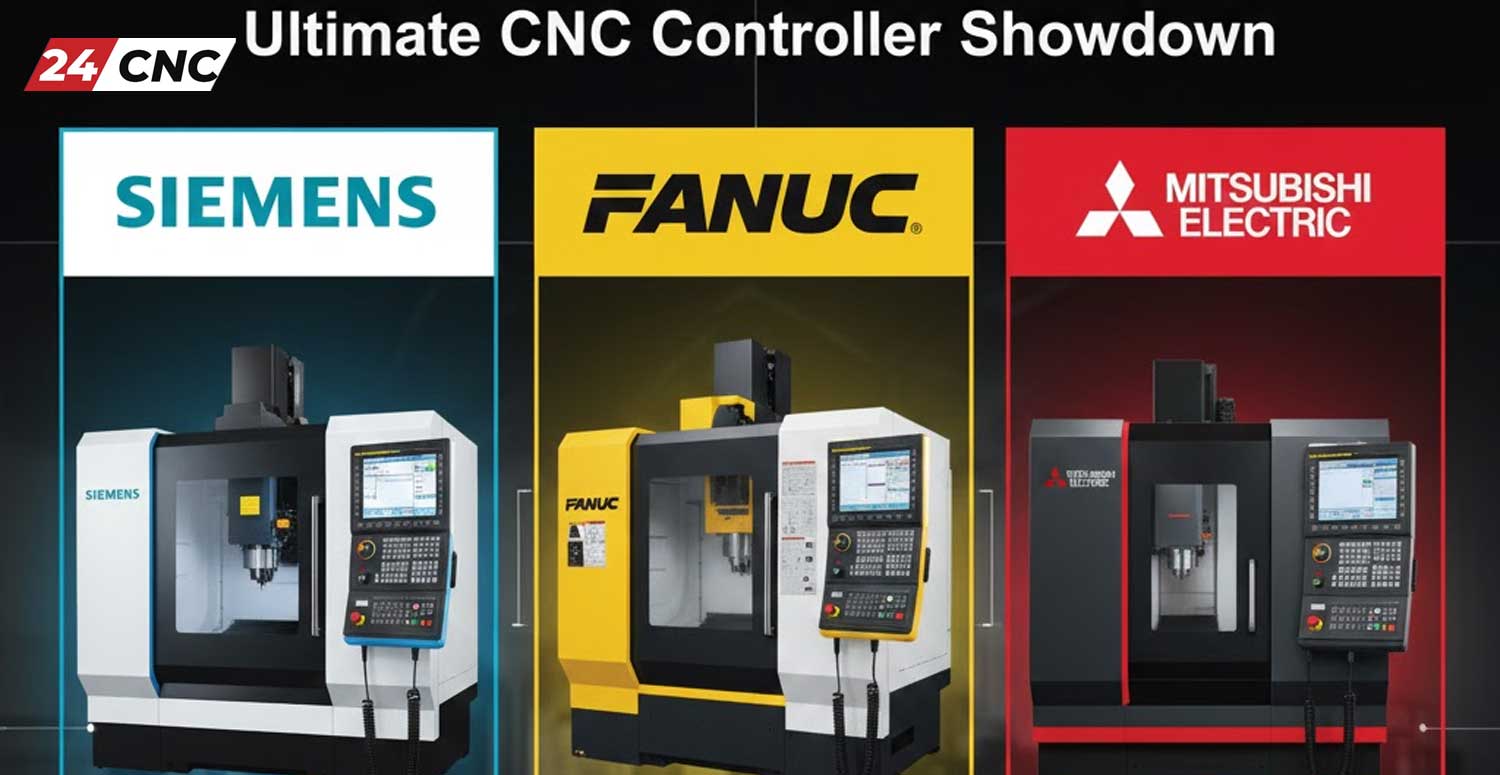
The “brain” of any modern machine shop is the CNC controller. It dictates not just how a machine moves, but how your operators interact with it, how fast you can go from print to part, and how much downtime you might face over the next decade. Choosing between the “Big Three”—Siemens, Fanuc, and Mitsubishi—is rarely a simple decision. It is a strategic choice that impacts your workflow, your maintenance budget, and your bottom line.
At 24cnc.com, we supply parts for all major systems, so we have a unique, unbiased view of what breaks, what lasts, and what users actually prefer. In this comprehensive guide, we will break down the strengths, weaknesses, and ideal use cases for the three giants of the CNC world.

The Global Heavyweight: Fanuc
Fanuc (Fuji Automatic NUmerical Control) is undeniably the market leader, holding a massive share of the global CNC market. If you walk into almost any job shop in the world, you are likely to see a machine with that iconic yellow styling.
The “Fanuc Standard” of Reliability
The primary selling point of a Fanuc Controller is its legendary reliability. These systems are often described as “bulletproof.” It is not improved uncommon to see 30-year-old Fanuc controls still running daily production. This reliability extends to their hardware ecosystem, including their robust Fanuc servo motors and drives.
Pros of Fanuc:
- Ubiquity: Because they are so common, finding operators who know G-code for Fanuc is easy.
- Backward Compatibility: Programs written for a Fanuc system from the 90s will often run on a modern Series 30i model with minimal changes.
- Parts Availability: Whether you need a Fanuc power supply or a replacement input/output module, parts are readily available, keeping downtime to a minimum.
Cons of Fanuc:
- User Interface: Older models, and even some newer ones, are criticized for having a dated, menu-heavy interface compared to modern touchscreen expectations.
- Cost of Options: Fanuc is notorious for charging extra for software features that might be standard on other controls.
The Technological Powerhouse: Siemens
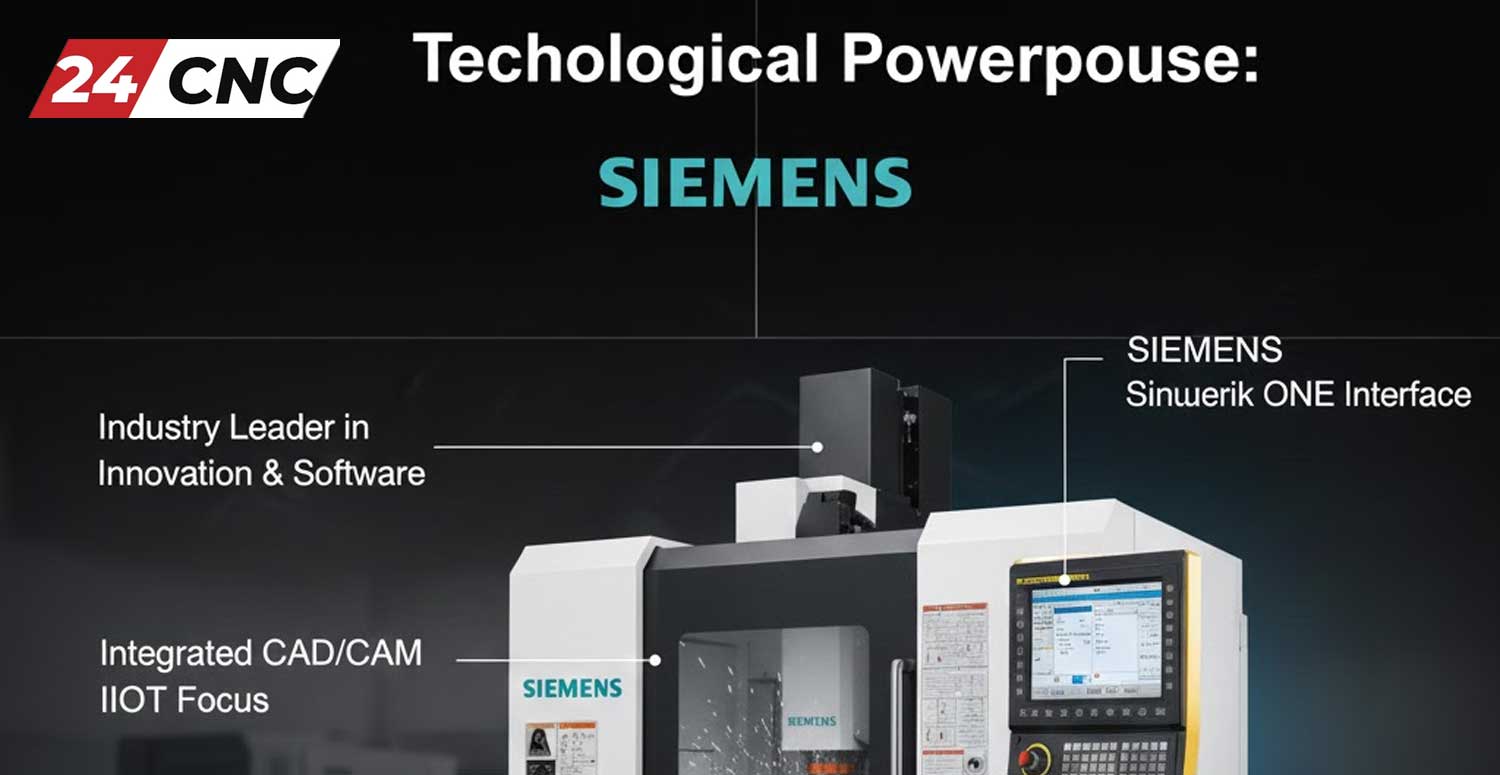
While Fanuc dominates in standard reliability, Siemens is often viewed as the leader in high-end technological capability and user experience. The Siemens Sinumerik series is a favorite in the aerospace and automotive industries where complex 5-axis machining is common.
ShopMill and ShopTurn: A Programmer’s Dream
Siemens shines with its conversational programming. Their “ShopMill” and “ShopTurn” interfaces allow operators to program complex parts directly at the machine using visual prompts, without needing to know a single line of G-code. This can drastically reduce setup time for high-mix, low-volume shops.
Pros of Siemens:
- Advanced Interface: Modern Siemens controls feature large, high-resolution screens (often requiring specific Siemens keyboards and labels) that feel like using a smartphone or tablet.
- Digital Twin Technology: Siemens is a pioneer in digitalizing manufacturing, allowing for superior simulation and integration with CAD/CAM systems.
- 5-Axis Superiority: For complex mold and die work, Siemens’ motion control algorithms are often considered the gold standard.
Cons of Siemens:
- Learning Curve: For operators raised on Fanuc G-code, the Siemens structure can feel foreign initially.
- Complexity: The sheer number of parameters can be overwhelming for simple 2-axis lathe work.
The Cost-Effective Performer: Mitsubishi
Mitsubishi Electric sits comfortably as a strong competitor that balances high performance with cost-effectiveness. The Mitsubishi control systems, particularly the M8 series, are incredibly fast and are standard on many high-speed tapping centers (like Brother or Mazak machines, which often use modified Mitsubishi controls).
Speed and Integration
Mitsubishi controls are known for their high-speed processing capabilities. They integrate seamlessly with Mitsubishi drives and motors to provide rapid acceleration and deceleration, which is critical for reducing cycle times in mass production environments.
Pros of Mitsubishi:
- Value: Generally offers a higher performance-to-price ratio than Fanuc or Siemens.
- User-Friendly: Newer models offer a dual-mode interface—standard G-code for veterans and conversational programming for newer machinists.
- Robust Hardware: Like Fanuc, Mitsubishi hardware is durable. However, should you need repairs, finding a Mitsubishi encoder or amplifier is straightforward.
Cons of Mitsubishi:
- Market Share: While popular in Asia, they have less market penetration in the US and Europe compared to Fanuc, meaning fewer trained specialized technicians may be available locally.
Hardware and Maintenance Comparisons
Regardless of which controller you choose, eventually, hardware wears out. Understanding the maintenance ecosystem is vital.
Screens and Interfaces
The HMI (Human Machine Interface) is the most touched part of the machine. Over time, LCDs dim or crack. Fanuc often uses robust screens, but upgrading or replacing them is common. Siemens tends to use larger, more proprietary displays. At 24cnc, we stock replacement LCD panels for all three brands, including specialized options like Sharp LCDs often found in older control units.
Drives and Motors
The “muscle” of the machine involves the servo amplifiers and spindle drives.
Fanuc: Their drives are modular but can be sensitive to power fluctuations. Ensuring you have good fuses and cooling is key.
Mitsubishi: Their drives are compact and highly efficient.
Siemens: Often uses a bus system that is very tidy but requires careful matching of components.
Check our Amplifier and Inverter section for replacements across all brands.
Sensors and Feedback
Accuracy depends on feedback. Whether it’s a Fanuc Pulse Coder or a specialized sensor, these components are the first line of defense against bad parts. Fanuc’s serial feedback system is proprietary, whereas Siemens and Mitsubishi can sometimes be more flexible with third-party scales, though sticking to OEM is always recommended.
Technical Comparison at a Glance
| Feature | Fanuc (Series 0i/30i) | Siemens (Sinumerik 828D/840D) | Mitsubishi (M8 Series) |
|---|---|---|---|
| Primary Strength | Reliability & Market Share | Advanced Tech & 5-Axis | High Speed & Cost Value |
| Programming | G-Code Focused (Manual Guide i) | Conversational (ShopMill/Turn) | Hybrid (G-Code + Conversational) |
| Spare Parts Access | Excellent (Global availability) | Good (Strong in Europe) | Good (Growing in West) |
| Learning Curve | Moderate (Industry Standard) | Low for beginners, High for experts | Moderate |
| Key Components | Fanuc Controllers | Siemens Controllers | Mitsubishi Drives |
Common Accessories and Retrofitting
No matter which controller you run, the peripherals are often universal or require specific adapters.
- Handwheels (MPG): Operators love a good manual pulse generator. Whether you need a standard MPG or a specific MPG60, these are essential for setup.
- Cooling: Electronics hate heat. Keeping your cabinet cool with the right fan is the cheapest insurance policy you can buy.
- Cabling: Communication errors are often just bad cables. High-quality optical cables are crucial for modern, high-speed data transfer in newer controls.
Frequently Asked Questions (FAQ)
Which CNC controller is easiest to learn?
For absolute beginners with no G-code experience, Siemens (with ShopMill/ShopTurn) is generally considered the easiest because it uses graphical, conversational programming. However, because Fanuc is so common, more training resources and experienced mentors are available for it.
Are Fanuc parts interchangeable with Mitsubishi?
Generally, no. The communication protocols, voltage requirements, and connectors are different. You cannot plug a Mitsubishi motor into a Fanuc drive. However, some general accessories like switches or cooling fans may be generic.
Which controller is best for high-speed machining?
While all three have high-speed options, Mitsubishi is famous for its high-speed processing in tapping centers, and Siemens 840D is renowned for high-speed 5-axis contouring smoothness.
Where can I buy replacement keys or membranes?
Keypads wear out frequently. We stock a wide variety of labels and keyboards for Fanuc, Siemens, and other controllers to get your operator panel looking and working like new.
Final Verdict: Which One Should You Choose?
The “best” controller depends entirely on your shop’s needs:
- Choose Fanuc if: You want maximum reliability, you are in a production environment where downtime is not an option, and you want access to the largest pool of qualified operators and spare parts.
- Choose Siemens if: You are doing high-mix/low-volume work, complex 5-axis machining, or want a modern, graphical user interface that helps new operators produce parts faster.
- Choose Mitsubishi if: You need high-speed performance for mass production (like drilling/tapping) and want a cost-effective solution without sacrificing durability.
Regardless of the logo on the front of the cabinet, keeping your machine running requires a reliable partner for parts. From control cards to sensors, maintaining your CNC investment is what we do best.
Need Parts for Your CNC Controller?
Whether you run Fanuc, Siemens, or Mitsubishi, downtime costs money. Browse our extensive inventory of high-quality replacement parts, from servo motors to main boards.
Leave a comment
Your email address will not be published. Required fields are marked *